

Ultimate Journey: Peru, Argentina, Brazil & Antarctica
CRUISE ID # SCENICOLA1060129-1
Lima TO Rio de Janeiro
Suites & Fares
Itinerary
- Day 1December 27, 2028
Pre-Cruise Night
- Day 2December 28, 2028
Pre-Cruise Night
- Day 3December 29, 2028
Pre-Cruise Night
- Day 4December 30, 2028
Pre-Cruise Night
- Day 5December 31, 2028
Pre-Cruise Night
- Day 6January 01, 2029
Pre-Cruise Night
- Day 7January 02, 2029
Pre-Cruise Night
- Day 8January 03, 2029
Pre-Cruise Night
- Day 9January 04, 2029
Pre-Cruise Night
- Day 10January 05, 2029
Pre-Cruise Night
- Day 11January 06, 2029
Lima, Peru
Lima, Peru, the vibrant capital, blends colonial charm with modern dynamism. Known for its rich history, the city showcases splendid architecture in the historic center, a UNESCO World Heritage site. Nestled along the Pacific coast, Lima boasts scenic ocean views, exquisite cuisine, and lively cultural scenes. Its diverse neighborhoods, from Miraflores' upscale vibe to Barranco's bohemian allure, offer unique experiences. Renowned museums, bustling markets, and the iconic Huaca Pucllana ruins highlight its heritage. Lima's bustling streets and warm, welcoming atmosphere make it a captivating destination for travelers.
- Day 12January 07, 2029
Lima, Peru
Lima, Peru, the vibrant capital, blends colonial charm with modern dynamism. Known for its rich history, the city showcases splendid architecture in the historic center, a UNESCO World Heritage site. Nestled along the Pacific coast, Lima boasts scenic ocean views, exquisite cuisine, and lively cultural scenes. Its diverse neighborhoods, from Miraflores' upscale vibe to Barranco's bohemian allure, offer unique experiences. Renowned museums, bustling markets, and the iconic Huaca Pucllana ruins highlight its heritage. Lima's bustling streets and warm, welcoming atmosphere make it a captivating destination for travelers.
- Day 13January 08, 2029
Sacred Valley
- Day 14January 09, 2029
Sacred Valley
Join your expert local guide for a walking tour of Ollantaytambo, the site where Manco Inca defeated the Spanish conquistadors in 1537.
Scenic Enrich
Indulge in an authentic Andean feast at a local hacienda, where tradition comes to life through vibrant weaving demonstrations and stories of local customs.The afternoon invites you to wander the charming village of Urubamba at your leisure.
- Day 15January 10, 2029
Sacred Valley
With another full day in the Sacred Valley, discover more of its distinctive heritage and culture.
Scenic Freechoice:
Tailor your day to your tastes and pace with one of these excursions:
Pisac Ruins and Markets: Explore the ruins of Pisac, built by the Incas in the 15th century, and its vibrant markets. Peruvians from surrounding villages come to purchase their fruit, vegetables and meat, and you can find authentic crafts and clothing.
Maras and Moray: Discover the agricultural and engineering wonders of the mountains. Explore the mysterious circular terraces of Moray and the mesmerising Incan salt pans of Maras, where thousands of pools are dug into the mountainside.Later, indulge in a culinary extravaganza featuring five tantalising meats, each prepared in a unique style using ingredients sourced from the hotel's own organic garden.
- Day 16January 11, 2029
Sacred Valley
This morning, embark on one of the world's most spectacular rail journeys on a Vistadome train that climbs through breathtaking landscapes to the legendary Machu Picchu. The most famous archaeological site in South America, this mountaintop citadel was built by the Incas in the 15th century but remained lost to history until it was rediscovered in the early 1900s. Explore the enigmatic ruins with expert guides, delving into the mysteries of this timeless site.
As night falls, retreat to your comfortable hotel in the nearby town of Aguas Calientes. - Day 16January 11, 2029
Machu Picchu, Peru
- Day 17January 12, 2029
Machu Picchu, Peru
Continue your journey by train to the charming city of Cusco, the imperial capital of the Incas. The oldest continually occupied city on the continent, it sits at a soaring 3,399 metres above sea level, making it one of the highest settlements in the world.
You will be welcomed to the luxurious Palacio del Inka, a Luxury Collection Hotel. Set inside a 500-year-old mansion, enjoy a two-night Scenic Special Stay ensconced in the heart of this storied city, surrounded by opulence and history. - Day 17January 12, 2029
Cusco, Peru
- Day 18January 13, 2029
Cusco, Peru
Unravel the secrets of Cusco as you wander through its cobblestone streets and past grand architecture. On your walking tour, you will uncover the history of this World Heritage-listed site where ancient Incan ruins sit alongside colonial whitewashed houses and Baroque palaces. Your final stop will be the imposing ruins of Sacsayhuamán fortress, where the carved stone blocks form the shape of a puma’s head.
Experience vibrant local culture as you explore the bustling San Pedro Market, where traditions, aromas and flavours create an authentic cultural encounter at every turn. - Day 19January 14, 2029
Cuzco, Peru
Welcome to Buenos Aires. The colourful Argentine capital is known as the ‘Paris of the Americas’ and is an elegant city with pockets of unique character. Check in to your hotel for a two-night stay.
- Day 19January 14, 2029
Buenos Aires, Argentina
Glamorous and gritty, Buenos Aires is two cities in one. What makes Argentina's capital so fascinating is its dual heritage—part European, part Latin American. Plaza de Mayo resembles a grand square in Madrid, and the ornate Teatro Colón would not be out of place in Vienna. But you’ll know you’re in South America by the leather shoes for sale on cobbled streets and impromptu parades of triumphant soccer fans. Limited-production wines, juicy steaks, and ice cream in countless flavors are among the old-world imports the city has perfected.
- Day 20January 15, 2029
Buenos Aires, Argentina
Glamorous and gritty, Buenos Aires is two cities in one. What makes Argentina's capital so fascinating is its dual heritage—part European, part Latin American. Plaza de Mayo resembles a grand square in Madrid, and the ornate Teatro Colón would not be out of place in Vienna. But you’ll know you’re in South America by the leather shoes for sale on cobbled streets and impromptu parades of triumphant soccer fans. Limited-production wines, juicy steaks, and ice cream in countless flavors are among the old-world imports the city has perfected.
- Day 21January 16, 2029
Ushuaia, Argentina
At 55 degrees latitude south, Ushuaia (pronounced oo-swy-ah) is closer to the South Pole than to Argentina's northern border with Bolivia. It is the capital and tourism base for Tierra del Fuego, the island at the southernmost tip of Argentina.Although its stark physical beauty is striking, Tierra del Fuego's historical allure is based more on its mythical past than on rugged reality. The island was inhabited for 6,000 years by Yámana, Haush, Selk'nam, and Alakaluf Indians. But in 1902 Argentina, eager to populate Patagonia to bolster its territorial claims, moved to initiate an Ushuaian penal colony, establishing the permanent settlement of its most southern territories and, by implication, everything in between.When the prison closed in 1947, Ushuaia had a population of about 3,000, made up mainly of former inmates and prison staff. Today the Indians of Darwin's "missing link" theory are long gone—wiped out by diseases brought by settlers and by indifference to their plight—and the 60,000 residents of Ushuaia are hitching their star to tourism.The city rightly (if perhaps too loudly) promotes itself as the southernmost city in the world (Puerto Williams, a few miles south on the Chilean side of the Beagle Channel, is a small town). You can make your way to the tourism office to get your clichéd, but oh-so-necessary, "Southernmost City in the World" passport stamp. Ushuaia feels like a frontier boomtown, at heart still a rugged, weather-beaten fishing village, but exhibiting the frayed edges of a city that quadrupled in size in the '70s and '80s and just keeps growing. Unpaved portions of Ruta 3, the last stretch of the Pan-American Highway, which connects Alaska to Tierra del Fuego, are finally being paved. The summer months (December through March) draw more than 120,000 visitors, and dozens of cruise ships. The city is trying to extend those visits with events like March's Marathon at the End of the World and by increasing the gamut of winter activities buoyed by the excellent snow conditions.A terrific trail winds through the town up to the Martial Glacier, where a ski lift can help cut down a steep kilometer of your journey. The chaotic and contradictory urban landscape includes a handful of luxury hotels amid the concrete of public housing projects. Scores of "sled houses" (wooden shacks) sit precariously on upright piers, ready for speedy displacement to a different site. But there are also many small, picturesque homes with tiny, carefully tended gardens. Many of the newer homes are built in a Swiss-chalet style, reinforcing the idea that this is a town into which tourism has breathed new life. At the same time, the weather-worn pastel colors that dominate the town's landscape remind you that Ushuaia was once just a tiny fishing village, snuggled at the end of the Earth.As you stand on the banks of the Canal Beagle (Beagle Channel) near Ushuaia, the spirit of the farthest corner of the world takes hold. What stands out is the light: at sundown the landscape is cast in a subdued, sensual tone; everything feels closer, softer, and more human in dimension despite the vastness of the setting. The snowcapped mountains reflect the setting sun back onto a stream rolling into the channel, as nearby peaks echo their image—on a windless day—in the still waters.Above the city rise the last mountains of the Andean Cordillera, and just south and west of Ushuaia they finally vanish into the often-stormy sea. Snow whitens the peaks well into summer. Nature is the principal attraction here, with trekking, fishing, horseback riding, wildlife spotting, and sailing among the most rewarding activities, especially in the Parque Nacional Tierra del Fuego (Tierra del Fuego National Park).
- Day 22January 17, 2029
Day at Sea
- Day 23January 18, 2029
Antarctic Peninsula, Antarctica
Remote and otherworldly, Antarctic is irresistible for its spectacular iceberg sculptures and calving glaciers, and for the possibility of up-close encounters with marine mammals and the iconic penguins. The Antarctic Peninsula – the main peninsula closest to South America – has a human history of almost 200 years, with explorers, sealers, whalers, and scientists who have come to work, and eventually intrepid visitors coming to enjoy this pristine and remote wilderness. It is a region of protected bays, unscaled snow-capped mountains, vast glaciers and a few places where whalers or scientists have worked. Just as irresistible are the many Gentoo and Chinstrap Penguin colonies, the seals basking on ice floes, the whales and orcas.
- Day 24January 19, 2029
Antarctic Peninsula, Antarctica
Remote and otherworldly, Antarctic is irresistible for its spectacular iceberg sculptures and calving glaciers, and for the possibility of up-close encounters with marine mammals and the iconic penguins. The Antarctic Peninsula – the main peninsula closest to South America – has a human history of almost 200 years, with explorers, sealers, whalers, and scientists who have come to work, and eventually intrepid visitors coming to enjoy this pristine and remote wilderness. It is a region of protected bays, unscaled snow-capped mountains, vast glaciers and a few places where whalers or scientists have worked. Just as irresistible are the many Gentoo and Chinstrap Penguin colonies, the seals basking on ice floes, the whales and orcas.
- Day 25January 20, 2029
Antarctic Peninsula, Antarctica
Remote and otherworldly, Antarctic is irresistible for its spectacular iceberg sculptures and calving glaciers, and for the possibility of up-close encounters with marine mammals and the iconic penguins. The Antarctic Peninsula – the main peninsula closest to South America – has a human history of almost 200 years, with explorers, sealers, whalers, and scientists who have come to work, and eventually intrepid visitors coming to enjoy this pristine and remote wilderness. It is a region of protected bays, unscaled snow-capped mountains, vast glaciers and a few places where whalers or scientists have worked. Just as irresistible are the many Gentoo and Chinstrap Penguin colonies, the seals basking on ice floes, the whales and orcas.
- Day 26January 21, 2029
Antarctic Peninsula, Antarctica
Remote and otherworldly, Antarctic is irresistible for its spectacular iceberg sculptures and calving glaciers, and for the possibility of up-close encounters with marine mammals and the iconic penguins. The Antarctic Peninsula – the main peninsula closest to South America – has a human history of almost 200 years, with explorers, sealers, whalers, and scientists who have come to work, and eventually intrepid visitors coming to enjoy this pristine and remote wilderness. It is a region of protected bays, unscaled snow-capped mountains, vast glaciers and a few places where whalers or scientists have worked. Just as irresistible are the many Gentoo and Chinstrap Penguin colonies, the seals basking on ice floes, the whales and orcas.
- Day 27January 22, 2029
Antarctic Peninsula, Antarctica
Remote and otherworldly, Antarctic is irresistible for its spectacular iceberg sculptures and calving glaciers, and for the possibility of up-close encounters with marine mammals and the iconic penguins. The Antarctic Peninsula – the main peninsula closest to South America – has a human history of almost 200 years, with explorers, sealers, whalers, and scientists who have come to work, and eventually intrepid visitors coming to enjoy this pristine and remote wilderness. It is a region of protected bays, unscaled snow-capped mountains, vast glaciers and a few places where whalers or scientists have worked. Just as irresistible are the many Gentoo and Chinstrap Penguin colonies, the seals basking on ice floes, the whales and orcas.
- Day 28January 23, 2029
Antarctic Peninsula, Antarctica
Remote and otherworldly, Antarctic is irresistible for its spectacular iceberg sculptures and calving glaciers, and for the possibility of up-close encounters with marine mammals and the iconic penguins. The Antarctic Peninsula – the main peninsula closest to South America – has a human history of almost 200 years, with explorers, sealers, whalers, and scientists who have come to work, and eventually intrepid visitors coming to enjoy this pristine and remote wilderness. It is a region of protected bays, unscaled snow-capped mountains, vast glaciers and a few places where whalers or scientists have worked. Just as irresistible are the many Gentoo and Chinstrap Penguin colonies, the seals basking on ice floes, the whales and orcas.
- Day 29January 24, 2029
Antarctic Peninsula, Antarctica
Remote and otherworldly, Antarctic is irresistible for its spectacular iceberg sculptures and calving glaciers, and for the possibility of up-close encounters with marine mammals and the iconic penguins. The Antarctic Peninsula – the main peninsula closest to South America – has a human history of almost 200 years, with explorers, sealers, whalers, and scientists who have come to work, and eventually intrepid visitors coming to enjoy this pristine and remote wilderness. It is a region of protected bays, unscaled snow-capped mountains, vast glaciers and a few places where whalers or scientists have worked. Just as irresistible are the many Gentoo and Chinstrap Penguin colonies, the seals basking on ice floes, the whales and orcas.
- Day 30January 25, 2029
Day at Sea
- Day 31January 26, 2029
Ushuaia, Argentina
At 55 degrees latitude south, Ushuaia (pronounced oo-swy-ah) is closer to the South Pole than to Argentina's northern border with Bolivia. It is the capital and tourism base for Tierra del Fuego, the island at the southernmost tip of Argentina.Although its stark physical beauty is striking, Tierra del Fuego's historical allure is based more on its mythical past than on rugged reality. The island was inhabited for 6,000 years by Yámana, Haush, Selk'nam, and Alakaluf Indians. But in 1902 Argentina, eager to populate Patagonia to bolster its territorial claims, moved to initiate an Ushuaian penal colony, establishing the permanent settlement of its most southern territories and, by implication, everything in between.When the prison closed in 1947, Ushuaia had a population of about 3,000, made up mainly of former inmates and prison staff. Today the Indians of Darwin's "missing link" theory are long gone—wiped out by diseases brought by settlers and by indifference to their plight—and the 60,000 residents of Ushuaia are hitching their star to tourism.The city rightly (if perhaps too loudly) promotes itself as the southernmost city in the world (Puerto Williams, a few miles south on the Chilean side of the Beagle Channel, is a small town). You can make your way to the tourism office to get your clichéd, but oh-so-necessary, "Southernmost City in the World" passport stamp. Ushuaia feels like a frontier boomtown, at heart still a rugged, weather-beaten fishing village, but exhibiting the frayed edges of a city that quadrupled in size in the '70s and '80s and just keeps growing. Unpaved portions of Ruta 3, the last stretch of the Pan-American Highway, which connects Alaska to Tierra del Fuego, are finally being paved. The summer months (December through March) draw more than 120,000 visitors, and dozens of cruise ships. The city is trying to extend those visits with events like March's Marathon at the End of the World and by increasing the gamut of winter activities buoyed by the excellent snow conditions.A terrific trail winds through the town up to the Martial Glacier, where a ski lift can help cut down a steep kilometer of your journey. The chaotic and contradictory urban landscape includes a handful of luxury hotels amid the concrete of public housing projects. Scores of "sled houses" (wooden shacks) sit precariously on upright piers, ready for speedy displacement to a different site. But there are also many small, picturesque homes with tiny, carefully tended gardens. Many of the newer homes are built in a Swiss-chalet style, reinforcing the idea that this is a town into which tourism has breathed new life. At the same time, the weather-worn pastel colors that dominate the town's landscape remind you that Ushuaia was once just a tiny fishing village, snuggled at the end of the Earth.As you stand on the banks of the Canal Beagle (Beagle Channel) near Ushuaia, the spirit of the farthest corner of the world takes hold. What stands out is the light: at sundown the landscape is cast in a subdued, sensual tone; everything feels closer, softer, and more human in dimension despite the vastness of the setting. The snowcapped mountains reflect the setting sun back onto a stream rolling into the channel, as nearby peaks echo their image—on a windless day—in the still waters.Above the city rise the last mountains of the Andean Cordillera, and just south and west of Ushuaia they finally vanish into the often-stormy sea. Snow whitens the peaks well into summer. Nature is the principal attraction here, with trekking, fishing, horseback riding, wildlife spotting, and sailing among the most rewarding activities, especially in the Parque Nacional Tierra del Fuego (Tierra del Fuego National Park).
- Day 32January 27, 2029
Buenos Aires, Argentina
Glamorous and gritty, Buenos Aires is two cities in one. What makes Argentina's capital so fascinating is its dual heritage—part European, part Latin American. Plaza de Mayo resembles a grand square in Madrid, and the ornate Teatro Colón would not be out of place in Vienna. But you’ll know you’re in South America by the leather shoes for sale on cobbled streets and impromptu parades of triumphant soccer fans. Limited-production wines, juicy steaks, and ice cream in countless flavors are among the old-world imports the city has perfected.
- Day 33January 28, 2029
Buenos Aires, Argentina
Glamorous and gritty, Buenos Aires is two cities in one. What makes Argentina's capital so fascinating is its dual heritage—part European, part Latin American. Plaza de Mayo resembles a grand square in Madrid, and the ornate Teatro Colón would not be out of place in Vienna. But you’ll know you’re in South America by the leather shoes for sale on cobbled streets and impromptu parades of triumphant soccer fans. Limited-production wines, juicy steaks, and ice cream in countless flavors are among the old-world imports the city has perfected.
- Day 34January 29, 2029
Buenos Aires, Argentina
Glamorous and gritty, Buenos Aires is two cities in one. What makes Argentina's capital so fascinating is its dual heritage—part European, part Latin American. Plaza de Mayo resembles a grand square in Madrid, and the ornate Teatro Colón would not be out of place in Vienna. But you’ll know you’re in South America by the leather shoes for sale on cobbled streets and impromptu parades of triumphant soccer fans. Limited-production wines, juicy steaks, and ice cream in countless flavors are among the old-world imports the city has perfected.
- Day 35January 30, 2029
Iguazú Falls, Brazil
- Day 36January 31, 2029
Iguazú Falls, Brazil
Wake up early this morning to watch the sun rising over the falls, a truly unforgettable experience. Then enjoy a leisurely tour to discover the Brazilian side of the falls. Stand on the walkway in the middle and take in this vast spectacle with 275 individual cascades spread over a four-kilometre crescent shaped cliff. Enjoy lunch with a beautiful view inside the National Park.
After lunch, embark on an exhilarating jet boat adventure toward the base of the falls, where you’ll feel the refreshing spray on your face and the sheer power of the cascading water up close.Optional helicopter flight
Take to the skies on an optional helicopter flight and soar above Iguazú Falls for a breathtaking bird’s-eye view of this natural wonder. (Additional cost, please book on tour.) - Day 37February 01, 2029
Iguazú Falls, Brazil
This morning, visit the Argentinian side of the falls before the park gates open to the public. Around 80 per cent of the falls are on this side of the border and the many walkways that thread between the upper and lower falls allow you to get closer into the cliff face. Walk to the lookout where you will see the famous Devil’s Throat, the largest and most formidable waterfall within the entire system. Be awed by the sheer volume of water cascading over the falls.
- Day 38February 02, 2029
Iguazú Falls, Brazil
After one final glorious sunrise, bid farewell to the magnificent Iguazú Falls. Fly to the vibrant city of Rio de Janeiro, famous for its golden beaches, lush jungle and colourful favelas, all under the watchful eye of Christ the Redeemer. The days are fuelled by sunshine and the nights by vibrant samba music. Settle into the refined comfort of the Fairmont Rio de Janeiro Copacabana for a three-night Scenic Special stay, where sophisticated design meets exceptional service and world-class amenities.
Scenic Sunset Drinks
Enjoy Scenic sunset drinks at Sugarloaf Mountain, savouring a local tapas dinner while taking in the breathtaking views of Rio at sunset. - Day 38February 02, 2029
Rio de Janeiro, Brazil
Welcome to the Cidade Maravilhosa, or the Marvelous City, as Rio is known in Brazil. Synonymous with the girl from Ipanema, the dramatic views from Christ the Redeemer atop Corcovado mountain, and fabulously flamboyant Carnival celebrations, Rio is a city of stunning architecture, abundant museums, and marvelous food. Rio is also home to 23 beaches, an almost continuous 73-km (45-mile) ribbon of sand.As you leave the airport and head to Rio's beautiful Zona Sul (the touristic South Zone), you'll drive for about 40 minutes on a highway from where you'll begin to get a sense of the dramatic contrast between beautiful landscape and devastating poverty. In this teeming metropolis of 12 million people (6.2 million of whom live in Rio proper), the very rich and the very poor live in uneasy proximity. You'll drive past seemingly endless cinder-block favela, but by the time you reach Copacabana's breezy, sunny Avenida Atlântica—flanked on one side by white beach and azure sea and on the other by condominiums and hotels—your heart will leap with expectation as you begin to recognize the postcard-famous sights. Now you're truly in Rio, where cariocas (Rio residents) and tourists live life to its fullest.Enthusiasm is contagious in Rio. Prepare to have your senses engaged and your inhibitions untied. Rio seduces with a host of images: the joyous bustle of vendors at Sunday's Feira Hippie (Hippie Fair); the tipsy babble at sidewalk cafés as patrons sip their last glass of icy beer under the stars; the blanket of lights beneath the Pão de Açúcar (Sugarloaf Mountain); the bikers, joggers, strollers, and power walkers who parade along the beach each morning. Borrow the carioca spirit for your stay; you may find yourself reluctant to give it back.
- Day 39February 03, 2029
Rio de Janeiro, Brazil
Welcome to the Cidade Maravilhosa, or the Marvelous City, as Rio is known in Brazil. Synonymous with the girl from Ipanema, the dramatic views from Christ the Redeemer atop Corcovado mountain, and fabulously flamboyant Carnival celebrations, Rio is a city of stunning architecture, abundant museums, and marvelous food. Rio is also home to 23 beaches, an almost continuous 73-km (45-mile) ribbon of sand.As you leave the airport and head to Rio's beautiful Zona Sul (the touristic South Zone), you'll drive for about 40 minutes on a highway from where you'll begin to get a sense of the dramatic contrast between beautiful landscape and devastating poverty. In this teeming metropolis of 12 million people (6.2 million of whom live in Rio proper), the very rich and the very poor live in uneasy proximity. You'll drive past seemingly endless cinder-block favela, but by the time you reach Copacabana's breezy, sunny Avenida Atlântica—flanked on one side by white beach and azure sea and on the other by condominiums and hotels—your heart will leap with expectation as you begin to recognize the postcard-famous sights. Now you're truly in Rio, where cariocas (Rio residents) and tourists live life to its fullest.Enthusiasm is contagious in Rio. Prepare to have your senses engaged and your inhibitions untied. Rio seduces with a host of images: the joyous bustle of vendors at Sunday's Feira Hippie (Hippie Fair); the tipsy babble at sidewalk cafés as patrons sip their last glass of icy beer under the stars; the blanket of lights beneath the Pão de Açúcar (Sugarloaf Mountain); the bikers, joggers, strollers, and power walkers who parade along the beach each morning. Borrow the carioca spirit for your stay; you may find yourself reluctant to give it back.
- Day 40February 04, 2029
Rio de Janeiro, Brazil
Welcome to the Cidade Maravilhosa, or the Marvelous City, as Rio is known in Brazil. Synonymous with the girl from Ipanema, the dramatic views from Christ the Redeemer atop Corcovado mountain, and fabulously flamboyant Carnival celebrations, Rio is a city of stunning architecture, abundant museums, and marvelous food. Rio is also home to 23 beaches, an almost continuous 73-km (45-mile) ribbon of sand.As you leave the airport and head to Rio's beautiful Zona Sul (the touristic South Zone), you'll drive for about 40 minutes on a highway from where you'll begin to get a sense of the dramatic contrast between beautiful landscape and devastating poverty. In this teeming metropolis of 12 million people (6.2 million of whom live in Rio proper), the very rich and the very poor live in uneasy proximity. You'll drive past seemingly endless cinder-block favela, but by the time you reach Copacabana's breezy, sunny Avenida Atlântica—flanked on one side by white beach and azure sea and on the other by condominiums and hotels—your heart will leap with expectation as you begin to recognize the postcard-famous sights. Now you're truly in Rio, where cariocas (Rio residents) and tourists live life to its fullest.Enthusiasm is contagious in Rio. Prepare to have your senses engaged and your inhibitions untied. Rio seduces with a host of images: the joyous bustle of vendors at Sunday's Feira Hippie (Hippie Fair); the tipsy babble at sidewalk cafés as patrons sip their last glass of icy beer under the stars; the blanket of lights beneath the Pão de Açúcar (Sugarloaf Mountain); the bikers, joggers, strollers, and power walkers who parade along the beach each morning. Borrow the carioca spirit for your stay; you may find yourself reluctant to give it back.
- Day 41February 05, 2029
Rio de Janeiro, Brazil
Welcome to the Cidade Maravilhosa, or the Marvelous City, as Rio is known in Brazil. Synonymous with the girl from Ipanema, the dramatic views from Christ the Redeemer atop Corcovado mountain, and fabulously flamboyant Carnival celebrations, Rio is a city of stunning architecture, abundant museums, and marvelous food. Rio is also home to 23 beaches, an almost continuous 73-km (45-mile) ribbon of sand.As you leave the airport and head to Rio's beautiful Zona Sul (the touristic South Zone), you'll drive for about 40 minutes on a highway from where you'll begin to get a sense of the dramatic contrast between beautiful landscape and devastating poverty. In this teeming metropolis of 12 million people (6.2 million of whom live in Rio proper), the very rich and the very poor live in uneasy proximity. You'll drive past seemingly endless cinder-block favela, but by the time you reach Copacabana's breezy, sunny Avenida Atlântica—flanked on one side by white beach and azure sea and on the other by condominiums and hotels—your heart will leap with expectation as you begin to recognize the postcard-famous sights. Now you're truly in Rio, where cariocas (Rio residents) and tourists live life to its fullest.Enthusiasm is contagious in Rio. Prepare to have your senses engaged and your inhibitions untied. Rio seduces with a host of images: the joyous bustle of vendors at Sunday's Feira Hippie (Hippie Fair); the tipsy babble at sidewalk cafés as patrons sip their last glass of icy beer under the stars; the blanket of lights beneath the Pão de Açúcar (Sugarloaf Mountain); the bikers, joggers, strollers, and power walkers who parade along the beach each morning. Borrow the carioca spirit for your stay; you may find yourself reluctant to give it back.
- Day 42February 06, 2029
Day at Sea
- Day 43February 07, 2029
Day at Sea
- Day 44February 08, 2029
Day at Sea
- Day 45February 09, 2029
Day at Sea
- Day 46February 10, 2029
Day at Sea
- Day 47February 11, 2029
Day at Sea
- Day 48February 12, 2029
Day at Sea
- Day 49February 13, 2029
Day at Sea
- Day 50February 14, 2029
Day at Sea
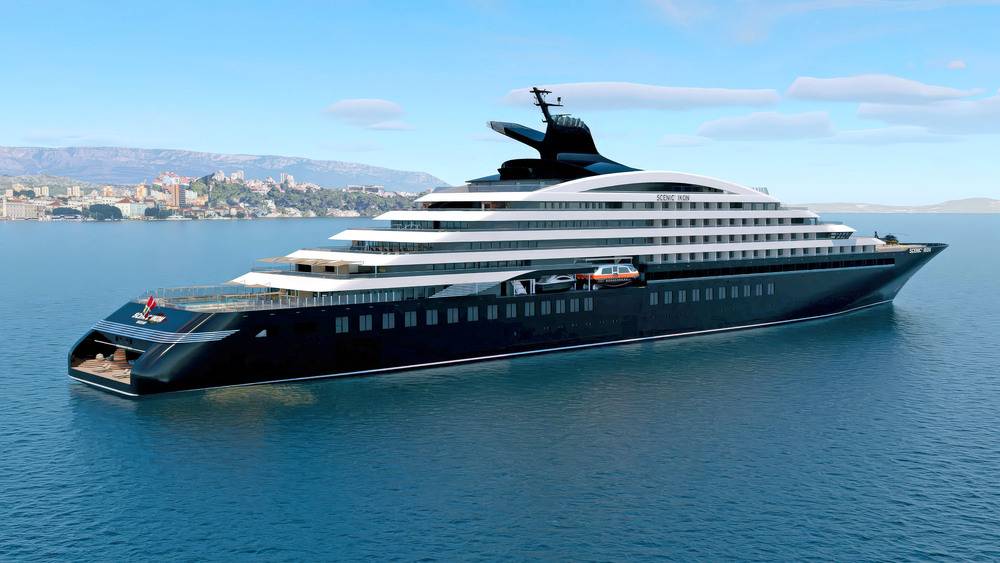
About the Ship
Scenic Ikon

- 270Guests
- 135Cabins
- 2028Launched
- 205 mLength
All ship facts
- Decks
- 8
- Gross tonnage
- 26500
- Width
- 24 m
- Currency on board
- USD
- Language
- en-US