

High Arctic, Greenland & Iceland Wonders - Cruise & Land journey
CRUISE ID # SCENICONI2060728-2
Oslo TO Reykjavík
Suites & Fares
Itinerary
- Day 1July 05, 2028
Pre-Cruise Night
- Day 2July 06, 2028
Oslo, Norway
Oslo is the capital of Norway and is also its largest city, situated at the head of Oslo Fjord and surrounded by hills and forests. Home to some 50 museums and full of galleries, cafés, a sculpture park and the Royal Palace, this vibrant city with its handsome 19th-century buildings and wide streets has much to offer. Its history dates back 1,000 years, and includes a rich seafaring heritage that ranges from the Viking era to Thor Heyerdahl’s Kon Tiki expedition. Discover more about this exciting city on our varied selection of excursions.
- Day 3July 07, 2028
Longyearbyen, Svalbard and Jan Mayen
Longyearbyen is the biggest settlement in Svalbard. Seat of the Norwegian administration, it also has the best services and infrastructure in the archipelago. Located deep in the Adventfjord, a sidearm of the Isfjorden (Icefjord), Longyearbyen’s airport can be used all-year round, but its harbor is blocked by ice in winter. Most shops, hotels, restaurants and a hospital are within easy walking distance of the port. One of the most prominent buildings in town is the UNIS center, where several Norwegian universities have joined forces to operate and offer the northernmost higher education to both Norwegian and international students. Adjacent to UNIS, and well worth a visit, is the Svalbard Museum, covering the natural history and exploitation of Svalbard. Remnants of the former mining activity can be seen all around Longyearbyen and even in town.
- Day 4July 08, 2028
Spitsbergen, Svalbard and Jan Mayen
Welcome to the remote wilderness of the Svalbard Archipelago, a dramatic polar region of rugged glaciers, craggy mountains, and frozen tundra. Open the blackout curtains of your ultra-luxury suite and step onto your private verandah to take in ever-changing vistas, from volcanic islands dotted with sparse greenery to snow-capped peaks peeking through the horizon.
Over the next few days, your itinerary will remain flexible, with the Captain and Discovery Leader adjusting plans daily to make the most of weather, ice conditions, and daylight. You may have the opportunity to enjoy Zodiac cruises, kayak tours, nature walks, and discover Arctic scenery, wildlife, and marine life up close. Throughout the day, the Discovery Team will host lectures and presentations in the state-of-the-art theatre, sharing insights into the region’s history, geology, and ecology, while evenings offer world-class performances from musical theatre to interactive shows, rounding out an unforgettable polar experience. - Day 5July 09, 2028
Spitsbergen, Svalbard and Jan Mayen
As your journey continues through Svalbard’s rugged archipelago, keep your eyes peeled for Arctic wildlife. Walruses bask on ice floes, seals surface in the fjords, and seabirds wheel overhead, while the more elusive Svalbard reindeer, Arctic foxes, wolverines, and rabbits may appear on the tundra. Binoculars from your suite or the Swarovski telescopes in the Observation Lounge offer a closer look at these extraordinary creatures in their natural environment.
Scenic Discovery:
Subject to weather and ice conditions, venture ashore and onto the water with Zodiacs, kayaks, and guided nature walks, exploring pristine locations while discovering the majestic landscapes, glaciers, and wildlife that define this polar wilderness. - Day 6July 10, 2028
Spitsbergen, Svalbard and Jan Mayen
Continue cruising around the spectacular Svalbard Archipelago. Whilst enjoying daily Discovery Excursions, seek photography tips and guidance from your expert Discovery Team on capturing wildlife encounters and dramatic landscapes. They will help you document these remarkable moments while cruising on Zodiacs, kayaking, or stand-up paddleboarding around impressive ice formations. Comprised of up to 20 specialists in polar sciences, natural history, and wildlife, the Discovery Team is at the heart of your Expedition Voyage.
Scenic Discovery:
Daily activities may include Zodiac cruises, kayaking, and guided nature walks, providing opportunities to explore untouched Arctic landscapes, tundra, and coastal habitats, while observing native wildlife and marine life in their natural setting. - Day 7July 11, 2028
Day at Sea
- Day 8July 12, 2028
Ittoqqortoormiit, Greenland
On the northern side of the entrance to the Scoresbysund fjord system stands Ittoqqortoormiit, the only permanent settlement in the region. The population here is approximately 430 people, largely dependent on a subsistence lifestyle. The inhabitants make their living hunting seals, narwhals, muskoxen and polar bears. Ittoqqortoormiit is the northernmost settlement on Greenland’s east coast, apart from a few meteorological and military stations. Brightly colored, quaint little houses and dogsled enclosures dot the rocky slopes of the settlement. It must be incredible to live here every day enjoying the magnificent views of Kap Brewster and the Volquart Boon Coast to the south.
- Day 9July 13, 2028
Scoresby Sund, Greenland
Begin your journey into Scoresby Sund, one of the world’s largest and most dramatic fjord systems. Stretching over 350 kilometres and plunging to depths of 600 metres, the fjord is dotted with colossal icebergs, calving gently from the Inland Ice.
Take in this Arctic grandeur from the Observation Deck, where the Discovery Team is on hand to explain the geology and wildlife, or savour the view in private from your suite’s verandah, as the icy landscape drifts by. - Day 10July 14, 2028
Scoresby Sund, Greenland
Today, sail deeper into Scoresby Sund, an awe-inspiring labyrinth of fjords and towering cliffs. Witness icebergs slowly breaking from their parent glaciers, drifting in the glassy Arctic waters beneath snow-dusted peaks.
Enjoy uninterrupted views from your private verandah or join the Discovery Team on the Observation Deck for insights into the fjord’s glacial formations, Arctic wildlife, and the remote landscapes that make this one of the planet’s most remarkable natural wonders. - Day 11July 15, 2028
Scoresby Sund, Greenland
Today your Scenic Discovery Yacht will exit the magnificent Scoresby Sund fjord. Wake up at your own time and ask your butler to bring breakfast to your suite, so you can take in the awe-inspiring views from your private verandah.
Enjoy some downtime at the expansive 550sqm Senses Spa. Book an appointment# with the wellness therapists and surrender yourself to bliss. Afterwards, hold on to that feeling of calm for a while longer in the Zen-like space of the Vitality Lounge. Here, ambient light envelops you with tranquil music as the heat from our soothing thermal loungers works to gently purify the body. - Day 12July 16, 2028
Akureyri, Iceland
Akureyri, called the Capital of the North is the second largest urban area in Iceland, and a lively one at that. Hemmed by the 60-km (37-mile) long Eyjafjörður, Akureyri is sheltered from the ocean winds and embraced by mountains on three sides. Late 19th-century wooden houses impart a sense of history, and the twin spires of a modern Lutheran church rising on a green hill near the waterfront, provide a focal point. To the south of Akureyri is the pyramid-shape rhyolite mountain Súlur. Beyond it is Kerling, the highest peak in Eyjafjörður District.
- Day 13July 17, 2028
Akureyri, Iceland
Akureyri, called the Capital of the North is the second largest urban area in Iceland, and a lively one at that. Hemmed by the 60-km (37-mile) long Eyjafjörður, Akureyri is sheltered from the ocean winds and embraced by mountains on three sides. Late 19th-century wooden houses impart a sense of history, and the twin spires of a modern Lutheran church rising on a green hill near the waterfront, provide a focal point. To the south of Akureyri is the pyramid-shape rhyolite mountain Súlur. Beyond it is Kerling, the highest peak in Eyjafjörður District.
- Day 14July 18, 2028
Vigur Island, Iceland
Vigur Island is a little more than a mile (1.6 km) in length and about 450 yards (412 m) wide. This green oasis punctuates the waters of the Ísafjarðardjúp fjord east of the town of Isafjordur. The island is home to a single farming family and has some meticulously preserved historical landmarks including Iceland’s only windmill, built in 1840 and used until 1917 for grinding imported wheat from Denmark; and a 200-year-old rowing boat, which is still in use to ferry sheep to the mainland. Summer is the best time to see large numbers of Atlantic Puffins, Arctic Terns and Black Guillemots. One of the export articles from this small island was eider down and one can see where the eider ducks nest and how the down is collected and cleaned.
- Day 15July 19, 2028
Dynjandi Waterfalls, Iceland
Iceland is well-known for its spectacular waterfalls. The iconic Dynjandi waterfall, located in the Westfjords region, is regarded as one of Iceland’s most impressive and majestic waterfalls. At the top, the cascading water is roughly 100 feet wide and tumbles down about 330 feet into the fjord. Its name Dynjandi means, “the thundering one” and its vast size, enormous sound, and sheer force is overwhelming. It has also been nicknamed, ‘The Bridal Veil’ because of the way the water sprays and spreads over the rocks.
- Day 16July 20, 2028
Reykjavík, Iceland
Sprawling Reykjavík, the nation's nerve center and government seat, is home to half the island's population. On a bay overlooked by proud Mt. Esja (pronounced eh-shyuh), with its ever-changing hues, Reykjavík presents a colorful sight, its concrete houses painted in light colors and topped by vibrant red, blue, and green roofs. In contrast to the almost treeless countryside, Reykjavík has many tall, native birches, rowans, and willows, as well as imported aspen, pines, and spruces.Reykjavík's name comes from the Icelandic words for smoke, reykur, and bay, vík. In AD 874, Norseman Ingólfur Arnarson saw Iceland rising out of the misty sea and came ashore at a bay eerily shrouded with plumes of steam from nearby hot springs. Today most of the houses in Reykjavík are heated by near-boiling water from the hot springs. Natural heating avoids air pollution; there's no smoke around. You may notice, however, that the hot water brings a slight sulfur smell to the bathroom.Prices are easily on a par with other major European cities. A practical option is to purchase a Reykjavík City Card at the Tourist Information Center or at the Reykjavík Youth Hostel. This card permits unlimited bus usage and admission to any of the city's seven pools, the Family Park and Zoo, and city museums. The cards are valid for one (ISK 3,300), two (ISK 4,400), or three days (ISK 4,900), and they pay for themselves after three or four uses a day. Even lacking the City Card, paying admission (ISK 500, or ISK 250 for seniors and people with disabilities) to one of the city art museums (Hafnarhús, Kjarvalsstaðir, or Ásmundarsafn) gets you free same-day admission to the other two.
- Day 17July 21, 2028
Reykjavík, Iceland
Sprawling Reykjavík, the nation's nerve center and government seat, is home to half the island's population. On a bay overlooked by proud Mt. Esja (pronounced eh-shyuh), with its ever-changing hues, Reykjavík presents a colorful sight, its concrete houses painted in light colors and topped by vibrant red, blue, and green roofs. In contrast to the almost treeless countryside, Reykjavík has many tall, native birches, rowans, and willows, as well as imported aspen, pines, and spruces.Reykjavík's name comes from the Icelandic words for smoke, reykur, and bay, vík. In AD 874, Norseman Ingólfur Arnarson saw Iceland rising out of the misty sea and came ashore at a bay eerily shrouded with plumes of steam from nearby hot springs. Today most of the houses in Reykjavík are heated by near-boiling water from the hot springs. Natural heating avoids air pollution; there's no smoke around. You may notice, however, that the hot water brings a slight sulfur smell to the bathroom.Prices are easily on a par with other major European cities. A practical option is to purchase a Reykjavík City Card at the Tourist Information Center or at the Reykjavík Youth Hostel. This card permits unlimited bus usage and admission to any of the city's seven pools, the Family Park and Zoo, and city museums. The cards are valid for one (ISK 3,300), two (ISK 4,400), or three days (ISK 4,900), and they pay for themselves after three or four uses a day. Even lacking the City Card, paying admission (ISK 500, or ISK 250 for seniors and people with disabilities) to one of the city art museums (Hafnarhús, Kjarvalsstaðir, or Ásmundarsafn) gets you free same-day admission to the other two.
- Day 18July 22, 2028
Kirkjubæjarklaustur, Iceland
- Day 19July 23, 2028
Kirkjubæjarklaustur, Iceland
Embark on a thrilling experience as you board an amphibian vessel at Jökulsárlón. This glacial lagoon offers up-close encounters with majestic icebergs and the chance to taste 1,000-year-old ice. Look out for playful seals splashing in the frigid waters. The journey concludes on one of the lagoon’s black sand beaches, which are dotted with massive blocks of ice, earning them the nickname Diamond Beach.
- Day 20July 24, 2028
Kirkjubæjarklaustur, Iceland
Travel along Iceland's captivating south coast, marvelling at dramatic landscapes, steep canyons, meandering rivers and ancient volcanic lava fields. Take a leisurely stroll on Reynisfjara, a world-famous black sand beach, to admire the Reynisdrangar rock formation of dramatic basalt columns rising from the sea. You may also spot charming Icelandic puffins. Later, explore the southernmost town of Vík and indulge in the flavours of Iceland at a local brewery with a tasting of exquisite craft beers.
- Day 20July 24, 2028
Golden Circle
- Day 21July 25, 2028
Golden Circle
Enjoy an unforgettable journey around Iceland's legendary Golden Circle. Start in Thingvellir, the place where Iceland's nationhood was established in the mid 19th century against a backdrop of breathtaking scenery. Continue to Gullfoss, the iconic 'Golden Waterfall,' renowned for its captivating cascade and photogenic allure. Be awed as 100,000 litres of glacial water plummet 31 meters into the Gullfossgljúfur canyon every second.
Conclude your day at Haukadalur, a geothermal wonderland where active geysers display explosive eruptions. The mighty Strokkur geyser has reliable eruptions every eight to 10 minutes, reaching heights of up to 30 metres. - Day 22July 26, 2028
Golden Circle
Return to Iceland’s lively capital for a one-night Special Stay in the heart of Reykjavik. This evening, join your fellow guests for a farewell dinner that pays homage to Iceland’s culture and traditions.
Scenic Enrich
Visit Reykjanes, a World Heritage-listed Global Geopark where the landscape is shaped by the Earth's raw power. Then indulge in an Icelandic bathing ritual at Sky Lagoon. - Day 22July 26, 2028
Reykjavík, Iceland
Sprawling Reykjavík, the nation's nerve center and government seat, is home to half the island's population. On a bay overlooked by proud Mt. Esja (pronounced eh-shyuh), with its ever-changing hues, Reykjavík presents a colorful sight, its concrete houses painted in light colors and topped by vibrant red, blue, and green roofs. In contrast to the almost treeless countryside, Reykjavík has many tall, native birches, rowans, and willows, as well as imported aspen, pines, and spruces.Reykjavík's name comes from the Icelandic words for smoke, reykur, and bay, vík. In AD 874, Norseman Ingólfur Arnarson saw Iceland rising out of the misty sea and came ashore at a bay eerily shrouded with plumes of steam from nearby hot springs. Today most of the houses in Reykjavík are heated by near-boiling water from the hot springs. Natural heating avoids air pollution; there's no smoke around. You may notice, however, that the hot water brings a slight sulfur smell to the bathroom.Prices are easily on a par with other major European cities. A practical option is to purchase a Reykjavík City Card at the Tourist Information Center or at the Reykjavík Youth Hostel. This card permits unlimited bus usage and admission to any of the city's seven pools, the Family Park and Zoo, and city museums. The cards are valid for one (ISK 3,300), two (ISK 4,400), or three days (ISK 4,900), and they pay for themselves after three or four uses a day. Even lacking the City Card, paying admission (ISK 500, or ISK 250 for seniors and people with disabilities) to one of the city art museums (Hafnarhús, Kjarvalsstaðir, or Ásmundarsafn) gets you free same-day admission to the other two.
- Day 23July 27, 2028
Reykjavík, Iceland
Sprawling Reykjavík, the nation's nerve center and government seat, is home to half the island's population. On a bay overlooked by proud Mt. Esja (pronounced eh-shyuh), with its ever-changing hues, Reykjavík presents a colorful sight, its concrete houses painted in light colors and topped by vibrant red, blue, and green roofs. In contrast to the almost treeless countryside, Reykjavík has many tall, native birches, rowans, and willows, as well as imported aspen, pines, and spruces.Reykjavík's name comes from the Icelandic words for smoke, reykur, and bay, vík. In AD 874, Norseman Ingólfur Arnarson saw Iceland rising out of the misty sea and came ashore at a bay eerily shrouded with plumes of steam from nearby hot springs. Today most of the houses in Reykjavík are heated by near-boiling water from the hot springs. Natural heating avoids air pollution; there's no smoke around. You may notice, however, that the hot water brings a slight sulfur smell to the bathroom.Prices are easily on a par with other major European cities. A practical option is to purchase a Reykjavík City Card at the Tourist Information Center or at the Reykjavík Youth Hostel. This card permits unlimited bus usage and admission to any of the city's seven pools, the Family Park and Zoo, and city museums. The cards are valid for one (ISK 3,300), two (ISK 4,400), or three days (ISK 4,900), and they pay for themselves after three or four uses a day. Even lacking the City Card, paying admission (ISK 500, or ISK 250 for seniors and people with disabilities) to one of the city art museums (Hafnarhús, Kjarvalsstaðir, or Ásmundarsafn) gets you free same-day admission to the other two.
- Day 24July 28, 2028
Day at Sea
- Day 25July 29, 2028
Day at Sea
- Day 26July 30, 2028
Day at Sea
- Day 27July 31, 2028
Day at Sea
- Day 28August 01, 2028
Day at Sea
- Day 29August 02, 2028
Day at Sea
- Day 30August 03, 2028
Day at Sea
About the Ship
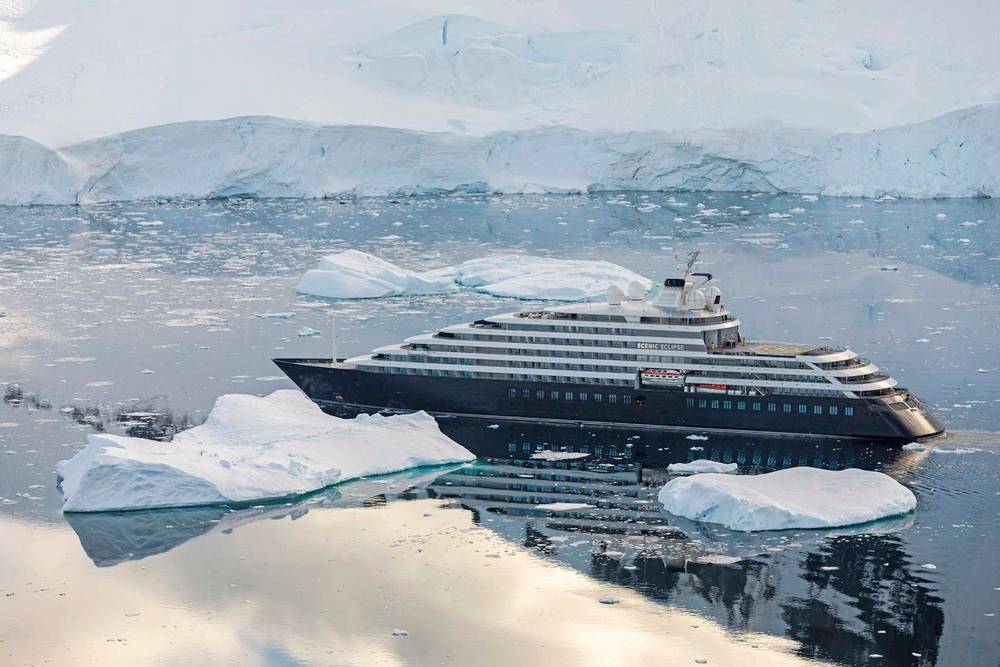
Scenic Eclipse

- 228Guests
- 114Cabins
- 2019Launched
- 168 mLength
All ship facts
- Crew
- 176
- Decks
- 8
- Gross tonnage
- 17545
- Speed
- 17 kts
- Width
- 22 m
- Wheelchair cabins
- 0
- Currency on board
- USD
- Language
- en-US