

Svalbard in Spring: Sea Ice, Pristine Snow and Wildlife
CRUISE ID # QUARKOEX20280526
Helsinki TO Helsinki
Suites & Fares
Itinerary
- Day 1May 26, 2028
Arrive in Helsinki, Finland
Arrive in the Finnish capital and make your way to the group hotel located right at Helsinki airport—included in your Charter Flight & Hotel Package. You will have the rest of the day to explore the many museums, galleries and restaurants, relax at a Finnish sauna or wander the vibrant Design District. If you do plan to visit Helsinki city center, take advantage of the convenient 40-minute rail service from the airport.
- Day 2May 27, 2028
Fly to Longyearbyen, Svalbard, and Embark
After breakfast, the group will transfer to the Helsinki airport and board our private charter flight to Longyearbyen, part of your Charter Flight & Hotel Package. Our journey to the High Arctic now truly begins. You will see the coastal and birch forests of southern Scandinavia give way to taiga and tundra environments, the mountains of Norway and northern Sweden, and the convergence of the Norwegian and Barents seas. Approaching Svalbard, you may get your first views of a pure, snow-capped wilderness, complete with ridgelines, glaciers, and perhaps even sea ice in the distance. We land in Longyearbyen, Svalbard’s largest settlement, and transfer to the harbor where we will embark on our ship.
- Day 3May 28, 2028
Springtime in the Svalbard Wilderness
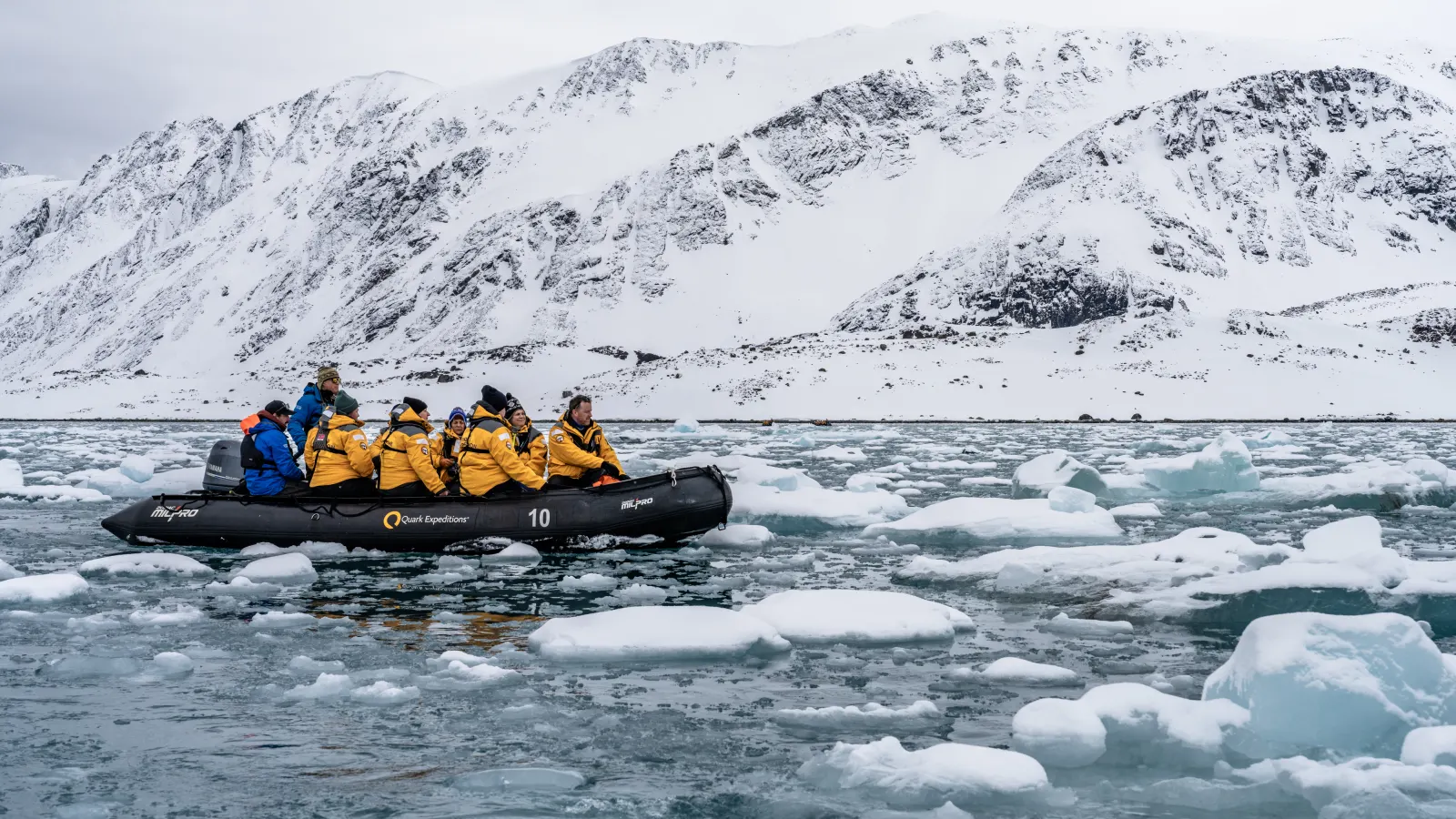
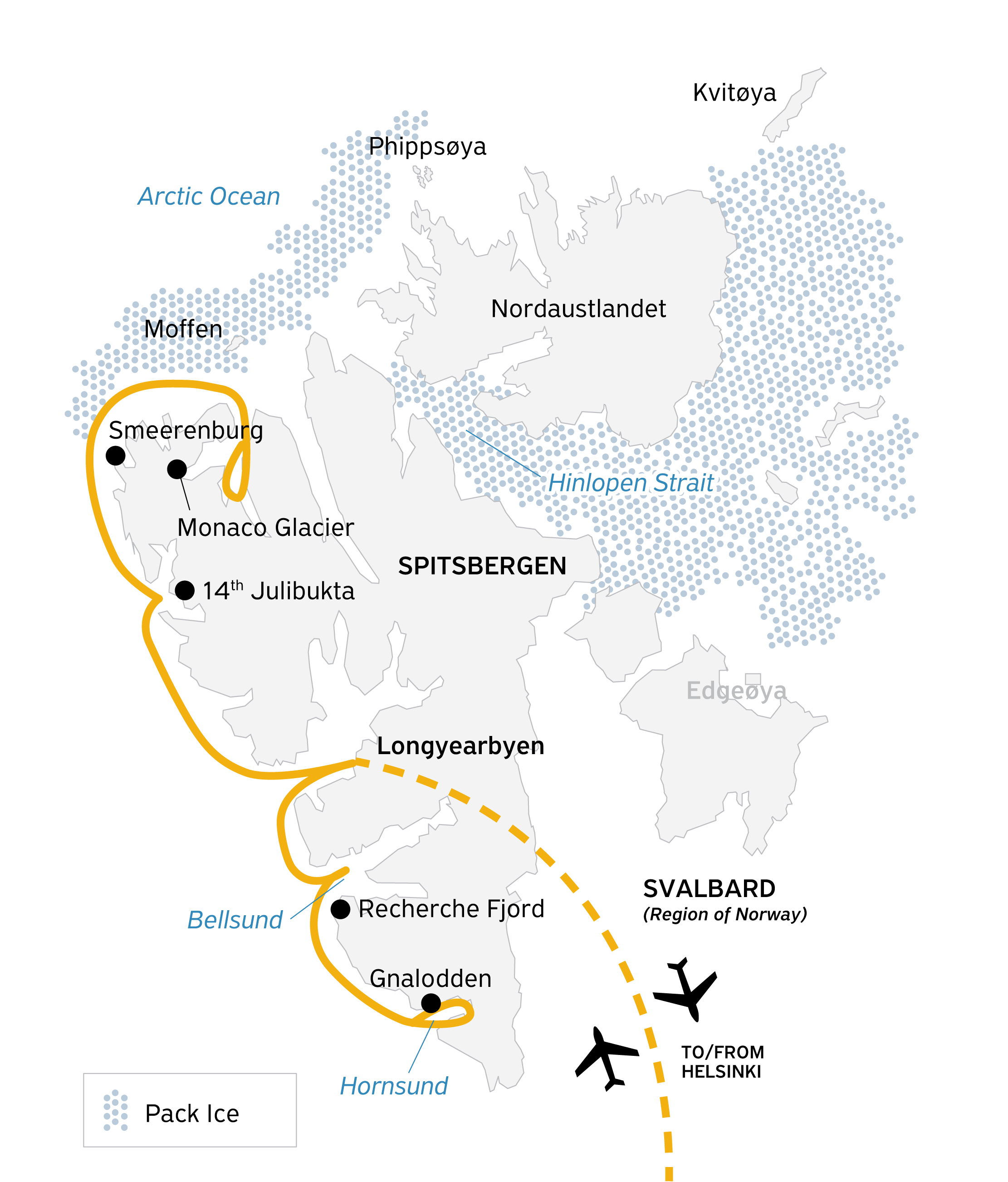
Spring in Svalbard is characterized by a beautiful combination of snow, ice and Midnight Sun. A fascinating contrast unfolds with the arrival of spring: majestic polar landscapes illuminated by continuous daylight. Sea ice is at or near its annual maximum, drawing us north. If experiencing Arctic sea ice is on your bucket list, you have chosen the perfect time to visit. Your Expedition Team and Bridge Officers will consult the latest ice charts daily—sea ice is incredibly dynamic and can drift dozens of kilometers in a day. Our route will depend on where sea ice offers the best opportunities for exploration and wildlife encounters. Sea ice is the primary hunting, resting, and travelling platform for iconic Arctic species—and spring offers the best chance to see it all. As we navigate the ice edge—or even through it—spend time on deck with your binoculars at the ready. Somewhere in the maze of marooned icebergs and pressure ridges, wildlife may be present—perhaps even polar bears who are lured to the ice edge by the presence of seals—a primary food source. Watch for clues, shapes, and shadows that could signal something special. And while polar bears may be the main goal, you may also spot walruses, Arctic foxes, and ivory gulls—in addition to ringed and bearded seals. On shore, spring landscapes remain blanketed in snow, with many bays still filled with ice—habitat crucial to Arctic wildlife for food and survival. It’s the kind of scenery that embodies the word “pristine.” On sunny days, snowcapped ridges against cobalt skies are electric in their beauty. On cloudy days, the Arctic’s muted palette of whites, greys, and blues creates moody, powerful vistas. Photography tip: try switching your camera to black-and-white mode—textures become dramatic, and light behaves differently. Alongside drifting sea ice, you may see icebergs and bergy bits—fragments of glacial ice whose origins lie deep in mountain valleys. Spring in the Arctic is also a time of awakening. As we travel, we’ll witness this seasonal transformation firsthand. Some slopes, beaches, and valleys begin to melt faster than others, revealing bare ground untouched for months. Grasses and mosses emerge, seizing every opportunity to photosynthesize in the returning sunlight. Meltwater trickles grow into fast-flowing runoff, adding sound and motion to the awakening landscape. Yet spring remains cold. In fact, these areas may go through multiple freeze-thaw cycles, especially farther north and east. In Svalbard, this mesmerizing transition is vivid and inspiring—a reminder to all of us of the powerful rhythms of Arctic life. Spring also welcomes migratory birds and whales. As the season unfolds, cliffsides will become busy with seabirds, such as little auks, guillemots and kittiwakes, returning to breed. Each day brings new arrivals. Nest-building, courting, and bird calls fill the air in a sensory-rich spectacle. When we encounter these colonies, take time to pause. Put down your camera. Simply observe the vibrant pulse of life and imagine the sheer abundance of food required to feed so many birds—and the chicks that will soon arrive. Whales, too, may appear. While sightings can never be guaranteed, some large migrators—such as blue whales—begin arriving in coastal waters by late spring. Others, like belugas, live here year-round and may be spotted threading through sea ice. Each encounter, however brief, reminds us of the interconnectedness of Arctic ecosystems. With seven full expedition days in Svalbard, we aim to explore a wide range of locations. The order of our journey will be shaped by sea ice conditions, which vary daily. Potential destinations include the spectacular fjord systems of Hornsund, Bellsund, Isfjorden, Krossfjorden, Smeerenburgfjorden, Raudfjorden, Woodfjorden, Sorgfjorden, and others. These fjords feature dramatic mountains rising directly from the sea, folding into endless layers. Glaciers spill from the highlands, many reaching the water’s edge where they calve into the sea. Throughout Svalbard, we’ll look for thriving seabird colonies and hope to make regular landings along the coasts and within fjords. Some outings may take place on exposed rocky terrain, but most will involve walking on snow. And if conditions are safe and suitable, we may even set foot on the sea ice itself—an unforgettable moment that truly feels like walking on water.
- Day 4May 29, 2028
Springtime in the Svalbard Wilderness
Spring in Svalbard is characterized by a beautiful combination of snow, ice and Midnight Sun. A fascinating contrast unfolds with the arrival of spring: majestic polar landscapes illuminated by continuous daylight. Sea ice is at or near its annual maximum, drawing us north. If experiencing Arctic sea ice is on your bucket list, you have chosen the perfect time to visit. Your Expedition Team and Bridge Officers will consult the latest ice charts daily—sea ice is incredibly dynamic and can drift dozens of kilometers in a day. Our route will depend on where sea ice offers the best opportunities for exploration and wildlife encounters. Sea ice is the primary hunting, resting, and travelling platform for iconic Arctic species—and spring offers the best chance to see it all. As we navigate the ice edge—or even through it—spend time on deck with your binoculars at the ready. Somewhere in the maze of marooned icebergs and pressure ridges, wildlife may be present—perhaps even polar bears who are lured to the ice edge by the presence of seals—a primary food source. Watch for clues, shapes, and shadows that could signal something special. And while polar bears may be the main goal, you may also spot walruses, Arctic foxes, and ivory gulls—in addition to ringed and bearded seals. On shore, spring landscapes remain blanketed in snow, with many bays still filled with ice—habitat crucial to Arctic wildlife for food and survival. It’s the kind of scenery that embodies the word “pristine.” On sunny days, snowcapped ridges against cobalt skies are electric in their beauty. On cloudy days, the Arctic’s muted palette of whites, greys, and blues creates moody, powerful vistas. Photography tip: try switching your camera to black-and-white mode—textures become dramatic, and light behaves differently. Alongside drifting sea ice, you may see icebergs and bergy bits—fragments of glacial ice whose origins lie deep in mountain valleys. Spring in the Arctic is also a time of awakening. As we travel, we’ll witness this seasonal transformation firsthand. Some slopes, beaches, and valleys begin to melt faster than others, revealing bare ground untouched for months. Grasses and mosses emerge, seizing every opportunity to photosynthesize in the returning sunlight. Meltwater trickles grow into fast-flowing runoff, adding sound and motion to the awakening landscape. Yet spring remains cold. In fact, these areas may go through multiple freeze-thaw cycles, especially farther north and east. In Svalbard, this mesmerizing transition is vivid and inspiring—a reminder to all of us of the powerful rhythms of Arctic life. Spring also welcomes migratory birds and whales. As the season unfolds, cliffsides will become busy with seabirds, such as little auks, guillemots and kittiwakes, returning to breed. Each day brings new arrivals. Nest-building, courting, and bird calls fill the air in a sensory-rich spectacle. When we encounter these colonies, take time to pause. Put down your camera. Simply observe the vibrant pulse of life and imagine the sheer abundance of food required to feed so many birds—and the chicks that will soon arrive. Whales, too, may appear. While sightings can never be guaranteed, some large migrators—such as blue whales—begin arriving in coastal waters by late spring. Others, like belugas, live here year-round and may be spotted threading through sea ice. Each encounter, however brief, reminds us of the interconnectedness of Arctic ecosystems. With seven full expedition days in Svalbard, we aim to explore a wide range of locations. The order of our journey will be shaped by sea ice conditions, which vary daily. Potential destinations include the spectacular fjord systems of Hornsund, Bellsund, Isfjorden, Krossfjorden, Smeerenburgfjorden, Raudfjorden, Woodfjorden, Sorgfjorden, and others. These fjords feature dramatic mountains rising directly from the sea, folding into endless layers. Glaciers spill from the highlands, many reaching the water’s edge where they calve into the sea. Throughout Svalbard, we’ll look for thriving seabird colonies and hope to make regular landings along the coasts and within fjords. Some outings may take place on exposed rocky terrain, but most will involve walking on snow. And if conditions are safe and suitable, we may even set foot on the sea ice itself—an unforgettable moment that truly feels like walking on water.
- Day 5May 30, 2028
Springtime in the Svalbard Wilderness
Spring in Svalbard is characterized by a beautiful combination of snow, ice and Midnight Sun. A fascinating contrast unfolds with the arrival of spring: majestic polar landscapes illuminated by continuous daylight. Sea ice is at or near its annual maximum, drawing us north. If experiencing Arctic sea ice is on your bucket list, you have chosen the perfect time to visit. Your Expedition Team and Bridge Officers will consult the latest ice charts daily—sea ice is incredibly dynamic and can drift dozens of kilometers in a day. Our route will depend on where sea ice offers the best opportunities for exploration and wildlife encounters. Sea ice is the primary hunting, resting, and travelling platform for iconic Arctic species—and spring offers the best chance to see it all. As we navigate the ice edge—or even through it—spend time on deck with your binoculars at the ready. Somewhere in the maze of marooned icebergs and pressure ridges, wildlife may be present—perhaps even polar bears who are lured to the ice edge by the presence of seals—a primary food source. Watch for clues, shapes, and shadows that could signal something special. And while polar bears may be the main goal, you may also spot walruses, Arctic foxes, and ivory gulls—in addition to ringed and bearded seals. On shore, spring landscapes remain blanketed in snow, with many bays still filled with ice—habitat crucial to Arctic wildlife for food and survival. It’s the kind of scenery that embodies the word “pristine.” On sunny days, snowcapped ridges against cobalt skies are electric in their beauty. On cloudy days, the Arctic’s muted palette of whites, greys, and blues creates moody, powerful vistas. Photography tip: try switching your camera to black-and-white mode—textures become dramatic, and light behaves differently. Alongside drifting sea ice, you may see icebergs and bergy bits—fragments of glacial ice whose origins lie deep in mountain valleys. Spring in the Arctic is also a time of awakening. As we travel, we’ll witness this seasonal transformation firsthand. Some slopes, beaches, and valleys begin to melt faster than others, revealing bare ground untouched for months. Grasses and mosses emerge, seizing every opportunity to photosynthesize in the returning sunlight. Meltwater trickles grow into fast-flowing runoff, adding sound and motion to the awakening landscape. Yet spring remains cold. In fact, these areas may go through multiple freeze-thaw cycles, especially farther north and east. In Svalbard, this mesmerizing transition is vivid and inspiring—a reminder to all of us of the powerful rhythms of Arctic life. Spring also welcomes migratory birds and whales. As the season unfolds, cliffsides will become busy with seabirds, such as little auks, guillemots and kittiwakes, returning to breed. Each day brings new arrivals. Nest-building, courting, and bird calls fill the air in a sensory-rich spectacle. When we encounter these colonies, take time to pause. Put down your camera. Simply observe the vibrant pulse of life and imagine the sheer abundance of food required to feed so many birds—and the chicks that will soon arrive. Whales, too, may appear. While sightings can never be guaranteed, some large migrators—such as blue whales—begin arriving in coastal waters by late spring. Others, like belugas, live here year-round and may be spotted threading through sea ice. Each encounter, however brief, reminds us of the interconnectedness of Arctic ecosystems. With seven full expedition days in Svalbard, we aim to explore a wide range of locations. The order of our journey will be shaped by sea ice conditions, which vary daily. Potential destinations include the spectacular fjord systems of Hornsund, Bellsund, Isfjorden, Krossfjorden, Smeerenburgfjorden, Raudfjorden, Woodfjorden, Sorgfjorden, and others. These fjords feature dramatic mountains rising directly from the sea, folding into endless layers. Glaciers spill from the highlands, many reaching the water’s edge where they calve into the sea. Throughout Svalbard, we’ll look for thriving seabird colonies and hope to make regular landings along the coasts and within fjords. Some outings may take place on exposed rocky terrain, but most will involve walking on snow. And if conditions are safe and suitable, we may even set foot on the sea ice itself—an unforgettable moment that truly feels like walking on water.
- Day 6May 31, 2028
Springtime in the Svalbard Wilderness
Spring in Svalbard is characterized by a beautiful combination of snow, ice and Midnight Sun. A fascinating contrast unfolds with the arrival of spring: majestic polar landscapes illuminated by continuous daylight. Sea ice is at or near its annual maximum, drawing us north. If experiencing Arctic sea ice is on your bucket list, you have chosen the perfect time to visit. Your Expedition Team and Bridge Officers will consult the latest ice charts daily—sea ice is incredibly dynamic and can drift dozens of kilometers in a day. Our route will depend on where sea ice offers the best opportunities for exploration and wildlife encounters. Sea ice is the primary hunting, resting, and travelling platform for iconic Arctic species—and spring offers the best chance to see it all. As we navigate the ice edge—or even through it—spend time on deck with your binoculars at the ready. Somewhere in the maze of marooned icebergs and pressure ridges, wildlife may be present—perhaps even polar bears who are lured to the ice edge by the presence of seals—a primary food source. Watch for clues, shapes, and shadows that could signal something special. And while polar bears may be the main goal, you may also spot walruses, Arctic foxes, and ivory gulls—in addition to ringed and bearded seals. On shore, spring landscapes remain blanketed in snow, with many bays still filled with ice—habitat crucial to Arctic wildlife for food and survival. It’s the kind of scenery that embodies the word “pristine.” On sunny days, snowcapped ridges against cobalt skies are electric in their beauty. On cloudy days, the Arctic’s muted palette of whites, greys, and blues creates moody, powerful vistas. Photography tip: try switching your camera to black-and-white mode—textures become dramatic, and light behaves differently. Alongside drifting sea ice, you may see icebergs and bergy bits—fragments of glacial ice whose origins lie deep in mountain valleys. Spring in the Arctic is also a time of awakening. As we travel, we’ll witness this seasonal transformation firsthand. Some slopes, beaches, and valleys begin to melt faster than others, revealing bare ground untouched for months. Grasses and mosses emerge, seizing every opportunity to photosynthesize in the returning sunlight. Meltwater trickles grow into fast-flowing runoff, adding sound and motion to the awakening landscape. Yet spring remains cold. In fact, these areas may go through multiple freeze-thaw cycles, especially farther north and east. In Svalbard, this mesmerizing transition is vivid and inspiring—a reminder to all of us of the powerful rhythms of Arctic life. Spring also welcomes migratory birds and whales. As the season unfolds, cliffsides will become busy with seabirds, such as little auks, guillemots and kittiwakes, returning to breed. Each day brings new arrivals. Nest-building, courting, and bird calls fill the air in a sensory-rich spectacle. When we encounter these colonies, take time to pause. Put down your camera. Simply observe the vibrant pulse of life and imagine the sheer abundance of food required to feed so many birds—and the chicks that will soon arrive. Whales, too, may appear. While sightings can never be guaranteed, some large migrators—such as blue whales—begin arriving in coastal waters by late spring. Others, like belugas, live here year-round and may be spotted threading through sea ice. Each encounter, however brief, reminds us of the interconnectedness of Arctic ecosystems. With seven full expedition days in Svalbard, we aim to explore a wide range of locations. The order of our journey will be shaped by sea ice conditions, which vary daily. Potential destinations include the spectacular fjord systems of Hornsund, Bellsund, Isfjorden, Krossfjorden, Smeerenburgfjorden, Raudfjorden, Woodfjorden, Sorgfjorden, and others. These fjords feature dramatic mountains rising directly from the sea, folding into endless layers. Glaciers spill from the highlands, many reaching the water’s edge where they calve into the sea. Throughout Svalbard, we’ll look for thriving seabird colonies and hope to make regular landings along the coasts and within fjords. Some outings may take place on exposed rocky terrain, but most will involve walking on snow. And if conditions are safe and suitable, we may even set foot on the sea ice itself—an unforgettable moment that truly feels like walking on water.
- Day 7June 01, 2028
Springtime in the Svalbard Wilderness
Spring in Svalbard is characterized by a beautiful combination of snow, ice and Midnight Sun. A fascinating contrast unfolds with the arrival of spring: majestic polar landscapes illuminated by continuous daylight. Sea ice is at or near its annual maximum, drawing us north. If experiencing Arctic sea ice is on your bucket list, you have chosen the perfect time to visit. Your Expedition Team and Bridge Officers will consult the latest ice charts daily—sea ice is incredibly dynamic and can drift dozens of kilometers in a day. Our route will depend on where sea ice offers the best opportunities for exploration and wildlife encounters. Sea ice is the primary hunting, resting, and travelling platform for iconic Arctic species—and spring offers the best chance to see it all. As we navigate the ice edge—or even through it—spend time on deck with your binoculars at the ready. Somewhere in the maze of marooned icebergs and pressure ridges, wildlife may be present—perhaps even polar bears who are lured to the ice edge by the presence of seals—a primary food source. Watch for clues, shapes, and shadows that could signal something special. And while polar bears may be the main goal, you may also spot walruses, Arctic foxes, and ivory gulls—in addition to ringed and bearded seals. On shore, spring landscapes remain blanketed in snow, with many bays still filled with ice—habitat crucial to Arctic wildlife for food and survival. It’s the kind of scenery that embodies the word “pristine.” On sunny days, snowcapped ridges against cobalt skies are electric in their beauty. On cloudy days, the Arctic’s muted palette of whites, greys, and blues creates moody, powerful vistas. Photography tip: try switching your camera to black-and-white mode—textures become dramatic, and light behaves differently. Alongside drifting sea ice, you may see icebergs and bergy bits—fragments of glacial ice whose origins lie deep in mountain valleys. Spring in the Arctic is also a time of awakening. As we travel, we’ll witness this seasonal transformation firsthand. Some slopes, beaches, and valleys begin to melt faster than others, revealing bare ground untouched for months. Grasses and mosses emerge, seizing every opportunity to photosynthesize in the returning sunlight. Meltwater trickles grow into fast-flowing runoff, adding sound and motion to the awakening landscape. Yet spring remains cold. In fact, these areas may go through multiple freeze-thaw cycles, especially farther north and east. In Svalbard, this mesmerizing transition is vivid and inspiring—a reminder to all of us of the powerful rhythms of Arctic life. Spring also welcomes migratory birds and whales. As the season unfolds, cliffsides will become busy with seabirds, such as little auks, guillemots and kittiwakes, returning to breed. Each day brings new arrivals. Nest-building, courting, and bird calls fill the air in a sensory-rich spectacle. When we encounter these colonies, take time to pause. Put down your camera. Simply observe the vibrant pulse of life and imagine the sheer abundance of food required to feed so many birds—and the chicks that will soon arrive. Whales, too, may appear. While sightings can never be guaranteed, some large migrators—such as blue whales—begin arriving in coastal waters by late spring. Others, like belugas, live here year-round and may be spotted threading through sea ice. Each encounter, however brief, reminds us of the interconnectedness of Arctic ecosystems. With seven full expedition days in Svalbard, we aim to explore a wide range of locations. The order of our journey will be shaped by sea ice conditions, which vary daily. Potential destinations include the spectacular fjord systems of Hornsund, Bellsund, Isfjorden, Krossfjorden, Smeerenburgfjorden, Raudfjorden, Woodfjorden, Sorgfjorden, and others. These fjords feature dramatic mountains rising directly from the sea, folding into endless layers. Glaciers spill from the highlands, many reaching the water’s edge where they calve into the sea. Throughout Svalbard, we’ll look for thriving seabird colonies and hope to make regular landings along the coasts and within fjords. Some outings may take place on exposed rocky terrain, but most will involve walking on snow. And if conditions are safe and suitable, we may even set foot on the sea ice itself—an unforgettable moment that truly feels like walking on water.
- Day 8June 02, 2028
Springtime in the Svalbard Wilderness
Spring in Svalbard is characterized by a beautiful combination of snow, ice and Midnight Sun. A fascinating contrast unfolds with the arrival of spring: majestic polar landscapes illuminated by continuous daylight. Sea ice is at or near its annual maximum, drawing us north. If experiencing Arctic sea ice is on your bucket list, you have chosen the perfect time to visit. Your Expedition Team and Bridge Officers will consult the latest ice charts daily—sea ice is incredibly dynamic and can drift dozens of kilometers in a day. Our route will depend on where sea ice offers the best opportunities for exploration and wildlife encounters. Sea ice is the primary hunting, resting, and travelling platform for iconic Arctic species—and spring offers the best chance to see it all. As we navigate the ice edge—or even through it—spend time on deck with your binoculars at the ready. Somewhere in the maze of marooned icebergs and pressure ridges, wildlife may be present—perhaps even polar bears who are lured to the ice edge by the presence of seals—a primary food source. Watch for clues, shapes, and shadows that could signal something special. And while polar bears may be the main goal, you may also spot walruses, Arctic foxes, and ivory gulls—in addition to ringed and bearded seals. On shore, spring landscapes remain blanketed in snow, with many bays still filled with ice—habitat crucial to Arctic wildlife for food and survival. It’s the kind of scenery that embodies the word “pristine.” On sunny days, snowcapped ridges against cobalt skies are electric in their beauty. On cloudy days, the Arctic’s muted palette of whites, greys, and blues creates moody, powerful vistas. Photography tip: try switching your camera to black-and-white mode—textures become dramatic, and light behaves differently. Alongside drifting sea ice, you may see icebergs and bergy bits—fragments of glacial ice whose origins lie deep in mountain valleys. Spring in the Arctic is also a time of awakening. As we travel, we’ll witness this seasonal transformation firsthand. Some slopes, beaches, and valleys begin to melt faster than others, revealing bare ground untouched for months. Grasses and mosses emerge, seizing every opportunity to photosynthesize in the returning sunlight. Meltwater trickles grow into fast-flowing runoff, adding sound and motion to the awakening landscape. Yet spring remains cold. In fact, these areas may go through multiple freeze-thaw cycles, especially farther north and east. In Svalbard, this mesmerizing transition is vivid and inspiring—a reminder to all of us of the powerful rhythms of Arctic life. Spring also welcomes migratory birds and whales. As the season unfolds, cliffsides will become busy with seabirds, such as little auks, guillemots and kittiwakes, returning to breed. Each day brings new arrivals. Nest-building, courting, and bird calls fill the air in a sensory-rich spectacle. When we encounter these colonies, take time to pause. Put down your camera. Simply observe the vibrant pulse of life and imagine the sheer abundance of food required to feed so many birds—and the chicks that will soon arrive. Whales, too, may appear. While sightings can never be guaranteed, some large migrators—such as blue whales—begin arriving in coastal waters by late spring. Others, like belugas, live here year-round and may be spotted threading through sea ice. Each encounter, however brief, reminds us of the interconnectedness of Arctic ecosystems. With seven full expedition days in Svalbard, we aim to explore a wide range of locations. The order of our journey will be shaped by sea ice conditions, which vary daily. Potential destinations include the spectacular fjord systems of Hornsund, Bellsund, Isfjorden, Krossfjorden, Smeerenburgfjorden, Raudfjorden, Woodfjorden, Sorgfjorden, and others. These fjords feature dramatic mountains rising directly from the sea, folding into endless layers. Glaciers spill from the highlands, many reaching the water’s edge where they calve into the sea. Throughout Svalbard, we’ll look for thriving seabird colonies and hope to make regular landings along the coasts and within fjords. Some outings may take place on exposed rocky terrain, but most will involve walking on snow. And if conditions are safe and suitable, we may even set foot on the sea ice itself—an unforgettable moment that truly feels like walking on water.
- Day 9June 03, 2028
Springtime in the Svalbard Wilderness
Spring in Svalbard is characterized by a beautiful combination of snow, ice and Midnight Sun. A fascinating contrast unfolds with the arrival of spring: majestic polar landscapes illuminated by continuous daylight. Sea ice is at or near its annual maximum, drawing us north. If experiencing Arctic sea ice is on your bucket list, you have chosen the perfect time to visit. Your Expedition Team and Bridge Officers will consult the latest ice charts daily—sea ice is incredibly dynamic and can drift dozens of kilometers in a day. Our route will depend on where sea ice offers the best opportunities for exploration and wildlife encounters. Sea ice is the primary hunting, resting, and travelling platform for iconic Arctic species—and spring offers the best chance to see it all. As we navigate the ice edge—or even through it—spend time on deck with your binoculars at the ready. Somewhere in the maze of marooned icebergs and pressure ridges, wildlife may be present—perhaps even polar bears who are lured to the ice edge by the presence of seals—a primary food source. Watch for clues, shapes, and shadows that could signal something special. And while polar bears may be the main goal, you may also spot walruses, Arctic foxes, and ivory gulls—in addition to ringed and bearded seals. On shore, spring landscapes remain blanketed in snow, with many bays still filled with ice—habitat crucial to Arctic wildlife for food and survival. It’s the kind of scenery that embodies the word “pristine.” On sunny days, snowcapped ridges against cobalt skies are electric in their beauty. On cloudy days, the Arctic’s muted palette of whites, greys, and blues creates moody, powerful vistas. Photography tip: try switching your camera to black-and-white mode—textures become dramatic, and light behaves differently. Alongside drifting sea ice, you may see icebergs and bergy bits—fragments of glacial ice whose origins lie deep in mountain valleys. Spring in the Arctic is also a time of awakening. As we travel, we’ll witness this seasonal transformation firsthand. Some slopes, beaches, and valleys begin to melt faster than others, revealing bare ground untouched for months. Grasses and mosses emerge, seizing every opportunity to photosynthesize in the returning sunlight. Meltwater trickles grow into fast-flowing runoff, adding sound and motion to the awakening landscape. Yet spring remains cold. In fact, these areas may go through multiple freeze-thaw cycles, especially farther north and east. In Svalbard, this mesmerizing transition is vivid and inspiring—a reminder to all of us of the powerful rhythms of Arctic life. Spring also welcomes migratory birds and whales. As the season unfolds, cliffsides will become busy with seabirds, such as little auks, guillemots and kittiwakes, returning to breed. Each day brings new arrivals. Nest-building, courting, and bird calls fill the air in a sensory-rich spectacle. When we encounter these colonies, take time to pause. Put down your camera. Simply observe the vibrant pulse of life and imagine the sheer abundance of food required to feed so many birds—and the chicks that will soon arrive. Whales, too, may appear. While sightings can never be guaranteed, some large migrators—such as blue whales—begin arriving in coastal waters by late spring. Others, like belugas, live here year-round and may be spotted threading through sea ice. Each encounter, however brief, reminds us of the interconnectedness of Arctic ecosystems. With seven full expedition days in Svalbard, we aim to explore a wide range of locations. The order of our journey will be shaped by sea ice conditions, which vary daily. Potential destinations include the spectacular fjord systems of Hornsund, Bellsund, Isfjorden, Krossfjorden, Smeerenburgfjorden, Raudfjorden, Woodfjorden, Sorgfjorden, and others. These fjords feature dramatic mountains rising directly from the sea, folding into endless layers. Glaciers spill from the highlands, many reaching the water’s edge where they calve into the sea. Throughout Svalbard, we’ll look for thriving seabird colonies and hope to make regular landings along the coasts and within fjords. Some outings may take place on exposed rocky terrain, but most will involve walking on snow. And if conditions are safe and suitable, we may even set foot on the sea ice itself—an unforgettable moment that truly feels like walking on water.
- Day 10June 04, 2028
Disembarkation in Longyearbyen and Charter Flight to Helsinki
The time to say goodbye has come. Your adventure ends as it began, in the frontier settlement of Longyearbyen. From here, we’ll transfer you to the airport for your charter flight to Helsinki, and group hotel night. Both are included in your Charter Flight & Hotel Package.
- Day 11June 05, 2028
Depart Helsinki
After breakfast at your included hotel, make your way independently to the Helsinki airport for your onward flight home, or spend more time exploring the Finnish capital as prearranged.
About the Ship
Ocean Explorer

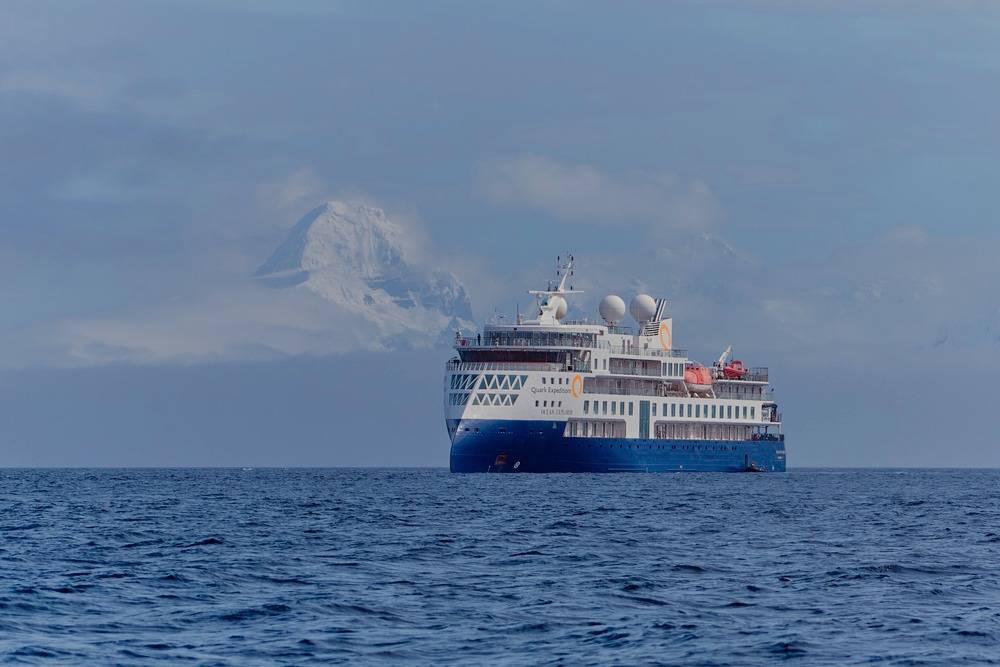
- 138Guests
- 72Cabins
- 2020Launched
- 104.4 mLength
All ship facts
- Crew
- 105
- Decks
- 7
- Speed
- 16 kts
- Width
- 5.3 m
- Currency on board
- USD
- Language
- en