

In the heart of the Northwest Passage
CRUISE ID # PONANTAU280827
Kangerlussuaq Havn TO Nuuk (Godthaab)

Suites & Fares
Itinerary
- Day 1August 28, 2027
Kangerlussuaq Havn, Greenland
The name Kangerlussuaq means "Big Fjord" in the local Kalaallisut language. The settlement of about 500 people is located in western Greenland on flat land at the head of a fjord with the same name. Kangerlussuaq is the site of Greenland's largest commercial airport and most of the economy here is dependent on the air transportation hub and tourism. The rugged lands around the settlement support terrestrial Arctic fauna including muskoxen, caribou, and Gyrfalcons.
- Day 2August 29, 2027
Nooralak
- Day 3August 30, 2027
Disko Bay, Greenland
- Day 4August 31, 2027
Disko Bay, Greenland
- Day 5September 01, 2027
Day at Sea
- Day 6September 02, 2027
Pond Inlet, Nunavut, Canada
Located in northern Baffin Island, Pond Inlet is a small, predo¬minantly Inuit community, with a population of roughly 1,500 inhabitants. In 1818, the British explorer John Ross named a bay in the vicinity after the English astronomer John Pond. Today Pond Inlet is considered one of Canada's "jewels of the North" thanks to several picturesque glaciers and mountain ranges nearby. Many archaeological sites of ancient Dorset and Thule peoples can be found near Pond Inlet. The Inuit hunted caribou, ringed and harp seals, fish, polar bears, walrus, narwhals, geese, ptarmigans and Arctic hares, long before European and American whalers came here to harvest bowhead whales. Pond Inlet is also known as a major center of Inuit art, especially the printmaking and stone carving that are featured in the town’s art galleries.
- Day 7September 03, 2027
Queen Harbour, Philpots Island, Nunavut, Canada
- Day 8September 04, 2027
Radstock Bay, Devon Island, Canada
Devon Island is Canada’s sixth largest island and was first seen by Europeans in the early 17th century. The Thule culture had already settled there many centuries before, and left behind qarmat homes, made of rocks, whale bones, rock and sod walls, and skins for roofs that tell a story of over 800 years of human habitation. Other striking finds in this area are the many fossils of corals, crinoids and nautiloids that can be seen. Just across Lancaster Sound is Prince Leopold Island, a Canadian Important Bird Area, a federally listed migratory bird sanctuary, and a Key Migratory Bird Terrestrial Habitat site with large numbers of Thick-billed Murres, Northern Fulmars and Black-legged Kittiwakes that breed there.
- Day 9September 05, 2027
Radstock Bay, Devon Island, Canada
Devon Island is Canada’s sixth largest island and was first seen by Europeans in the early 17th century. The Thule culture had already settled there many centuries before, and left behind qarmat homes, made of rocks, whale bones, rock and sod walls, and skins for roofs that tell a story of over 800 years of human habitation. Other striking finds in this area are the many fossils of corals, crinoids and nautiloids that can be seen. Just across Lancaster Sound is Prince Leopold Island, a Canadian Important Bird Area, a federally listed migratory bird sanctuary, and a Key Migratory Bird Terrestrial Habitat site with large numbers of Thick-billed Murres, Northern Fulmars and Black-legged Kittiwakes that breed there.
- Day 10September 06, 2027
Somerset Island, Canada
- Day 11September 07, 2027
Sailing in the Bellot Strait
- Day 11September 07, 2027
Prince of Wales Island, Nunavut, Canada
- Day 12September 08, 2027
Prescott Island, Nunavut, Canada
- Day 12September 08, 2027
Prince of Wales Island, Nunavut, Canada
- Day 13September 09, 2027
Lancaster Sound, Tallurutiup Imanga National Park, Nunavut, Canada
- Day 14September 10, 2027
Beechey Island, Nunavut, Canada
Beechey Island is a small island off the southwest coast of Devon Island, separated by a narrow waterway called the Barrow Strait. Captain William Edward Parry was the first European to visit the island in 1819. His lieutenant, Frederick William Beechey, named the island after his father, the artist William Beechey (1753–1839). Beechey Island played a significant role in the history of Arctic Exploration. During the winter of 1845-46, Sir John Franklin and his men camped on the island as part of their ill-fated quest to find the Northwest Passage. Mummified remains of three of Franklin’s crew were discovered, giving a better understanding of what happened before the disappearance of the expedition. In 1850 Edward Belcher used the island as a base while surveying the area. Later, in 1903, Norwegian explorer Roald Amundsen stopped at the island at the beginning of his successful voyage in search for the Northwest Passage. Subsequently, Beechey Island has been declared a "Territorial Historic Site" since 1975 by the Northwest Territories government
- Day 14September 10, 2027
Radstock Bay, Devon Island, Canada
Devon Island is Canada’s sixth largest island and was first seen by Europeans in the early 17th century. The Thule culture had already settled there many centuries before, and left behind qarmat homes, made of rocks, whale bones, rock and sod walls, and skins for roofs that tell a story of over 800 years of human habitation. Other striking finds in this area are the many fossils of corals, crinoids and nautiloids that can be seen. Just across Lancaster Sound is Prince Leopold Island, a Canadian Important Bird Area, a federally listed migratory bird sanctuary, and a Key Migratory Bird Terrestrial Habitat site with large numbers of Thick-billed Murres, Northern Fulmars and Black-legged Kittiwakes that breed there.
- Day 15September 11, 2027
Day at Sea
- Day 16September 12, 2027
Day at Sea
- Day 17September 13, 2027
Svartenhavn
- Day 18September 14, 2027
Qeqertarsuaq (Godhavn), Greenland
- Day 19September 15, 2027
Evighedsfjorden, Greenland
- Day 20September 16, 2027
Nuuk (Godthaab), Greenland
Nuuk, meaning “the cape”, was Greenland’s first town (1728). Started as a fort and later mission and trading post some 240 kilometers south of the Arctic Circle, it is the current capital. Almost 30% of Greenland’s population lives in the town. Not only does Nuuk have great natural beauty in its vicinity, but there are Inuit ruins, Hans Egede’s home, the parliament, and the Church of our Saviour as well. The Greenlandic National Museum has an outstanding collection of Greenlandic traditional dresses, as well as the famous Qilakitsoq mummies. The Katuaq Cultural Center’s building was inspired by the undulating Northern Lights and can house 10% of Nuuk’s inhabitants.
About the Ship
L'Austral

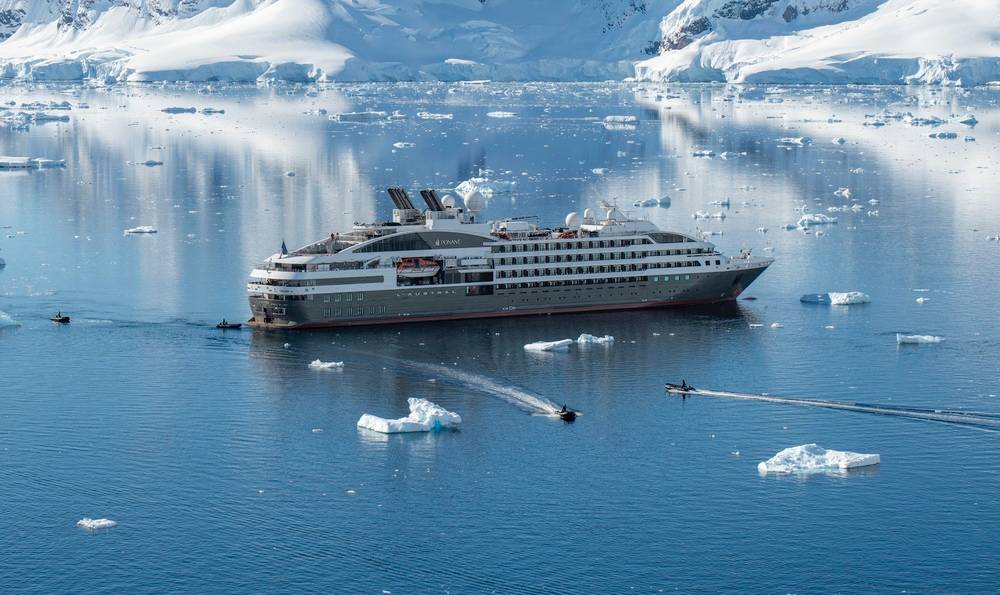
- 264Guests
- 132Cabins
- 2011Launched
- 142 mLength
All ship facts
- Crew
- 145
- Decks
- 5
- Gross tonnage
- 10944
- Speed
- 14 kts
- Width
- 18 m
- Wheelchair cabins
- 3
- Currency on board
- EUR
- Language
- fr+en