

Exploration from Greenland to Canada via Saint Pierre and Miquelon
CRUISE ID # PONANTEE290727
Reykjavík TO Toronto, Ontario

Suites & Fares
Itinerary
- Day 1July 29, 2027
Reykjavík, Iceland
Sprawling Reykjavík, the nation's nerve center and government seat, is home to half the island's population. On a bay overlooked by proud Mt. Esja (pronounced eh-shyuh), with its ever-changing hues, Reykjavík presents a colorful sight, its concrete houses painted in light colors and topped by vibrant red, blue, and green roofs. In contrast to the almost treeless countryside, Reykjavík has many tall, native birches, rowans, and willows, as well as imported aspen, pines, and spruces.Reykjavík's name comes from the Icelandic words for smoke, reykur, and bay, vík. In AD 874, Norseman Ingólfur Arnarson saw Iceland rising out of the misty sea and came ashore at a bay eerily shrouded with plumes of steam from nearby hot springs. Today most of the houses in Reykjavík are heated by near-boiling water from the hot springs. Natural heating avoids air pollution; there's no smoke around. You may notice, however, that the hot water brings a slight sulfur smell to the bathroom.Prices are easily on a par with other major European cities. A practical option is to purchase a Reykjavík City Card at the Tourist Information Center or at the Reykjavík Youth Hostel. This card permits unlimited bus usage and admission to any of the city's seven pools, the Family Park and Zoo, and city museums. The cards are valid for one (ISK 3,300), two (ISK 4,400), or three days (ISK 4,900), and they pay for themselves after three or four uses a day. Even lacking the City Card, paying admission (ISK 500, or ISK 250 for seniors and people with disabilities) to one of the city art museums (Hafnarhús, Kjarvalsstaðir, or Ásmundarsafn) gets you free same-day admission to the other two.
- Day 2July 30, 2027
Day at Sea
- Day 3July 31, 2027
Day at Sea
- Day 4August 01, 2027
Prince Christian Sound, Greenland
The transit through the Sound is one of this voyage’s highlights. Connecting the Labrador Sea with the Irminger Seat, Prince Christian Sound or “Prins Christian Sund” in Danish is named after Prince (later King) Christian VII (1749-1808). 100 km (60 miles ), long and at times just 500 m (1500 ft) wide, this majestic and spectacular fiord throws you back into a Viking era – flanked by soaring snow-topped mountains, rock-strewn cliffs and rolling hills, it is as if time has stood still and one easily forgets that this is the 21st century. As you marvel at the sheer size of the mountains that surround you, with the Arctic waters lapping deceptively at the hull, revel in the silence enveloping you. Icebergs float serenely by, carrying with them the ages of time. Be sure to wear warm clothing as this is one spectacle that you do not want to miss.
- Day 4August 01, 2027
Qaqortoq (Julianehaab), Greenland
The largest town in southern Greenland, Qaqortoq has been inhabited since prehistoric times. Upon arrival in this charming southern Greenland enclave, it's easy to see why. Qaqortoq rises quite steeply over the fjord system around the city, offering breath-taking panoramic vistas of the surrounding mountains, deep, blue sea, Lake Tasersuag, icebergs in the bay, and pastoral backcountry. Although the earliest signs of ancient civilization in Qaqortoq date back 4,300 years, Qaqortoq is known to have been inhabited by Norse and Inuit settlers in the 10th and 12th centuries, and the present-day town was founded in 1774. In the years since, Qaqortoq has evolved into a seaport and trading hub for fish and shrimp processing, tanning, fur production, and ship maintenance and repair.
- Day 5August 02, 2027
Day at Sea
- Day 6August 03, 2027
Day at Sea
- Day 7August 04, 2027
L'Anse aux Meadows, Newfoundland and Labrador, Canada
Around the year 1000, Vikings from Greenland and Iceland founded the first European settlement in North America, near the northern tip of Newfoundland. They arrived in the New World 500 years before Columbus but stayed only a few years and were forgotten for centuries. Since the settlement's rediscovery in the last century, the archaeological site has brought tourism to the area. Viking themes abound but so do views, whales, icebergs, fun dining experiences, and outdoor activities. L'Anse Aux Meadows on the northern tip of the island of Newfoundland is a remote community of just 40 people, with St Anthony, 40 minutes away, having a population of only 3,500. The region is locally famous for springtime polar bears, nesting eider ducks, the northern extreme of the Appalachians at nearby Belle Isle, numerous spring and summer icebergs, and a rich ocean fishery. L’Anse Aux Meadows National Historic Site is the UNESCO World Heritage Site that tells the story of Leif Erickson and the first Europeans in the new world. This site is often the keystone attraction for cruises themed around the Vikings. Discovered in 1960, it is the site of a Norse village, the only known one in North America outside of Greenland. The site remains the only widely-accepted instance of pre-Columbian trans-oceanic contact, and is notable for possible connections with the attempted colony of Vinland established by Leif Ericson around 1003, or more broadly with Norse exploration of the Americas. The root of the name "L'Anse aux Meadows" is believed to have originated with French fishermen in the area during the nineteenth and twentieth centuries, who named the site L'Anse aux Meduses, meaning 'Jellyfish Bay'.
- Day 8August 05, 2027
Woody Point, Gros Morne National Park, Newfoundland and Labrador, Canada
Acclaimed for its unearthly landscape, Woody Point is probably as close to Mars as you will ever get in this lifetime. Situated on the west coast of the island, the Tablelands behind Woody Point in the Gros Morne National Park are composed of peridotite — like much of the surface of Mars — and NASA, the Canadian Space Agency, plus others are studying this unique land form searching for insights into possible bacterial life on the red planet. The story of the Tablelands earned Gros Morne its World Heritage Site status from UNESCO in 2010, and the area remains a geological wonder, showcasing a time when the continents of Africa and North America collided. When the plates struck 485 million years ago, the peridotite was pushed to the surface, and remained above sea level. The rock lacks the nutrients to sustain plant life, thus giving the Tablelands a barren, isolated appearance. As the name suggests, the flat topped mountains dwarf the tiny village (population 281!), yet Woody Point has retained its character and the historic houses and buildings dating from 1870 have been beautifully maintained.
- Day 9August 06, 2027
Havre-Saint-Pierre, Québec, Canada
Havre St. Pierre is a tiny seaside port on the north shore of the Saint Lawrence River in Quebec. It was settled in 1857 by Acadians from the Magdalen Island, and still today locals speak a dialect more similar to Acadian French than to Quebec French. It was originally called Saint-Pierre-de-la-Pointe-aux-Esquimaux until 1927, when it was officially shortened to Havre St Pierre. Until recently the local economy relied mainly on fishing and lumbering, today it is mainly a titanium ore-transhipment port. Nearby is one of the world’s most amazing natural phenomena – the Mingan Archipelago. They are the largest group of erosional monoliths in Canada, and were declared a Nation Park in 1984. These limestone monoliths have formed over thousands of years by wave action, strong winds and seasonal freezing and thawing. The result is a unique set of large limestone sculptures.
- Day 10August 07, 2027
Day at Sea
- Day 11August 08, 2027
Saguenay, Québec, Canada
Just after visiting Saguenay, the wonderful Saguenay River pours into the massive St. Lawrence River. Before then, however, it slices through one of the world's most southerly fjords and dense forests of towering pine trees. The nature watching here is nothing short of sublime, with outdoor spots like the Parc National du Fjord-du-Saguenay offering panoramic vistas and sandy river-beaches. Island-sized blue whales cruise through the waters of the mighty rivers, and flick gallons of water into the air effortlessly with a single swish of their colossal tails. With hiking, kayaking and cycling opportunities inviting you to explore the spectacular scenery - you'll find endless ways to fall in love with this majestic outdoor escape. In fall, gorgeous colours ripple through the foliage, and in doing so, they provide one of nature's greatest performances.
- Day 12August 09, 2027
Tadoussac, Québec, Canada
Sitting on the natural junction where the River Saguenay unloads into the massive Saint Lawrence, a visit to strategically located Tadoussac leaves you fantastically placed to explore some of Quebec's finest history, wildlife and scenery. Sail a little further up the Saguenay, and you’ll be confronted by the glorious Saguenay Fjord, as you cruise through verdant hills of dense forestry, and steep cliffs. Or, alternatively, voyage out onto the deep waters of the Saint Lawrence river, where you can spot the surface parting, as the world's largest animals - blue whales - slowly emerge from the depths to gulp in air. With a fantastic supply of krill to tempt the whales, you can even spot the various species that visit from Tadoussac’s shoreline – just make sure you brush up on your whale knowledge beforehand, at the Marine Mammal Interpretation Centre.The town was the first trading post established by the French when they landed here, and it remains the oldest of the settlements still in existence. As the name suggests, Tadoussac's Old Chapel, has an impressive history, and is North America's oldest wooden chapel. You wouldn't necessarily know it from the outside, however, as the charming little church gleams tidily with a fresh lick of cherry red and white paint.
- Day 13August 10, 2027
Quebec City, Québec, Canada
Québec City's alluring setting atop Cape Diamond (Cap Diamant) evokes a past of high adventure, military history, and exploration. This French-speaking capital city is the only walled city north of Mexico. Visitors come for the delicious and inventive cuisine, the remarkable historical continuity, and to share in the seasonal exuberance of the largest Francophone population outside France.The historic heart of this community is the Old City (Vieux-Québec), comprising the part of Upper Town (Haute-Ville) surrounded by walls and Lower Town (Basse-Ville), which spreads out at the base of the hill from Place Royale. Many sets of staircases and the popular funicular link the top of the hill with the bottom. Cobblestone streets, horse-drawn carriages, and elaborate cathedrals here are charming in all seasons. The Old City earned recognition as an official UNESCO World Heritage site in 1985, thanks largely to city planners who managed to update and preserve the 400-year-old buildings and attractions without destroying what made them worth preserving. The most familiar icon of the city, Fairmont Château Frontenac, is set on the highest point in Upper Town, where it holds court over the entire city.Sitting proudly above the confluence of the St. Lawrence and St. Charles rivers, the city's famous military fortification, La Citadelle, built in the early 19th century, remains the largest of its kind in North America. In summer, visitors should try to catch the Changing of the Guard, held every morning at 10 am; you can get much closer to the guards here than at Buckingham Palace in London.Enchanting as it is, the Old City is just a small part of the true Québec City experience. Think outside the walls and explore St-Roch, a downtown hot spot, which has artsy galleries, foodie haunts, and a bustling square. Cruise the Grande-Allée and avenue Cartier to find a livelier part of town dotted with nightclubs and fun eateries. Or while away the hours in St-Jean-Baptiste, a neighborhood with trendy shops and hipster hangouts.
- Day 14August 11, 2027
Montréal, Québec, Canada
Canada's most diverse metropolis, Montréal, is an island city that favors style and elegance over order or even prosperity, a city where past and present intrude on each other daily. In some ways it resembles Vienna—well past its peak of power and glory, perhaps, yet still vibrant and grand.But don't get the wrong idea. Montréal has always had a bit of an edge. During Prohibition, thirsty Americans headed north to the city on the St. Lawrence for booze, music, and a good time, and people still come for the same things. Summer festivals celebrate everything from comedy and French music and culture to beer and fireworks, and, of course, jazz. And on those rare weeks when there isn't a planned event, the party continues. Clubs and sidewalk cafés are abuzz from late afternoon to the early hours of the morning. And Montréal is a city that knows how to mix it up even when it's 20 below zero. Rue St-Denis is almost as lively on a Saturday night in January as it is in July, and the festival Montréal en Lumière, or Montréal Highlights, enlivens the dreary days of February with concerts, balls, and fine food.Montréal takes its name from Parc du Mont-Royal, a stubby plug of tree-covered igneous rock that rises 764 feet above the surrounding cityscape. Although its height is unimpressive, "the Mountain" forms one of Canada's finest urban parks, and views from the Chalet du Mont-Royal atop the hill provide an excellent orientation to the city's layout and major landmarks.Old Montréal is home to museums, the municipal government, and the magnificent Basilique Notre-Dame-de-Montréal within its network of narrow, cobblestone streets. Although Montréal's centre-ville, or Downtown, bustles like many other major cities on the surface, it's active below street level as well, in the so-called Underground City–-the underground levels of shopping malls and food courts connected by pedestrian tunnels and the city's subway system, or métro. Residential Plateau Mont-Royal and trendy neighborhoods are abuzz with restaurants, nightclubs, art galleries, and cafés. The greener areas of town are composed of the Parc du Mont-Royal and the Jardin Botanique.
- Day 15August 12, 2027
Going through the locks of the Saint Lawrence Seaway Passage
- Day 16August 13, 2027
Toronto, Ontario, Canada
About the Ship
Le Bellot

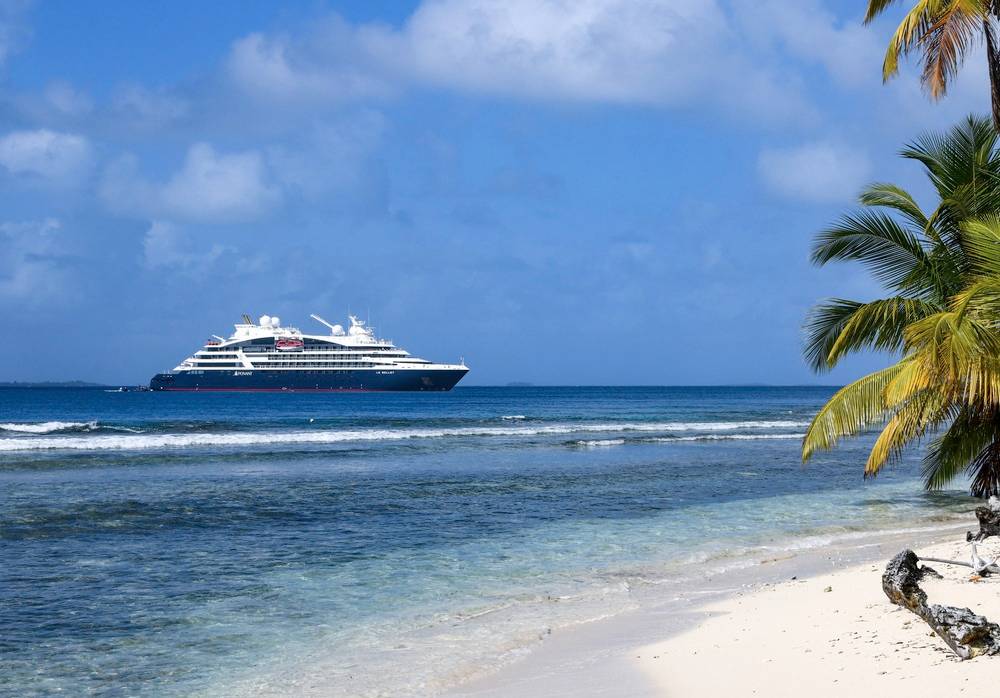
- 184Guests
- 92Cabins
- 2020Launched
- 131 mLength
All ship facts
- Crew
- 118
- Decks
- 5
- Gross tonnage
- 9976
- Speed
- 13 kts
- Width
- 18 m
- Currency on board
- EUR
- Language
- fr+en