

Weddell Sea – In search of the Emperor Penguin, incl. helicopters
CRUISE ID # OCEANWIDEOTL24-26
Ushuaia TO Ushuaia
All itineraries are for guidance only. Programs may vary depending on ice, weather, and wildlife conditions. Landings are subject to site availabilities, permissions, and environmental concerns per IAATO regulations. Official sailing plans and landing slots are scheduled with IAATO prior to the start of the season, but the expedition leader determines the final plan. Flexibility is paramount for expedition cruises. The average cruising speed of our vessel is 10.5 knots. If ice conditions are favorable and the route to Snow Hill Island is free of multi-year pack ice, you have the chance for ship-to-shore helicopter transfers to Snow Hill Island (roughly 45 minutes walking distance from the emperor penguin rookery). If successful, this is a once-in-a-lifetime experience. But please remember that nature writes the final itinerary out here: Attempts to reach Snow Hill Island during the voyages of 2012 – 19 did not always succeed. However, in 2013, 2017 until 2019, 2022 until 2024 conditions were favorable to land by helicopter on Snow Hill Island and to visit the emperor penguin rookery.
Suites & Fares
Itinerary

- Day 1December 05, 2026
Ushuaia
Your voyage begins where the world drops off. Ushuaia, Argentina, reputed to be the southernmost city on the planet, is located on the far southern tip of South America. Starting in the afternoon, you embark from this small resort town on Tierra del Fuego, nicknamed “The End of the World,” and sail the mountain-fringed Beagle Channel for the remainder of the evening. - Day 2December 06, 2026
Sailing to Antarctic Peninsula
Over the next two days on the Drake Passage, you enjoy some of the same experiences encountered by the great polar explorers who first charted these regions: cool salt breezes, rolling seas, maybe even a fin whale spouting up sea spray. After passing the Antarctic Convergence – Antarctica’s natural boundary, formed when north-flowing cold waters collide with warmer sub-Antarctic seas – you are in the circum-Antarctic upwelling zone. Not only does the marine life change, the avian life changes too. Wandering albatrosses, grey-headed albatrosses, black-browed albatrosses, light-mantled sooty albatrosses, cape pigeons, southern fulmars, Wilson’s storm petrels, blue petrels, and Antarctic petrels are a few of the birds you might see. - Day 3December 07, 2026
Sailing to Antarctic Peninsula
Over the next two days on the Drake Passage, you enjoy some of the same experiences encountered by the great polar explorers who first charted these regions: cool salt breezes, rolling seas, maybe even a fin whale spouting up sea spray. After passing the Antarctic Convergence – Antarctica’s natural boundary, formed when north-flowing cold waters collide with warmer sub-Antarctic seas – you are in the circum-Antarctic upwelling zone. Not only does the marine life change, the avian life changes too. Wandering albatrosses, grey-headed albatrosses, black-browed albatrosses, light-mantled sooty albatrosses, cape pigeons, southern fulmars, Wilson’s storm petrels, blue petrels, and Antarctic petrels are a few of the birds you might see. - Day 4December 08, 2026
Sailing along Antarctic Peninsula
Welcome to the southernmost continent on Earth, and one of nature's last true frontiers! Our exact route and activity locations depend heavily on weather and ice conditions, as well as emerging wildlife opportunities. We have two main variations of this itinerary, depending on whether ice conditions allow us to venture into the Weddell Sea and approach Snow Hill Island and the emperor penguin colony.
You may sail into the mighty Weddell Sea via the Antarctic Sound. Here, huge tabular icebergs herald your arrival on the eastern side of the Antarctic Peninsula. During this part of the cruise, you'll search for emperor penguins. If conditions allow, helicopter landings will enable us to reach locations otherwise beyond the ice capabilities of our vessel at this time of year.
We may visit the following locations, landing by ship or Zodiac. These are not exhaustive, and our exact itinerary may change to take advantage of conditions:
The west slopes of the Antarctic Sound – The western side of this area is only rarely seen from the air, though the landscape is truly worth the flight: Layered sandstones, lava flows, glaciers, icebergs, and pack-ice extend as far as the eye can see. There are often individual emperor penguins and Adélie penguins on the ice floes, as well as kelp gulls, skuas, and various breeds of petrel. Jagged mountain peaks stab through the snow, and enormous walls of ice lie shattered on the slopes below.Seymour Island – This is where the Swedish Antarctic Expedition of 1901 – 4 wintered under harrowing polar conditions. Sedimentary rock, fossils, and expansive views define this location.If conditions allow for deeper ventures into the Weddell Sea, Zodiac trips may include:Devil Island – Home to a large colony of Adélie penguins, this island offers a magnificent vantage point for hikers willing to foot it to the top of the hill. Melting ice sometimes forms a waterfall dropping from the cliffs close to Cape Well-met.Brown Bluff – Maybe the most scenic location in the entire northern tip of the Antarctic Continent: sheer canyon walls, fallen boulders, beautiful volcanic creations capped with ice. A large Adélie penguin rookery lives here, with gentoo penguins and nesting snow petrels also to be found.Gourdin Island – Chinstrap, gentoo, and Adélie penguins love this island, which is yet another landing option for your continuing Antarctic adventure. - Day 5December 09, 2026
Sailing along Antarctic Peninsula
Helicopters provide an advantage in reaching the emperor penguin colony, but our ability to use them depends entirely on ice, sea, and weather conditions.
If conditions are favorable, we will visit the colony. If conditions are exceptionally favorable, we will attempt to visit more than once. Helicopter operations take a full day, and flight duration depends on local conditions.
Each helicopter can accommodate 4 – 5 passengers per flight. The landing site is carefully chosen so that the penguins are not disturbed.
Upon arrival to the site, we will walk to the colony. This may take up to 45 minutes and can be challenging in places. Please keep in mind that you are in the world’s most remote region, so there are no guarantees: conditions may change rapidly, which can impact on helicopter operations. It is important to understand and respect this fact. Safety is our greatest concern, so no compromises can be made.
We aim for all groups to spend an equal amount of time at the colony. The time at the colony (and the time to get there from landing site) will often vary, however, due to local conditions and flight times.
- Day 6December 10, 2026
Sailing along Antarctic Peninsula
Helicopters provide an advantage in reaching the emperor penguin colony, but our ability to use them depends entirely on ice, sea, and weather conditions.
If conditions are favorable, we will visit the colony. If conditions are exceptionally favorable, we will attempt to visit more than once. Helicopter operations take a full day, and flight duration depends on local conditions.
Each helicopter can accommodate 4 – 5 passengers per flight. The landing site is carefully chosen so that the penguins are not disturbed.
Upon arrival to the site, we will walk to the colony. This may take up to 45 minutes and can be challenging in places. Please keep in mind that you are in the world’s most remote region, so there are no guarantees: conditions may change rapidly, which can impact on helicopter operations. It is important to understand and respect this fact. Safety is our greatest concern, so no compromises can be made.
We aim for all groups to spend an equal amount of time at the colony. The time at the colony (and the time to get there from landing site) will often vary, however, due to local conditions and flight times.
- Day 7December 11, 2026
Sailing along Antarctic Peninsula
Welcome to the southernmost continent on Earth, and one of nature's last true frontiers! Our exact route and activity locations depend heavily on weather and ice conditions, as well as emerging wildlife opportunities. We have two main variations of this itinerary, depending on whether ice conditions allow us to venture into the Weddell Sea and approach Snow Hill Island and the emperor penguin colony.
You may sail into the mighty Weddell Sea via the Antarctic Sound. Here, huge tabular icebergs herald your arrival on the eastern side of the Antarctic Peninsula. During this part of the cruise, you'll search for emperor penguins. If conditions allow, helicopter landings will enable us to reach locations otherwise beyond the ice capabilities of our vessel at this time of year.
We may visit the following locations, landing by ship or Zodiac. These are not exhaustive, and our exact itinerary may change to take advantage of conditions:
The west slopes of the Antarctic Sound – The western side of this area is only rarely seen from the air, though the landscape is truly worth the flight: Layered sandstones, lava flows, glaciers, icebergs, and pack-ice extend as far as the eye can see. There are often individual emperor penguins and Adélie penguins on the ice floes, as well as kelp gulls, skuas, and various breeds of petrel. Jagged mountain peaks stab through the snow, and enormous walls of ice lie shattered on the slopes below.Seymour Island – This is where the Swedish Antarctic Expedition of 1901 – 4 wintered under harrowing polar conditions. Sedimentary rock, fossils, and expansive views define this location.If conditions allow for deeper ventures into the Weddell Sea, Zodiac trips may include:Devil Island – Home to a large colony of Adélie penguins, this island offers a magnificent vantage point for hikers willing to foot it to the top of the hill. Melting ice sometimes forms a waterfall dropping from the cliffs close to Cape Well-met.Brown Bluff – Maybe the most scenic location in the entire northern tip of the Antarctic Continent: sheer canyon walls, fallen boulders, beautiful volcanic creations capped with ice. A large Adélie penguin rookery lives here, with gentoo penguins and nesting snow petrels also to be found.Gourdin Island – Chinstrap, gentoo, and Adélie penguins love this island, which is yet another landing option for your continuing Antarctic adventure. - Day 8December 12, 2026
Sailing along Antarctic Peninsula
In the morning, you sail to Deception Island for the last landing of the voyage, either at Pendulum Cove or Whalers Bay. Conditions on the Drake Passage determine the exact time of departure. - Day 9December 13, 2026
Sailing to Ushuaia
Your return voyage is far from lonely. While crossing the Drake, you’re again greeted by the vast array of seabirds remembered from the passage south. But they seem a little more familiar to you now, and you to them. - Day 10December 14, 2026
Sailing to Ushuaia
Your return voyage is far from lonely. While crossing the Drake, you’re again greeted by the vast array of seabirds remembered from the passage south. But they seem a little more familiar to you now, and you to them. - Day 11December 15, 2026
Ushuaia
Every adventure, no matter how grand, must eventually come to an end. It’s now time to disembark in Ushuaia, but with memories that will accompany you wherever your next adventure lies.
About the Ship
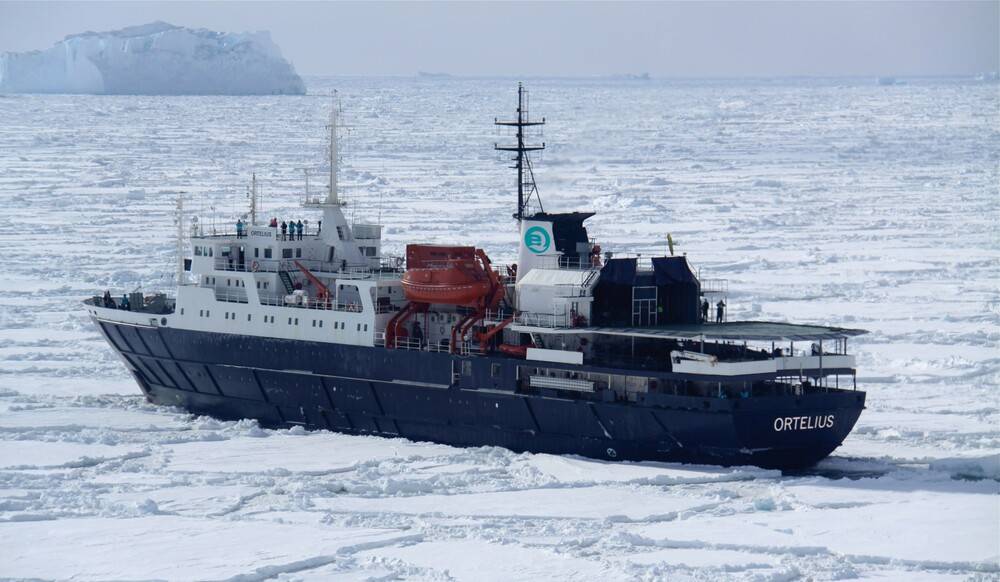
m/v Ortelius

- 108Guests
- 50Cabins
- 1989Launched
- 91 mLength
All ship facts
- Crew
- 53
- Decks
- 3
- Gross tonnage
- 4090
- Speed
- 11 kts
- Width
- 17 m
- Currency on board
- EUR
- Language
- en