

Basecamp - Weddell Sea
CRUISE ID # OCEANWIDEOTL30-28
Ushuaia TO Ushuaia
All itineraries are for guidance only. Programs may vary depending on ice, weather, and wildlife conditions. Landings are subject to site availabilities, permissions, and environmental concerns per IAATO regulations. Official sailing plans and landing slots are scheduled with IAATO prior to the start of the season, but the expedition leader determines the final plan. Flexibility is paramount for expedition cruises. The average cruising speed of our vessel is 10.5 knots.
Suites & Fares
Itinerary
- Day 1February 15, 2028
Ushuaia
Our voyage begins where the world drops off. Ushuaia, Argentina, reputed to be the southernmost city on the planet, is located on the far southern tip of South America. Starting in the afternoon, you embark from this small resort town on Tierra del Fuego, nicknamed “The End of the World,” and sail the mountain-fringed Beagle Channel for the remainder of the evening.
- Day 2February 16, 2028
Sailing towards the Weddell Sea
Over the next two days on the Drake Passage, we enjoy some of the same experiences encountered by the great polar explorers who first charted these regions: cool salt breezes, rolling seas, maybe even a fin whale spouting sea spray. After passing the Antarctic Convergence – Antarctica’s natural boundary, formed when north-flowing cold waters collide with warmer sub-Antarctic seas – you are in the circum-Antarctic upwelling zone. Not only does the marine life change, the avian life changes too. Wandering albatrosses, grey-headed albatrosses, black-browed albatrosses, light-mantled sooty albatrosses, cape petrels, southern fulmars, Wilson’s storm petrels, blue petrels, and Antarctic petrels are a few of the birds you might see.
- Day 3February 17, 2028
Sailing towards the Weddell Sea
Over the next two days on the Drake Passage, we enjoy some of the same experiences encountered by the great polar explorers who first charted these regions: cool salt breezes, rolling seas, maybe even a fin whale spouting sea spray. After passing the Antarctic Convergence – Antarctica’s natural boundary, formed when north-flowing cold waters collide with warmer sub-Antarctic seas – you are in the circum-Antarctic upwelling zone. Not only does the marine life change, the avian life changes too. Wandering albatrosses, grey-headed albatrosses, black-browed albatrosses, light-mantled sooty albatrosses, cape petrels, southern fulmars, Wilson’s storm petrels, blue petrels, and Antarctic petrels are a few of the birds you might see.
- Day 4February 18, 2028
Weddell Sea
The great Weddell Sea features massive tabular icebergs, wildly dramatic landscapes, and fascinating historical sites. It is also one of the best places in Antarctica for viewing iconic wildlife like whales, seals, and rarely seen seabirds.
We may visit the following locations, depending on local conditions:
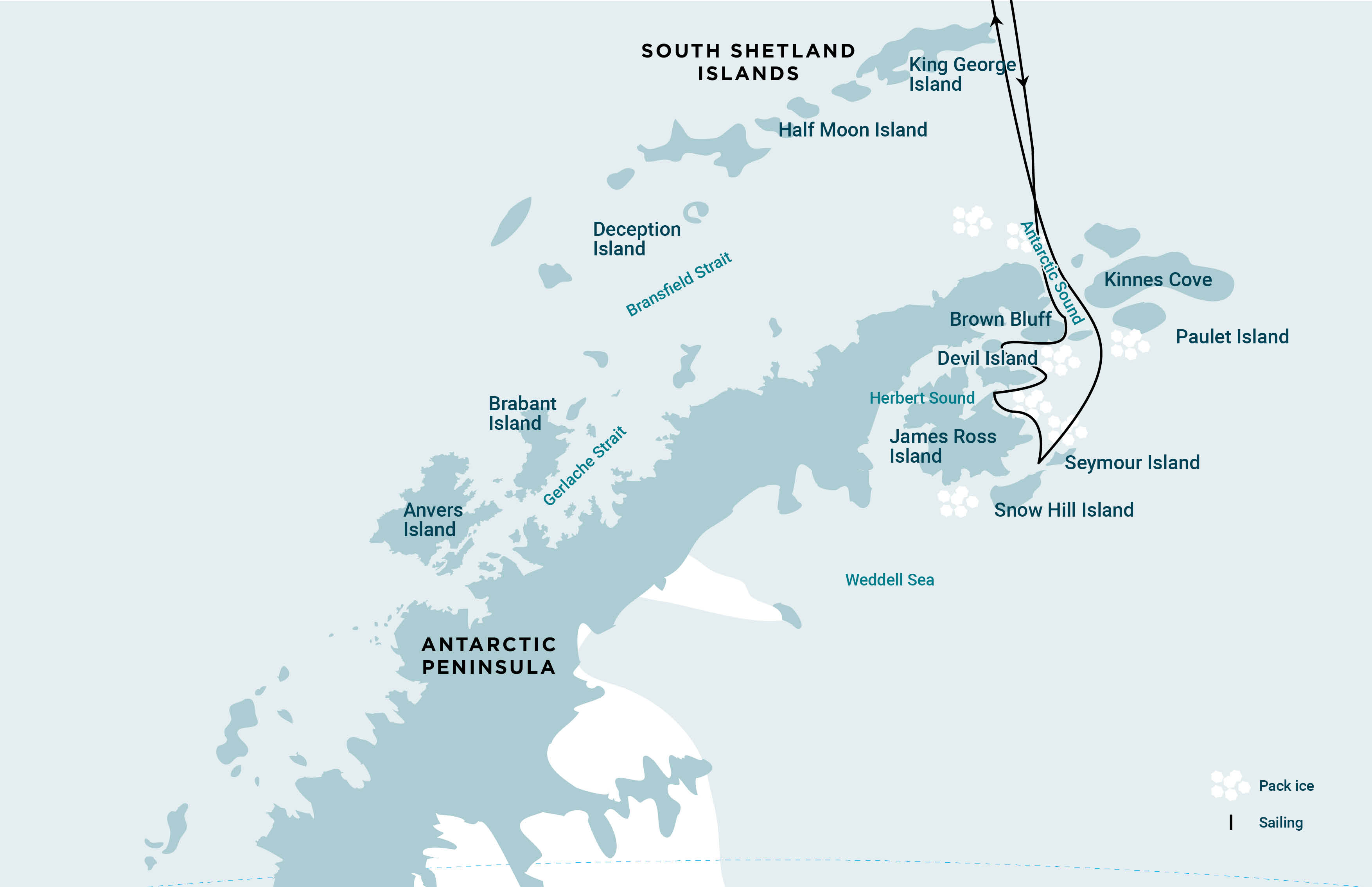
Antarctic Sound - Antarctic Sound is nicknamed “Iceberg Alley,” as we often see enormous tabular icebergs here.
Brown Bluff - Possibly the most scenic location in the northern Antarctic Continent, Brown Bluff is characterized by sheer canyon walls, fallen boulders, and beautiful volcanic creations capped with ice.
Herbert Sound - We will focus our attention on the visually impressive areas of Naze Peninsula and Comb Ridge.
Devil Island - This island offers a magnificent vantage point for hikers willing to foot it to the top of the hill. Melting ice sometimes forms a waterfall dropping from the cliffs close to Cape Well-met.
Erebus and Terror Gulf - Here we look for new activity opportunities and may visit Vega Island, experiencing the wilderness of Antarctica in its most remote places.
- Day 5February 19, 2028
Weddell Sea
The great Weddell Sea features massive tabular icebergs, wildly dramatic landscapes, and fascinating historical sites. It is also one of the best places in Antarctica for viewing iconic wildlife like whales, seals, and rarely seen seabirds.
We may visit the following locations, depending on local conditions:
Antarctic Sound - Antarctic Sound is nicknamed “Iceberg Alley,” as we often see enormous tabular icebergs here.
Brown Bluff - Possibly the most scenic location in the northern Antarctic Continent, Brown Bluff is characterized by sheer canyon walls, fallen boulders, and beautiful volcanic creations capped with ice.
Herbert Sound - We will focus our attention on the visually impressive areas of Naze Peninsula and Comb Ridge.
Devil Island - This island offers a magnificent vantage point for hikers willing to foot it to the top of the hill. Melting ice sometimes forms a waterfall dropping from the cliffs close to Cape Well-met.
Erebus and Terror Gulf - Here we look for new activity opportunities and may visit Vega Island, experiencing the wilderness of Antarctica in its most remote places.
- Day 6February 20, 2028
Weddell Sea
The great Weddell Sea features massive tabular icebergs, wildly dramatic landscapes, and fascinating historical sites. It is also one of the best places in Antarctica for viewing iconic wildlife like whales, seals, and rarely seen seabirds.
We may visit the following locations, depending on local conditions:
Antarctic Sound - Antarctic Sound is nicknamed “Iceberg Alley,” as we often see enormous tabular icebergs here.
Brown Bluff - Possibly the most scenic location in the northern Antarctic Continent, Brown Bluff is characterized by sheer canyon walls, fallen boulders, and beautiful volcanic creations capped with ice.
Herbert Sound - We will focus our attention on the visually impressive areas of Naze Peninsula and Comb Ridge.
Devil Island - This island offers a magnificent vantage point for hikers willing to foot it to the top of the hill. Melting ice sometimes forms a waterfall dropping from the cliffs close to Cape Well-met.
Erebus and Terror Gulf - Here we look for new activity opportunities and may visit Vega Island, experiencing the wilderness of Antarctica in its most remote places.
- Day 7February 21, 2028
Weddell Sea
The great Weddell Sea features massive tabular icebergs, wildly dramatic landscapes, and fascinating historical sites. It is also one of the best places in Antarctica for viewing iconic wildlife like whales, seals, and rarely seen seabirds.
We may visit the following locations, depending on local conditions:
Antarctic Sound - Antarctic Sound is nicknamed “Iceberg Alley,” as we often see enormous tabular icebergs here.
Brown Bluff - Possibly the most scenic location in the northern Antarctic Continent, Brown Bluff is characterized by sheer canyon walls, fallen boulders, and beautiful volcanic creations capped with ice.
Herbert Sound - We will focus our attention on the visually impressive areas of Naze Peninsula and Comb Ridge.
Devil Island - This island offers a magnificent vantage point for hikers willing to foot it to the top of the hill. Melting ice sometimes forms a waterfall dropping from the cliffs close to Cape Well-met.
Erebus and Terror Gulf - Here we look for new activity opportunities and may visit Vega Island, experiencing the wilderness of Antarctica in its most remote places.
- Day 8February 22, 2028
Weddell Sea
The great Weddell Sea features massive tabular icebergs, wildly dramatic landscapes, and fascinating historical sites. It is also one of the best places in Antarctica for viewing iconic wildlife like whales, seals, and rarely seen seabirds.
We may visit the following locations, depending on local conditions:
Antarctic Sound - Antarctic Sound is nicknamed “Iceberg Alley,” as we often see enormous tabular icebergs here.
Brown Bluff - Possibly the most scenic location in the northern Antarctic Continent, Brown Bluff is characterized by sheer canyon walls, fallen boulders, and beautiful volcanic creations capped with ice.
Herbert Sound - We will focus our attention on the visually impressive areas of Naze Peninsula and Comb Ridge.
Devil Island - This island offers a magnificent vantage point for hikers willing to foot it to the top of the hill. Melting ice sometimes forms a waterfall dropping from the cliffs close to Cape Well-met.
Erebus and Terror Gulf - Here we look for new activity opportunities and may visit Vega Island, experiencing the wilderness of Antarctica in its most remote places.
- Day 9February 23, 2028
Weddell Sea
The great Weddell Sea features massive tabular icebergs, wildly dramatic landscapes, and fascinating historical sites. It is also one of the best places in Antarctica for viewing iconic wildlife like whales, seals, and rarely seen seabirds.
We may visit the following locations, depending on local conditions:
Antarctic Sound - Antarctic Sound is nicknamed “Iceberg Alley,” as we often see enormous tabular icebergs here.
Brown Bluff - Possibly the most scenic location in the northern Antarctic Continent, Brown Bluff is characterized by sheer canyon walls, fallen boulders, and beautiful volcanic creations capped with ice.
Herbert Sound - We will focus our attention on the visually impressive areas of Naze Peninsula and Comb Ridge.
Devil Island - This island offers a magnificent vantage point for hikers willing to foot it to the top of the hill. Melting ice sometimes forms a waterfall dropping from the cliffs close to Cape Well-met.
Erebus and Terror Gulf - Here we look for new activity opportunities and may visit Vega Island, experiencing the wilderness of Antarctica in its most remote places.
- Day 10February 24, 2028
Weddell Sea
The great Weddell Sea features massive tabular icebergs, wildly dramatic landscapes, and fascinating historical sites. It is also one of the best places in Antarctica for viewing iconic wildlife like whales, seals, and rarely seen seabirds.
We may visit the following locations, depending on local conditions:
Antarctic Sound - Antarctic Sound is nicknamed “Iceberg Alley,” as we often see enormous tabular icebergs here.
Brown Bluff - Possibly the most scenic location in the northern Antarctic Continent, Brown Bluff is characterized by sheer canyon walls, fallen boulders, and beautiful volcanic creations capped with ice.
Herbert Sound - We will focus our attention on the visually impressive areas of Naze Peninsula and Comb Ridge.
Devil Island - This island offers a magnificent vantage point for hikers willing to foot it to the top of the hill. Melting ice sometimes forms a waterfall dropping from the cliffs close to Cape Well-met.
Erebus and Terror Gulf - Here we look for new activity opportunities and may visit Vega Island, experiencing the wilderness of Antarctica in its most remote places.
- Day 11February 25, 2028
Sailing to Ushuaia
Our return voyage is far from lonely. While crossing the Drake, we’re again greeted by the vast array of seabirds remembered from the passage south. But they seem a little more familiar to us now, and us to them.
- Day 12February 26, 2028
Sailing to Ushuaia
Our return voyage is far from lonely. While crossing the Drake, we’re again greeted by the vast array of seabirds remembered from the passage south. But they seem a little more familiar to us now, and us to them.
- Day 13February 27, 2028
Ushuaia
Even great adventures must eventually come to an end. It’s now time to disembark in Ushuaia with memories that will accompany you wherever your next journey lies.
About the Ship
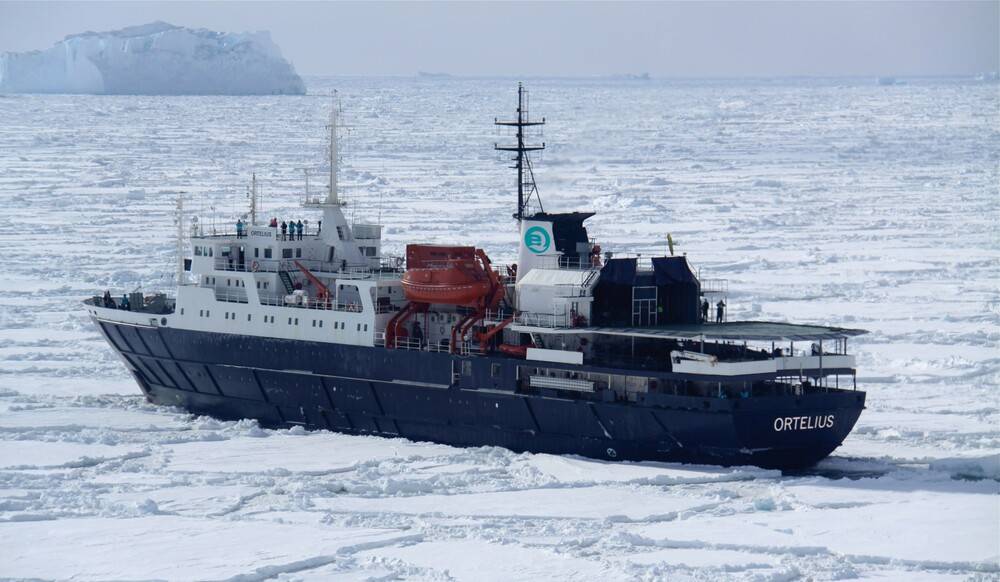
m/v Ortelius

- 108Guests
- 50Cabins
- 1989Launched
- 91 mLength
All ship facts
- Crew
- 53
- Decks
- 3
- Gross tonnage
- 4090
- Speed
- 11 kts
- Width
- 17 m
- Currency on board
- EUR
- Language
- en