

Alaska's Inside Passage
CRUISE ID # LINDBLADVEALAS-270509
Juneau, Alaska TO Sitka, Alaska
Suites & Fares
Itinerary
- Day 1May 09, 2027
Juneau, Alaska, United States
Juneau, Alaska's capital and third-largest city, is on the North American mainland but can't be reached by road. Bounded by steep mountains and water, the city’s geographic isolation and compact size make it much more akin to an island community such as Sitka than to other Alaskan urban centers, such as Fairbanks or Anchorage. Juneau is full of contrasts. Its dramatic hillside location and historic downtown buildings provide a frontier feeling, but the city's cosmopolitan nature comes through in fine museums, noteworthy restaurants, and a literate and outdoorsy populace. The finest of the museums, the Alaska State Museum, is scheduled to reopen in May 2016 on its old site as the expanded Alaska State Library, Archives, and Museum (SLAM) following several years of planning and exhibit research. Another new facility, the Walter Soboleff Center, offers visitors a chance to learn about the indigenous cultures of Southeast Alaska–-Tlingit, Haida, and Tsimshian. Other highlights include the Mt. Roberts Tramway, plenty of densely forested wilderness areas, quiet bays for sea kayaking, and even a famous drive-up glacier, Mendenhall Glacier. For goings-on, pick up the Juneau Empire (www.juneauempire.com), which keeps tabs on state politics, business, sports, and local news.
- Day 2May 10, 2027
Endicott Arm, Alaska, United States
Endicott Arm is a long fjord branching off Stephen’s Passage, the major inner passage heading southeast from Juneau. The easternmost tip of Endicott Arm nearly reaches the Canadian border. Like all the fords in this region, it was carved by glaciers during the last Ice Age which ended about 11,000 years ago. One either side of the fjord the steep, nearly vertical walls, rise to a height of about 370 meters or 1,200 feet. Sitka spruce and western hemlock trees manage to cling onto the rock faces, adding to the breath-taking beauty of the landscape.
- Day 3May 11, 2027
Petersburg, Alaska, United States
Petersburg lies on the northern end of Mitkof Island, in the Inside Passage, on the banks of Frederick Sound where it joins the Wrangell Narrows. It is halfway between Juneau, 120 mi to the north, and Ketchikan 110 mi to the south. Remnants of fish traps and ancient petroglyphs indicate that this area was used by the Tlingit people as a summer fish camp. For more than 1,000 years In 1897 Peter Buschmann, a Norwegian immigrant, settled here. The place was named Petersburg after him, and was incorporated as a town in 1910. It flourished as a fishing port, and even today, it remains an island community that makes its living from the sea. It is the largest home-based halibut fleet in Alaska, and is ranked the 15th-most lucrative fisheries port in the United States by volume.
- Day 4May 12, 2027
Frederick Sound, Alaska, United States
These waters are prime areas for both orca and humpback whales. With luck, guests may observe their fascinating behavior—breaching, tail-slapping and variations on feeding—as you listen to the play-by-play from your expert naturalists. Explore spectacular bays and inlets, following bear trails and salmon streams. Once ashore, you'll have the opportunity to walk along a quiet forest trail. The still waters are excellent for kayaking, offering another option for up-close exploration.
- Day 5May 13, 2027
Inian Islands, Alaska, United States
The Inian Islands are a collection of half a dozen small, rocky islands located at the Pacific Ocean at the end of the Icy Strait. The islands possess a particularly rich ecosystem, on land as in the sea with Steller sea lions, Tridactyl gulls, cormorants and sea otters calling the Inian Island home which you can explore further with a Zodiac® outing.
- Day 6May 14, 2027
Glacier Bay National Park, Alaska, United States
Located in Southeast Alaska, west of the capital city of Juneau, Glacier Bay is a beautiful National Park full of snow capped mountains, tidewater glaciers and wildlife. Experience wildlife in all its beauty from boat trips for whale watching and hiking through the trails of the Park. It is a protected area full of wonder to be explored.
- Day 7May 15, 2027
Cruising Inside Passage, U.S.A
Today, nature is your guide as you set forth with the flexibility to take advantage of wildlife and weather conditions. You might stop at an isolated beach to take a closer look at tide pools, beachcomb and hike stunning forest trails. Keep an eye out for old bear tracks worn into the soil as you move from forest to meadow. Sightings of bald eagles are common. If conditions permit, you'll have the opportunity to do some kayaking, always watching for marine and terrestrial life.
- Day 8May 16, 2027
Sitka, Alaska, United States
It's hard not to like Sitka, with its eclectic blend of Alaska Native, Russian, and American history and its dramatic and beautiful open-ocean setting. This is one of the best Inside Passage towns to explore on foot, with St. Michael's Cathedral, Sheldon Jackson Museum, Castle Hill, Sitka National Historical Park, and the Alaska Raptor Center topping the must-see list.Sitka was home to the Kiksádi clan of the Tlingit people for centuries prior to the 18th-century arrival of the Russians under the direction of territorial governor Alexander Baranof, who believed the region was ideal for the fur trade. The governor also coveted the Sitka site for its beauty, mild climate, and economic potential; in the island's massive timber forests he saw raw materials for shipbuilding. Its location offered trading routes as far west as Asia and as far south as California and Hawaii. In 1799 Baranof built St. Michael Archangel—a wooden fort and trading post 6 miles north of the present town.Strong disagreements arose shortly after the settlement. The Tlingits attacked the settlers and burned their buildings in 1802. Baranof, however, was away in Kodiak at the time. He returned in 1804 with a formidable force—including shipboard cannons—and attacked the Tlingits at their fort near Indian River, site of the present-day 105-acre Sitka National Historical Park, forcing many of them north to Chichagof Island.By 1821 the Tlingits had reached an accord with the Russians, who were happy to benefit from the tribe's hunting skills. Under Baranof and succeeding managers, the Russian-American Company and the town prospered, becoming known as the Paris of the Pacific. The community built a major shipbuilding and repair facility, sawmills, and forges, and even initiated an ice industry, shipping blocks of ice from nearby Swan Lake to the booming San Francisco market. The settlement that was the site of the 1802 conflict is now called Old Sitka. It is a state park and listed as a National Historic Landmark.The town declined after its 1867 transfer from Russia to the United States, but it became prosperous again during World War II, when it served as a base for the U.S. effort to drive the Japanese from the Aleutian Islands. Today its most important industries are fishing, government, and tourism.
About the Ship
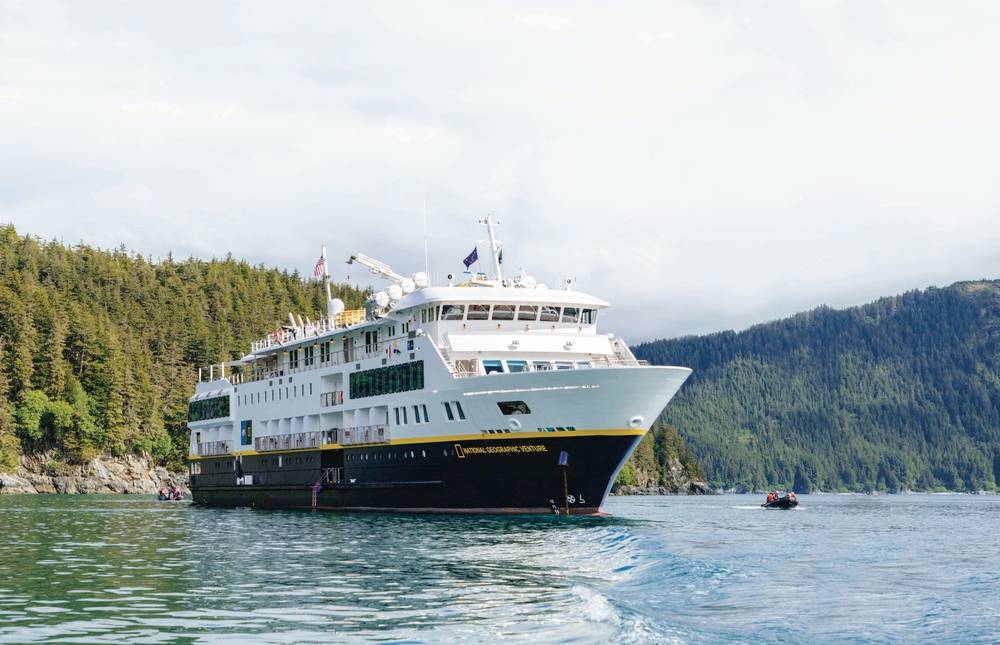
National Geographic Venture

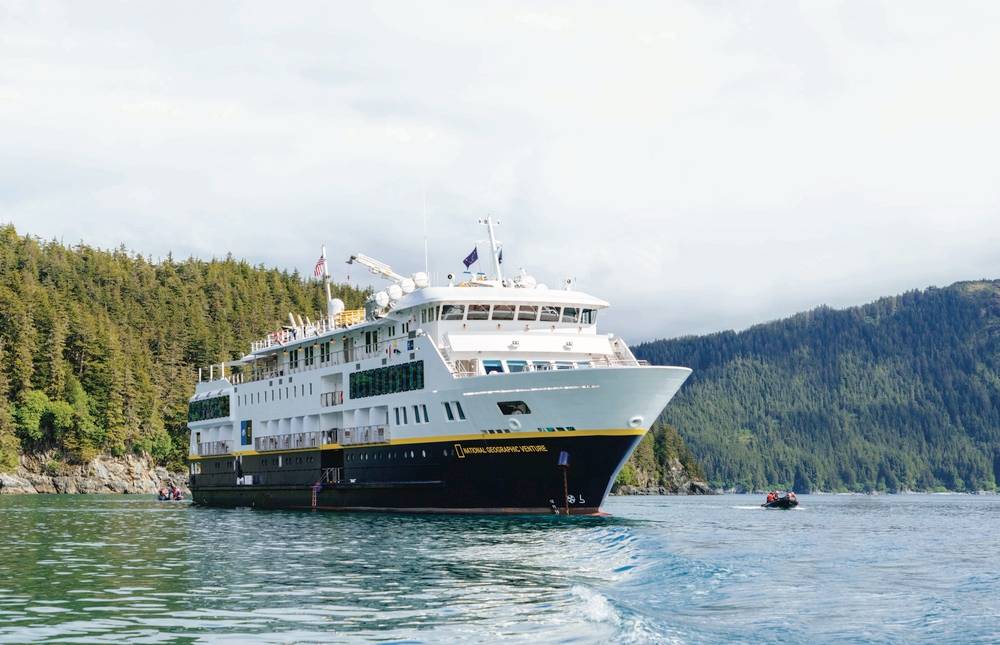
- 100Guests
- 50Cabins
- 2018Launched
- 73 mLength
All ship facts
- Crew
- 52
- Decks
- 4
- Gross tonnage
- 2920
- Speed
- 12 kts
- Width
- 14 m
- Currency on board
- USD
- Language
- en