

Voyage Name Aleutians to Katmai: Wild Alaska Revealed (Southbound)
CRUISE ID # HXRAALA09-280724
Whittier TO Vancouver, British Columbia
17-day all-inclusive Alaska expedition cruise from Anchorage to Vancouver
Venture into the volcanic wilderness of Katmai National Park, home to the world’s highest concentration of protected brown bears.
Sail Alaska’s wild Pacific edge, the volcanic arc of the Aleutian Islands along the Ring of Fire to the rainforests of Southeast Alaska.
Spend two days in Kodiak Island’s communities, exploring the ancestral homeland of the Sugpiaq people and one of Alaska’s richest ecosystems.
Fire and ice
The Aleutian Islands arc westward across the Pacific, one of the most geologically active stretches on Earth. Starting in the dramatic fjords of Prince William Sound and visiting the bear wilderness of Katmai, Dutch Harbor, and remote island shores, this voyage traces Alaska's wild Pacific edge from volcanic tundra to ancient rainforest.
Into the wild
We sail south through mist-draped fjords and along volcanic coastlines before reaching the lush rainforests of Southeast Alaska. The deeper south we go, the greener it becomes… Volcanic peaks and open ocean horizons give way to dense rainforest, sheltered waterways, and communities whose connection to the land runs thousands of years deep, before we reach Vancouver's Pacific shores.
Suites & Fares
Itinerary
- Day 1July 24, 2028
Whittier, United States
The tiny city of Whittier has just over 200 residents. It’s around 58 miles southeast of Anchorage in Alaska.
- Day 2July 25, 2028
Prince William Sound, Alaska, United States
Sailing southwest towards Katmai
Today we enjoy a day at sea as we head southwest along the Alaskan coast toward Katmai National Park.
The mountains of the Kenai Peninsula fall behind us as we round the coast. Join the Expedition Team for lectures and citizen science projects. Keep watch for sea otters, seabirds, and whales moving through these cold northern waters.
- Day 3July 26, 2028
Geographic Harbor, Alaska, United States
Geographic Harbour is the heart of the Katmai National Park and Preserve. The distinctive rocky cliffs are characterised by white marks that are the remains of ash deposits that accumulated following a volcanic eruption. Explore the Geographic Haber and its tall cliffs in more detail as you board a Zodiac® inflatable with a National Geographic Expert.
- Day 4July 27, 2028
Unga Island, Alaska, United States
The Aleutian island of Unga holds an ancient petrified wood forest and a more recent ghost town that was the site of a small gold rush in the late 1800s and early 1900s. The village was eventually abandoned in the 1960’s and now has a somewhat somber appearance. Many of the houses have collapsed and are overgrown with brilliant fuchsia fireweed wildflowers. From a distance the church looks intact, but up closer it is apparent that the roof is standing on the ground, and the walls have completely collapsed. Great Horned Owls nest near the church and in the bay kittiwakes, Double Crested and Pelagic Cormorants, Common Murres and Tufted Puffins can be seen.
- Day 5July 28, 2028
Aleutian Islands, Alaska, United States
- Day 6July 29, 2028
Chagulak Island, Aleutian Islands, Alaska, United States
- Day 7July 30, 2028
Chuginadak Island, Aleutian Islands, Alaska, United States
Chuginadak Island is located in the Islands of Four Mountains of the Aleutian archipelago. The western part of the island is dominated by Mount Cleveland, one of the most active volcanoes in the Aleutian arc. A narrow strip of land separates the volcano from the rugged and lower eastern side of the island.
- Day 8July 31, 2028
Dutch Harbor, Alaska, United States
The crumpled peaks, and tranquil scenery, of Dutch Harbor belies its history as one of the few places on American soil to have been directly attacked by the Japanese - who bombed the significant US military base here during the Second World War. Located on a string of islands, which loops down into the Pacific from Alaska, a visit to this Aleutian Island destination offers comprehensive military history, and extraordinary ocean scenery. Hike the volcanic, gloriously green landscapes, and look out for wonderful wildlife, like bald eagles, as they survey the surroundings. You can also watch on in awe, as incredible marine mammals crash through the waves just offshore.Dutch Harbor, gives you the chance to sample some of the rich local fishing heritage. Why not book yourself onto a voyage aboard a working fishing boat, to see for yourself how richly filled the waters of the Bering Sea are, as the hard-working fishermen pull bountiful supplies of cod and pollock from the water? The fish plucked from the Bering Sea are shipped to dining tables across America, and you’ll quickly see why Dutch Harbor is one of the US's most important fishing locations
- Day 9August 01, 2028
Cruising the Gulf of Alaska
Sailing toward the Gulf of Alaska
Enjoy a day at sea as we leave the volcanic chain of the Aleutian Islands behind and turn east, toward the Gulf of Alaska.
Attend a lecture on Aleutian ecology and geology in the Science Centre, or take time on deck to watch the ocean. These are cold, productive waters. Watch for seabirds tracing the ship’s route and marine mammals, who surface when you least expect them.
- Day 10August 02, 2028
Old Harbor, Kodiak Island, Alaska, United States
The ancestral homeland of the Sugpiaq
Known as the 'Emerald Isle', Kodiak rises from the Gulf of Alaska in a sweep of lush temperate forest and rugged shoreline. This is the ancestral homeland of the Sugpiaq people, whose connection to these islands runs thousands of years deep.
We’ll spend two days here, visiting Kodiak town and a small coastal community to learn about local culture and traditions first-hand. Out on the water, we search for humpback whales, sea otters, and harbour seals. The Kodiak National Wildlife Refuge, covering roughly two-thirds of the island, is home to around 3,500 Kodiak brown bears, a subspecies found nowhere else on Earth.
- Day 11August 03, 2028
Kodiak, Alaska, United States
Today, commercial fishing is king in Kodiak. Despite its small population—about 6,475 people scattered among the several islands in the Kodiak group—the city is among the busiest fishing ports in the United States. The harbor is also an important supply point for small communities on the Aleutian Islands and the Alaska Peninsula.Visitors to the island tend to follow one of two agendas: either immediately fly out to a remote lodge for fishing, kayaking, or bear viewing; or stay in town and access whatever pursuits they can reach from the limited road system. If the former is too pricey an option, consider combining the two: drive the road system to see what can be seen inexpensively, then add a fly-out or charter-boat excursion to a remote lodge or wilderness access point.Floatplane and boat charters are available from Kodiak to many remote attractions, chief among them the Kodiak National Wildlife Refuge , which covers four islands in the Gulf of Alaska: Kodiak, Afognak, Ban, and Uganik.
- Day 12August 04, 2028
Cruising the Gulf of Alaska
Birdwatching and relaxing at sea
Your cruise continues across the Gulf of Alaska. It's the ideal time to enjoy onboard facilities such as the infinity pool, hot tubs, and sauna. Go for a run, hit the gym, or enjoy a massage in the spa.
In the Science Centre, the Expedition Team invite you to join lectures about subjects such as Alaska’s wildlife, geology, glaciology, history and culture.
Relax in the Explorer Lounge & Bar and share a drink with your fellow guests, or just sit back and enjoy the view. See if you can spot all three species of North Pacific albatross. The Laysan and Black-footed Albatross are often sighted, but the Short-tailed Albatross is harder to spot.
- Day 13August 05, 2028
Sitka, Alaska, United States
It's hard not to like Sitka, with its eclectic blend of Alaska Native, Russian, and American history and its dramatic and beautiful open-ocean setting. This is one of the best Inside Passage towns to explore on foot, with St. Michael's Cathedral, Sheldon Jackson Museum, Castle Hill, Sitka National Historical Park, and the Alaska Raptor Center topping the must-see list.Sitka was home to the Kiksádi clan of the Tlingit people for centuries prior to the 18th-century arrival of the Russians under the direction of territorial governor Alexander Baranof, who believed the region was ideal for the fur trade. The governor also coveted the Sitka site for its beauty, mild climate, and economic potential; in the island's massive timber forests he saw raw materials for shipbuilding. Its location offered trading routes as far west as Asia and as far south as California and Hawaii. In 1799 Baranof built St. Michael Archangel—a wooden fort and trading post 6 miles north of the present town.Strong disagreements arose shortly after the settlement. The Tlingits attacked the settlers and burned their buildings in 1802. Baranof, however, was away in Kodiak at the time. He returned in 1804 with a formidable force—including shipboard cannons—and attacked the Tlingits at their fort near Indian River, site of the present-day 105-acre Sitka National Historical Park, forcing many of them north to Chichagof Island.By 1821 the Tlingits had reached an accord with the Russians, who were happy to benefit from the tribe's hunting skills. Under Baranof and succeeding managers, the Russian-American Company and the town prospered, becoming known as the Paris of the Pacific. The community built a major shipbuilding and repair facility, sawmills, and forges, and even initiated an ice industry, shipping blocks of ice from nearby Swan Lake to the booming San Francisco market. The settlement that was the site of the 1802 conflict is now called Old Sitka. It is a state park and listed as a National Historic Landmark.The town declined after its 1867 transfer from Russia to the United States, but it became prosperous again during World War II, when it served as a base for the U.S. effort to drive the Japanese from the Aleutian Islands. Today its most important industries are fishing, government, and tourism.
- Day 14August 06, 2028
Klawock, Alaska, United States
Klawock is a city in Prince of Wales–Hyder Census Area, in the U.S. state of Alaska, on the west coast of Prince of Wales Island, on Klawock Inlet, across from Klawock Island. The population was 755 at the 2010 census, down from 854 in 2000.
- Day 15August 07, 2028
Misty Fjords National Monument, Alaska, United States
Rudyerd Bay is one of the highlights of the Misty Fiords, 40 miles east of Ketchikan, along the Inside Passage. This fjord cuts through steep-sided mountainous terrain and extends far into the mainland. The scenery is stunning, with dramatic thousand-foot waterfalls plunging down rainforest covered cliffs to the water below.
- Day 16August 08, 2028
Queen Charlotte Sound, New Zealand
Marine wildlife along the Pacific coast
The Inside Passage is one of the great coastal routes of the world, with over 900 miles of sheltered Pacific waterway, carved by glaciers and fringed by ancient forest. Today we venture beyond its shelter into the open waters of Queen Charlotte Sound and Hecate Strait, where the island of Haida Gwaii lies to the west.
These are productive seas. Keep watch for humpback and fin whales, orcas, minke whales, and Pacific white-sided dolphins. This is a voyage that rewards those who keep their eyes on the horizon.
- Day 17August 09, 2028
Vancouver, British Columbia, Canada
Vancouver is a delicious juxtaposition of urban sophistication and on-your-doorstep wilderness adventure. The mountains and seascape make the city an outdoor playground for hiking, skiing, kayaking, cycling, and sailing—and so much more—while the cuisine and arts scenes are equally diverse, reflecting the makeup of Vancouver's ethnic (predominantly Asian) mosaic. Vancouver is consistently ranked as one of the world's most livable cities, and it's easy for visitors to see why. It's beautiful, it's outdoorsy, and there's a laidback West Coast vibe. On the one hand, there's easy access to a variety of outdoor activities, a fabulous variety of beaches, and amazing parks. At the same time, the city has a multicultural vitality and cosmopolitan flair. The attraction is as much in the range of food choices—the fresh seafood and local produce are some of North America's best—as it is in the museums, shopping, and nightlife.Vancouver's landscaping also adds to the city's walking appeal. In spring, flowerbeds spill over with tulips and daffodils while sea breezes scatter scented cherry blossoms throughout Downtown; in summer office workers take to the beaches, parks, and urban courtyards for picnic lunches and laptop meetings. More than 8 million visitors each year come to Vancouver, Canada's third-largest metropolitan area. Because of its peninsula location, traffic flow is a contentious issue. Thankfully, Vancouver is wonderfully walkable, especially in the downtown core. The North Shore is a scoot across the harbor, and the rapid-transit system to Richmond and the airport means that staying in the more affordable ’burbs doesn't have to be synonymous with sacrificing convenience. The mild climate, exquisite natural scenery, and relaxed outdoor lifestyle keep attracting residents, and the number of visitors is increasing for the same reasons. People often get their first glimpse of Vancouver when catching an Alaskan cruise, and many return at some point to spend more time here.
About the Ship
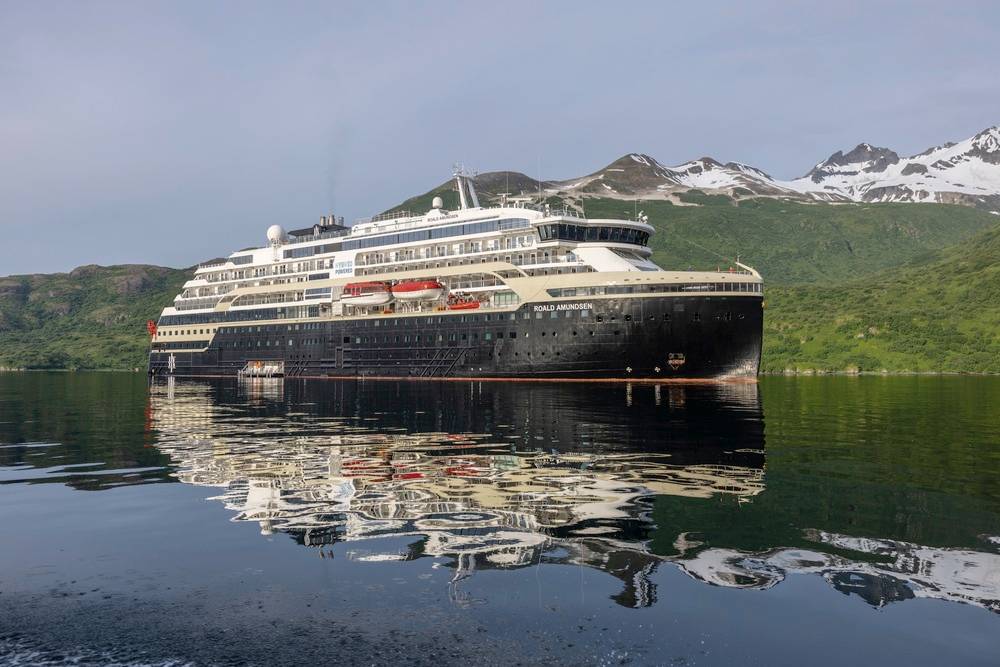
MS Roald Amundsen

- 530Guests
- 265Cabins
- 2019Launched
- 140 mLength
All ship facts
- Crew
- 98
- Decks
- 9
- Gross tonnage
- 20889
- Speed
- 15 kts
- Width
- 23.6 m
- Currency on board
- NOK
- Language
- no+en