

Spitsbergen, Iceland, Faroe Islands –Island Hopping in and around the Arctic (Southbound) with Extended Stay in Longyearbyen
CRUISE ID # HXSPSVA05BD2-280921
Oslo TO Kiel
18-day all-inclusive Svalbard; Iceland; and the Faroe, Orkney, and Shetland Islands expedition cruise from Oslo to Kiel with Extended Stay in Longyearbyen
Begin in Svalbard's blue October twilight, when polar bears roam the shores and the Northern Lights return.
Sail south through Iceland's volcanic coast, the Faroe Islands' clifftop villages, and Shetland's Norse heritage.
Spot whales, seabirds, and Arctic wildlife across four countries and five wild island archipelagos.
Svalbard in autumn
This voyage begins where few expeditions dare to go this late in the season. In October, Svalbard takes on a different character: the Midnight Sun is gone, replaced by dramatic twilight, returning darkness, and the first shimmer of Northern Lights. Polar bears grow more active as sea ice reforms, walruses haul out on rocky shores, and there are more whales in these waters than earlier in the year. It's moody, atmospheric, and utterly unforgettable.
Island-hopping south
From Spitsbergen, we sail south through some of the North Atlantic's most captivating islands. Experience Iceland's volcanic terrain and look out for humpback and minke whales, white-beaked dolphins, and harbour porpoises. In the Faroe Islands, visit Tórshavn, one of Europe's oldest capitals, and the tiny village of Elduvík with its traditional turf-roofed houses. Then on to Shetland, where Norse heritage and delicate lace-making traditions endure, before a final transit through the Kiel Canal to journey's end.
Life in Longyearbyen
This voyage includes two additional days in Longyearbyen, with a curated programme designed to immerse you in life in the world's northernmost permanent settlement and prepare you for the adventure ahead.
Suites & Fares
Itinerary
- Day 1September 18, 2028
Pre-Cruise Night
- Day 2September 19, 2028
Pre-Cruise Night
- Day 3September 20, 2028
Pre-Cruise Night
- Day 4September 21, 2028
Oslo, Norway
Oslo is the capital of Norway and is also its largest city, situated at the head of Oslo Fjord and surrounded by hills and forests. Home to some 50 museums and full of galleries, cafés, a sculpture park and the Royal Palace, this vibrant city with its handsome 19th-century buildings and wide streets has much to offer. Its history dates back 1,000 years, and includes a rich seafaring heritage that ranges from the Viking era to Thor Heyerdahl’s Kon Tiki expedition. Discover more about this exciting city on our varied selection of excursions.
- Day 5September 22, 2028
Longyearbyen, Svalbard and Jan Mayen
Longyearbyen is the biggest settlement in Svalbard. Seat of the Norwegian administration, it also has the best services and infrastructure in the archipelago. Located deep in the Adventfjord, a sidearm of the Isfjorden (Icefjord), Longyearbyen’s airport can be used all-year round, but its harbor is blocked by ice in winter. Most shops, hotels, restaurants and a hospital are within easy walking distance of the port. One of the most prominent buildings in town is the UNIS center, where several Norwegian universities have joined forces to operate and offer the northernmost higher education to both Norwegian and international students. Adjacent to UNIS, and well worth a visit, is the Svalbard Museum, covering the natural history and exploitation of Svalbard. Remnants of the former mining activity can be seen all around Longyearbyen and even in town.
- Day 6September 23, 2028
Longyearbyen, Svalbard and Jan Mayen
Longyearbyen is the biggest settlement in Svalbard. Seat of the Norwegian administration, it also has the best services and infrastructure in the archipelago. Located deep in the Adventfjord, a sidearm of the Isfjorden (Icefjord), Longyearbyen’s airport can be used all-year round, but its harbor is blocked by ice in winter. Most shops, hotels, restaurants and a hospital are within easy walking distance of the port. One of the most prominent buildings in town is the UNIS center, where several Norwegian universities have joined forces to operate and offer the northernmost higher education to both Norwegian and international students. Adjacent to UNIS, and well worth a visit, is the Svalbard Museum, covering the natural history and exploitation of Svalbard. Remnants of the former mining activity can be seen all around Longyearbyen and even in town.
- Day 7September 24, 2028
Longyearbyen, Svalbard and Jan Mayen
Longyearbyen is the biggest settlement in Svalbard. Seat of the Norwegian administration, it also has the best services and infrastructure in the archipelago. Located deep in the Adventfjord, a sidearm of the Isfjorden (Icefjord), Longyearbyen’s airport can be used all-year round, but its harbor is blocked by ice in winter. Most shops, hotels, restaurants and a hospital are within easy walking distance of the port. One of the most prominent buildings in town is the UNIS center, where several Norwegian universities have joined forces to operate and offer the northernmost higher education to both Norwegian and international students. Adjacent to UNIS, and well worth a visit, is the Svalbard Museum, covering the natural history and exploitation of Svalbard. Remnants of the former mining activity can be seen all around Longyearbyen and even in town.
- Day 8September 25, 2028
Spitsbergen, Svalbard and Jan Mayen
A land of spectacular beauty
Spitsbergen, Svalbard's largest island, is a wilderness of steep mountains, glaciers, and scattered offshore islands.
Over the next few days, we'll explore dramatic fjords where glaciers creak and calve icebergs into the sea, push north towards Northwest Spitsbergen National Park where sea ice may shape our route, and scan for the wildlife that thrives here: polar bears, walruses, Arctic foxes, reindeer, and colonies of seabirds nesting on the cliffs.
Each day will be different. Landings, Zodiac cruises, kayaking, hikes: be ready for anything as your Captain and Expedition Team read the conditions and seize every opportunity the Arctic offers.
- Day 9September 26, 2028
Spitsbergen, Svalbard and Jan Mayen
- Day 10September 27, 2028
Cruising
A day at sea
As we sail south towards Jan Mayen, the open Arctic Ocean stretches around you. Spend time on deck scanning for whales and seabirds, soak in a hot tub as Svalbard fades behind us, or join the Science and Education Programme for insight into one of the world's most isolated islands. After the intensity of Spitsbergen, this is a chance to let everything settle before we reach somewhere even fewer people have seen.
- Day 11September 28, 2028
Jan Mayen Island, Norway
Described as one of the most remote islands in the world, Jan Mayen liesbetween Norway to the east and Greenland to the west. It is a rugged volcanicisland 34 miles long and is made up of two parts – the larger section to thenorth (Beerenbeg Volcano) and the longer but narrower section to the south. Amile-wide isthmus links these two parts. Geologically, the island was formed bya ‘hotspot’ where molten magma pushes up through the earth’s crust to createvolcanoes in the middle of nowhere. Politically, Jan Mayen is an integral partof Norway. The eighteen people living on the island work for either the NorwegianArmed Forces or the Norwegian Meteorological Institute. Their main purpose isto operate the Loran-C radio navigation system. From 1615 to 1638, the Dutchran a whaling station here. Today, the island is a nature reserve underNorwegian jurisdiction aimed at preserving the pristine Arctic island and themarine life, including the ocean floor.
- Day 12September 29, 2028
Cruising
A day at sea
As we sail towards northern Iceland, time is yours to enjoy at your own pace. Swap stories with fellow travellers in the Explorer Lounge, scan for marine life and seabirds from deck, or soak in a hot tub while the ocean does the work. The Expedition Team will be in the Science Centre setting the scene for Iceland: its volcanic landscapes, rich culture, and ancient beliefs.
- Day 13September 30, 2028
Husavik, Iceland
The town of Húsavík sits below Húsavíkurfjall mountain on the eastern shore of Skjálfandi bay. Just above the town is lake Botnsvatn, a popular place for outings. The lake is just the right size for a nice hike around it. The lakes surroundings are rich in vegetation and bird life and trout is said to be abundant, though small. Húsavík harbour lies below the bank right in the heart of town. The harbour once boasted a large fishing fleet, bustling with the activity of fishermen. It still serves as a fishing harbour but today's activity revolves more around the successful whale watching businesses. The first organised whale watching excursions in Iceland started from here in 1995. Since then, whale watching has become a major attraction and Húsavík continues to be the leading destination for whale watching. In addition to the tours, a fascinating whale museum is located right by the harbour. Húsavík is considered to be the oldest settlement in Iceland. The Swedish explorer, Gardar Svavarsson, spent one winter there in 870 AD during which time he built himself a house from which the settlement derives its name.
- Day 14October 01, 2028
Djupavik, Iceland
Local folklore and natural beauty
Today we'll explore Djúpivogur, a quiet village on Iceland's east coast where discovery unfolds at a slower, more intimate pace. From the historic harbour, wander a place where creativity and nature intertwine: the remarkable Stone & Mineral Museum reveals the hidden beauty within Iceland's rocks, while the striking Eggs of Merry Bay sculptures line the waterfront.
Gentle trails lead past cairns, bird-filled lakes, and sweeping coastal views beneath the iconic, pyramid-shaped Búlandstindur mountain. Old fish oil tanks now echo with music and art. Whether walking to secluded black sand beaches or sharing simple local flavours, this is Iceland up close: unhurried, authentic, and deeply connected to its land and people.
- Day 15October 02, 2028
Cruising
Relax at sea
As we leave Iceland behind and sail towards the Faroe Islands, the pace shifts. This is a day for curiosity and comfort in equal measure.
The Expedition Team will be hosting lectures on the Faroes, from their dramatic cliffs, to their Norse roots, and island way of life. Sort through your photographs, stretch out in the panoramic sauna, or do absolutely nothing at all. Tomorrow, a new archipelago awaits.
- Day 16October 03, 2028
Elduvík, Faroe Islands
Surround yourself with the sounds of Faroese nature
Today we stop at Elduvík, a tiny village of just 23 inhabitants set in the Funningsfjørður inlet in the Faroe Islands. Split in two by the river Stórá, this is a place of astonishing quiet.
Despite its size, Elduvík has a school, church, dock, and pier. From the waterfront, look across sparkling waters to the nearby island of Kalsoy. Walk the charming streets and listen for seabirds, bleating sheep, and waves lapping from the fjord. You'll notice many houses still wear traditional grass roofs, offering natural insulation against the Faroese weather.
- Day 17October 04, 2028
Thorshavn, Faroe Islands
More than 600 miles (nearly 1,000 kilometres) from Denmark’s west coast lie the Faroes, a triangle of eighteen windswept islands, seventeen of which are inhabited. Only 48,500 people plus some 70,000 sheep roam these remote lands. Much of the islands’ heritage reflects a medieval past, beginning with the arrival of farmers from western Norway who settled here in the 9th century. Evidence of this Scandinavian heritage is preserved through centuries of isolation; ancient structures can still be seen in villages clustered around old churches. Sheer cliffs and waterfalls carve Streymoy, the largest of the islands, where Torshavn is one of the world’s smallest capitals with about 12,400 inhabitants, plus another 5,000 living in the suburbs of Argir and Hoyvik. Visitors find interesting museums, churches, monuments and all the amenities of a modern town and thriving harbour here. The world’s oldest, still active parliament was founded in the Viking age. Today, it houses the main offices of the local government. Many of the attractions are found outside of Torshavn in the rugged beauty of Streymoy. There are fields with grazing ponies and sheep, tiny hamlets where residents live in half-timbered houses topped by green grass roofs, and dramatic rock formations. Birds by the thousands populate the craggy seaside cliffs, which make an ideal stopover for migratory gannets, guillemots and puffins. The Faroes' climate is generally wet and windy. Because of the Gulf Stream, the temperature is a good deal more moderate than the latitude might imply; it also helps to keep Faroe harbours ice-free year-round.
- Day 18October 05, 2028
Kirkwall, Orkney Islands, Scotland
In bustling Kirkwall, the main town on Orkney, there's plenty to see in the narrow, winding streets extending from the harbor. The cathedral and some museums are highlights.
- Day 19October 06, 2028
Cruising
Time to reflect
This is our final day at sea as we venture closer to Germany. Take this time to enjoy the facilities on board, share memories of the past few weeks with fellow travellers, or chat with the Expedition Team, perhaps you have unanswered questions about where we've been, or want to dive deeper in the Science Centre.
- Day 20October 07, 2028
Kiel, Germany
Known for the Kiel Canal and Kiel Week, the city boasts an important maritime history. Kiel is also a great place to sight-see, do some shopping and take part in one of the many festivals taking place there.
- Day 21October 08, 2028
Kiel, Germany
Known for the Kiel Canal and Kiel Week, the city boasts an important maritime history. Kiel is also a great place to sight-see, do some shopping and take part in one of the many festivals taking place there.
About the Ship
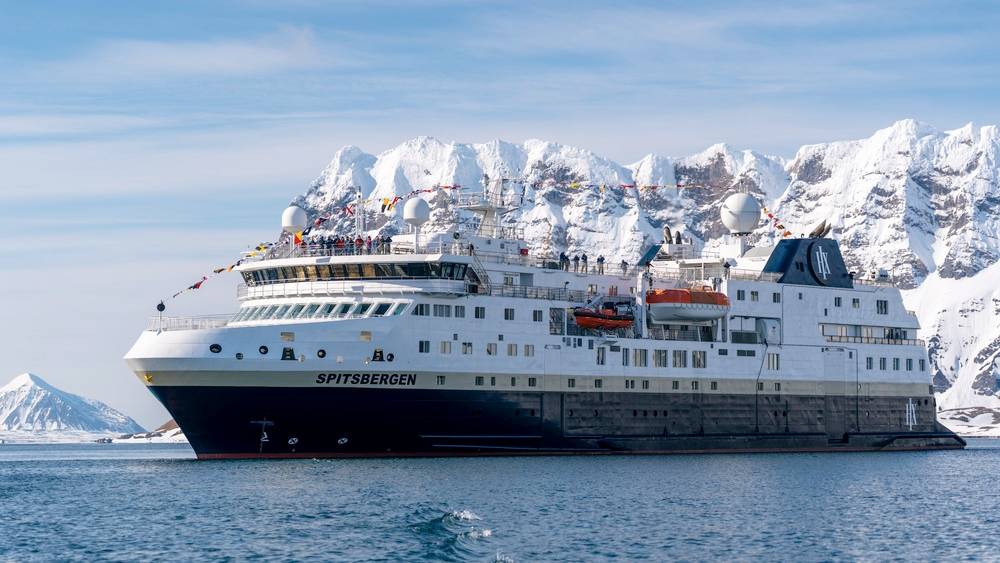
MS Spitsbergen

- 150Guests
- 180Cabins
- 2009Launched
- 100 mLength
All ship facts
- Crew
- 80
- Decks
- 3
- Gross tonnage
- 7344
- Speed
- 14 kts
- Width
- 18 m
- Wheelchair cabins
- 2
- Currency on board
- NOK
- Language
- no+en