

Spitsbergen, Iceland, Faroe Islands – Island Hopping in and around the Arctic (Southbound)
CRUISE ID # HXSPSVA05-270913
Longyearbyen TO Bergen
Southbound
16-day all-inclusive Iceland and Svalbard expedition cruise from Oslo to Bergen
Discover the history and natural wonders of five wild, beautiful islands in and around the Arctic across four countries.
Explore three fascinating archipelagos with stunning and varied landscapes and different cultures.
Enjoy spotting birds of the Arctic. Look out for humpback, minke and even blue whales.
Keep Watch for Wildlife
Fly from Oslo to Longyearbyen, the world’s northernmost town, before joining your expedition cruise to discover Spitsbergen’s landscapes, home to reindeers, Arctic foxes, walruses and elusive polar bears. Then experience Iceland's volcanic terrain and look out for white-beaked dolphins and harbour porpoises, as well as humpback and minke whales.
Culture of the Faroe Islands
Experience life on the Faroe Islands with visits to its capital, Tórshavn, and the tiny village of Elduvík, with its traditional turf-roofed houses designed to protect them from the harsh climate. In the Shetland Islands, learn about Norse heritage and local customs like the making of delicate Shetland lace shawls.
Suites & Fares
Itinerary
- Day 1September 13, 2027
Longyearbyen, Svalbard and Jan Mayen
Longyearbyen is the biggest settlement in Svalbard. Seat of the Norwegian administration, it also has the best services and infrastructure in the archipelago. Located deep in the Adventfjord, a sidearm of the Isfjorden (Icefjord), Longyearbyen’s airport can be used all-year round, but its harbor is blocked by ice in winter. Most shops, hotels, restaurants and a hospital are within easy walking distance of the port. One of the most prominent buildings in town is the UNIS center, where several Norwegian universities have joined forces to operate and offer the northernmost higher education to both Norwegian and international students. Adjacent to UNIS, and well worth a visit, is the Svalbard Museum, covering the natural history and exploitation of Svalbard. Remnants of the former mining activity can be seen all around Longyearbyen and even in town.
- Day 2September 14, 2027
Longyearbyen, Svalbard and Jan Mayen
Longyearbyen is the biggest settlement in Svalbard. Seat of the Norwegian administration, it also has the best services and infrastructure in the archipelago. Located deep in the Adventfjord, a sidearm of the Isfjorden (Icefjord), Longyearbyen’s airport can be used all-year round, but its harbor is blocked by ice in winter. Most shops, hotels, restaurants and a hospital are within easy walking distance of the port. One of the most prominent buildings in town is the UNIS center, where several Norwegian universities have joined forces to operate and offer the northernmost higher education to both Norwegian and international students. Adjacent to UNIS, and well worth a visit, is the Svalbard Museum, covering the natural history and exploitation of Svalbard. Remnants of the former mining activity can be seen all around Longyearbyen and even in town.
- Day 3September 15, 2027
Hornsund, Svalbard and Jan Mayen
A land of spectacular beauty
Svalbard’s largest island Spitsbergen showcases Arctic beauty in its untouched glory; a wilderness of steep mountains, glaciers, and islands.
Over the next four days, you'll explore some of the world's most dramatic fjords, listening for the creaks of glaciers as they calve icebergs into the sea.
Delight in the rare chance to seek the region’s apex predator, the magnificent polar bear, in its natural environment following the sea-ice edge hunting for seals.
We’ll take advantage of every opportunity to land, taking expedition boats ashore for hiking and other activities. If we can, we’ll launch our kayaks to enjoy the scenery in near-perfect silence.
- Day 3September 15, 2027
Ny-Ålesund, Svalbard and Jan Mayen
A land of spectacular beauty
Svalbard’s largest island Spitsbergen showcases Arctic beauty in its untouched glory; a wilderness of steep mountains, glaciers, and islands.
Over the next four days, you'll explore some of the world's most dramatic fjords, listening for the creaks of glaciers as they calve icebergs into the sea.
Delight in the rare chance to seek the region’s apex predator, the magnificent polar bear, in its natural environment following the sea-ice edge hunting for seals.
We’ll take advantage of every opportunity to land, taking expedition boats ashore for hiking and other activities. If we can, we’ll launch our kayaks to enjoy the scenery in near-perfect silence.
- Day 4September 16, 2027
Hornsund, Svalbard and Jan Mayen
- Day 5September 17, 2027
Hornsund, Svalbard and Jan Mayen
- Day 6September 18, 2027
Cruising
Enjoy a relaxing day as we cruise towards Jan Mayen
As we head towards the island of Jan Mayen, enjoy a day at sea.
There's plenty to do on board. Why not scan the seas for marine wildlife from the deck, enjoy the panoramic sauna or a soak in a hot tub. Visit the Science Centre for insights into the destinations ahead on your island-hopping expedition.
Enjoy a fascinating lecture from the Expedition Team or help collect important data to contribute to Citizen Science projects. Photography enthusiasts can pick up some pointers on how to capture wildlife and landscapes from our onboard photographer. You'll find the comfort of the Explorer Lounge & Bar a great place to read, chat with other guests, or just watch the world glide by.
- Day 7September 19, 2027
Jan Mayen Island, Norway
Described as one of the most remote islands in the world, Jan Mayen liesbetween Norway to the east and Greenland to the west. It is a rugged volcanicisland 34 miles long and is made up of two parts – the larger section to thenorth (Beerenbeg Volcano) and the longer but narrower section to the south. Amile-wide isthmus links these two parts. Geologically, the island was formed bya ‘hotspot’ where molten magma pushes up through the earth’s crust to createvolcanoes in the middle of nowhere. Politically, Jan Mayen is an integral partof Norway. The eighteen people living on the island work for either the NorwegianArmed Forces or the Norwegian Meteorological Institute. Their main purpose isto operate the Loran-C radio navigation system. From 1615 to 1638, the Dutchran a whaling station here. Today, the island is a nature reserve underNorwegian jurisdiction aimed at preserving the pristine Arctic island and themarine life, including the ocean floor.
- Day 8September 20, 2027
Cruising
Enjoy a relaxing day as we cruise towards Iceland
As we sail from Jan Mayen to Akureyri, you'll have time to sit back and swap stories of your adventures so far. Keep your eyes peeled while on deck for some wonderful marine life and seabirds – you can even relax in a hot tub while doing so!
Join the Expedition Team in the Science Center as they set the scene for the next leg of your expedition. Learn about Iceland’s stunning landscapes, cultures, and beliefs.
- Day 9September 21, 2027
Akureyri, Iceland
Akureyri, called the Capital of the North is the second largest urban area in Iceland, and a lively one at that. Hemmed by the 60-km (37-mile) long Eyjafjörður, Akureyri is sheltered from the ocean winds and embraced by mountains on three sides. Late 19th-century wooden houses impart a sense of history, and the twin spires of a modern Lutheran church rising on a green hill near the waterfront, provide a focal point. To the south of Akureyri is the pyramid-shape rhyolite mountain Súlur. Beyond it is Kerling, the highest peak in Eyjafjörður District.
- Day 10September 22, 2027
Husavik, Iceland
The town of Húsavík sits below Húsavíkurfjall mountain on the eastern shore of Skjálfandi bay. Just above the town is lake Botnsvatn, a popular place for outings. The lake is just the right size for a nice hike around it. The lakes surroundings are rich in vegetation and bird life and trout is said to be abundant, though small. Húsavík harbour lies below the bank right in the heart of town. The harbour once boasted a large fishing fleet, bustling with the activity of fishermen. It still serves as a fishing harbour but today's activity revolves more around the successful whale watching businesses. The first organised whale watching excursions in Iceland started from here in 1995. Since then, whale watching has become a major attraction and Húsavík continues to be the leading destination for whale watching. In addition to the tours, a fascinating whale museum is located right by the harbour. Húsavík is considered to be the oldest settlement in Iceland. The Swedish explorer, Gardar Svavarsson, spent one winter there in 870 AD during which time he built himself a house from which the settlement derives its name.
- Day 11September 23, 2027
Bakkagerði, Iceland
Local folklore and natural beauty
Your Iceland cruise continues to Bakkagerði, a tiny, remote settlement. According to folklore, Bakkagerði is inhabited by a large population of local land spirits or elves, known as huldufólk, meaning 'hidden people'. Walk around town to explore this magical place.
The area around Bakkagerði is a popular hiking area. You can join the Expedition Team to walk through lush, green valleys and gorgeous scenery among colourful rhyolite rocks.
Or tour a local brewery and visit KHB Brugghús, the only distillery in Iceland that produces Landi, the true Icelandic Moonshine.
- Day 12September 24, 2027
Cruising
Learn about the Faroe Islands and relax on board
Today we sail from Iceland towards the Faroe Islands. Take this opportunity to enjoy all the comforts your expedition ship has to offer and get ready for the days ahead.
You may have unanswered questions about things you've seen in Iceland, or things to come in the Faroe Islands. As ever, your Expedition Team will be on hand hosting lectures and offering insights about these remarkable islands.
The Science Center will keep enquiring minds busy. Work out in the gym or relax in the panoramic sauna, where you can watch the views as you sail. Look out for birds and wildlife from the decks, or just take the time to sort through all those photos you’ve been taking.
- Day 13September 25, 2027
Elduvík, Faroe Islands
Surround yourself with the sounds of Faroese nature
Today we’ll stop to explore the tiny village of Elduvík, with just 23 inhabitants. Set in the Funningsfjørður inlet in the Faroe Islands. Elduvík is split in two by the river Stórá.
While small, it comes complete with a school, church, dock and pier. From the pier, enjoy the view across the sparkling waters to the nearby island of Kalsoy – it’s astonishingly peaceful here.
As you walk through the village's charming streets, listen for the songs of seabirds, bleating sheep, and waves coming to shore from the fjord. You'll notice that the roofs of many houses are built in the traditional Icelandic style: covered in grass instead of slate, offering much-needed insulation and protection against the weather.
- Day 14September 26, 2027
Thorshavn, Faroe Islands
More than 600 miles (nearly 1,000 kilometres) from Denmark’s west coast lie the Faroes, a triangle of eighteen windswept islands, seventeen of which are inhabited. Only 48,500 people plus some 70,000 sheep roam these remote lands. Much of the islands’ heritage reflects a medieval past, beginning with the arrival of farmers from western Norway who settled here in the 9th century. Evidence of this Scandinavian heritage is preserved through centuries of isolation; ancient structures can still be seen in villages clustered around old churches. Sheer cliffs and waterfalls carve Streymoy, the largest of the islands, where Torshavn is one of the world’s smallest capitals with about 12,400 inhabitants, plus another 5,000 living in the suburbs of Argir and Hoyvik. Visitors find interesting museums, churches, monuments and all the amenities of a modern town and thriving harbour here. The world’s oldest, still active parliament was founded in the Viking age. Today, it houses the main offices of the local government. Many of the attractions are found outside of Torshavn in the rugged beauty of Streymoy. There are fields with grazing ponies and sheep, tiny hamlets where residents live in half-timbered houses topped by green grass roofs, and dramatic rock formations. Birds by the thousands populate the craggy seaside cliffs, which make an ideal stopover for migratory gannets, guillemots and puffins. The Faroes' climate is generally wet and windy. Because of the Gulf Stream, the temperature is a good deal more moderate than the latitude might imply; it also helps to keep Faroe harbours ice-free year-round.
- Day 15September 27, 2027
Lerwick, Shetland Islands, Scotland
Founded by Dutch fishermen in the 17th century, Lerwick today is a busy town and administrative center. Handsome stone buildings—known as lodberries—line the harbor; they provided loading bays for goods, some of them illegal. The town's twisting flagstone lanes and harbor once heaved with activity, and Lerwick is still an active port today. This is also where most visitors to Shetland dock, spilling out of cruise ships, allowing passengers to walk around the town.
- Day 16September 28, 2027
Bergen, Norway
Surrounded by mountains and sparkling fjords, the waterside city of Bergen has a spectacular setting. There has been a settlement here since medieval times and the colourful waterfront buildings of the Hanseatic wharf, known as Bryggen, are testament to its fascinating history of trade. As Norway’s best known medieval settlement, the Bryggen is listed by UNESCO as a World Heritage Site. Our comprehensive selection of excursions allows you to discover the many sides of Bergen, such as the fish market and narrow cobbled streets, as well as stunning views of the city from the summit of Mt Fløyen. Alternatively, those who have visited the city previously may like to experience one of the tours that travel further afield. Just 300 yards from the main piers, you will find the Fortress Museum (Fesningsmuseum), which has an interesting collection of objects related to World War II.
About the Ship
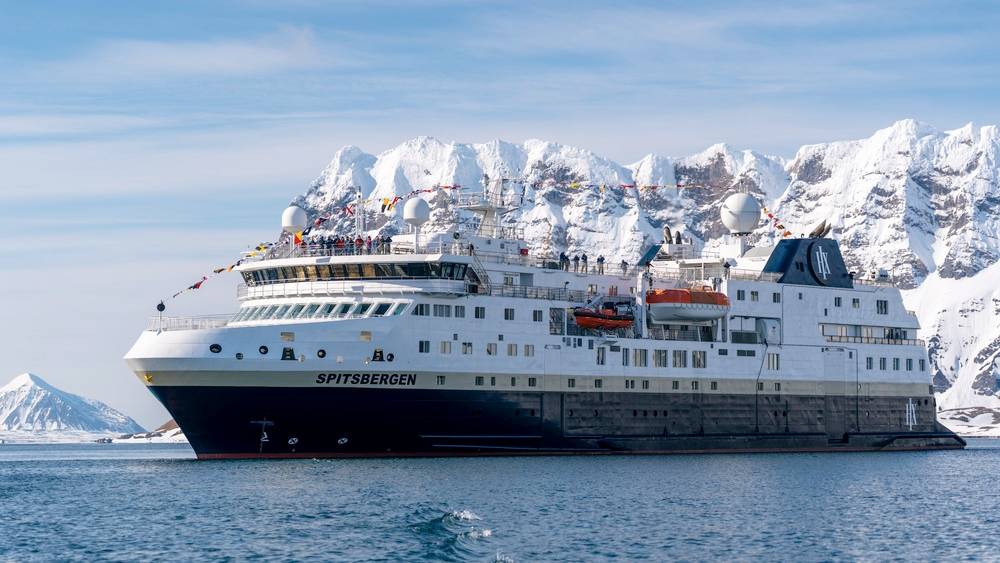
MS Spitsbergen

- 150Guests
- 180Cabins
- 2009Launched
- 100 mLength
All ship facts
- Crew
- 80
- Decks
- 3
- Gross tonnage
- 7344
- Speed
- 14 kts
- Width
- 18 m
- Wheelchair cabins
- 2
- Currency on board
- NOK
- Language
- no+en