

Northwest Passage – Across the Top of the World (Alaska to Greenland) (2027)
CRUISE ID # HXRANWP02-270808
Seattle, Washington TO Nuuk (Godthaab)
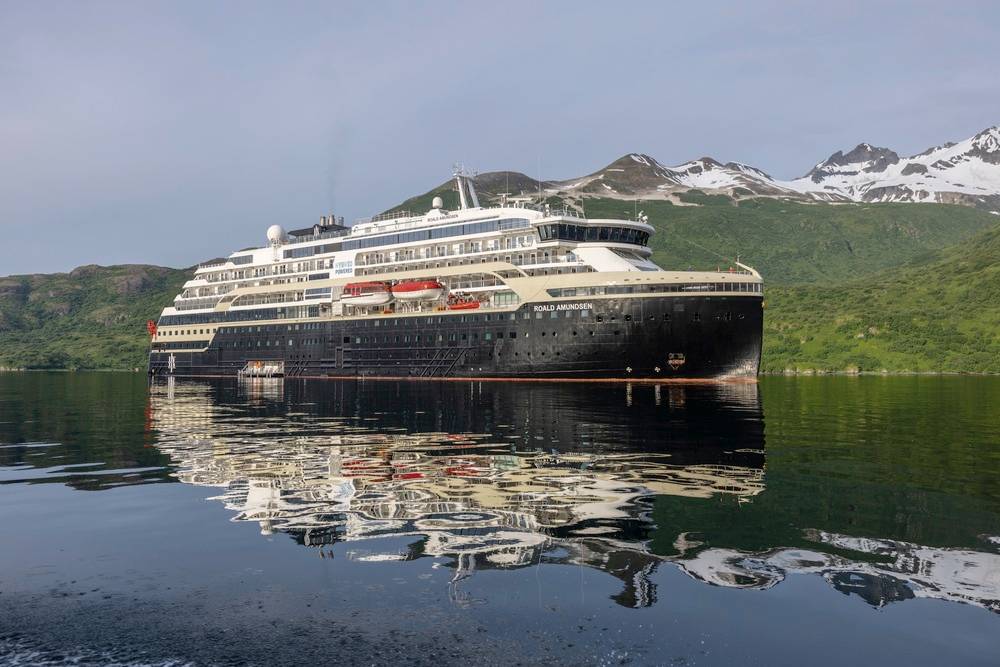
25-day all-inclusive Northwest Passage expedition cruise from Seattle to New York
Witness incredible beauty and experience the thrill of exploration as we sail through the fabled Northwest Passage from Nome in Alaska to Nuuk, Greenland.
Your dedicated Expedition Team will bring you to discover UNESCO-listed sites, spectacular scenery, wildlife habitats, and Inuit settlements.
Gain meaningful, personal insights into Inuit culture and heritage from our onboard Cultural Ambassadors.
Sail down the west coast of Greenland with its stunning coastal panoramas and pretty settlements of coloured houses.
This voyage ends in New York (planned airport) with a flight from Nuuk. An option to fly from Copenhagen or Reykjavik is also available.
Sail along the top of the world through the Northwest Passage
Sailing through the Northwest Passage on a state-of-the-art ice-class expedition ship is a captivating journey that blends natural wonders, culture, and history. The passage, once an elusive route for explorers, now offers intrepid travellers a chance to witness breathtaking Arctic landscapes and learn about indigenous communities through first-hand experiences and insights from Cultural Ambassadors on board. On this adventure, we’ll attempt to traverse the entire route and beyond, going from Nome in Alaska to Nuuk, Greenland.
Breathtaking beauty of the High Arctic and Greenland
Our 26-day voyage takes us ‘above’ the North American continent to the frozen far north. As we head up from Alaska through the famed Beaufort Sea and Bering Strait, we pass into the Western Arctic Canada where we’ll explore the western section of the Northwest Passage. From this point on, it’s pure expedition mode as we transit to Eastern Arctic Canada where you’ll experience a pristine and remote wilderness. We then emerge into Baffin Bay and sail to West Greenland, where you’ll encounter natural beauty like nowhere else.
In line with AECO
HX is a proud member of the Association of Arctic Expedition Cruise Operators (AECO). To protect the sensitive environments we explore, we carefully follow AECO standards on available landing sites and safe distances from wildlife, while still giving you an unforgettable expedition experience.
Suites & Fares
Itinerary
- Day 1August 08, 2027
Seattle, Washington, United States
Seattle is a scenic seaport city in western Washington, situated on an isthmus between Puget Sound to the west and Lake Washington to the east. It is the largest city in Washington. Five pioneer families from Illinois first settled the area in 1851, and named the town after a friendly Suquamish Indian chief. It was incorporated as a city in 1869, and grew quickly after the Great Northern Railway arrived in 1893, especially during the Alaska Gold Rush of 1897. When the Panama Canal opened in 1914, Seattle became a major Pacific port of entry, and today it is the region's commercial and transportation hub and the centre of manufacturing, trade, and finance, with an estimated 684,451 residents as of 2015.
- Day 2August 09, 2027
Nome, Alaska, United States
Nome is located on the edge of the Bering Sea, on the southwest side of the Seward Peninsula. Unlike other towns which are named for explorers, heroes or politicians, Nome was named as a result of a 50 year-old spelling error. In the 1850's an officer on a British ship off the coast of Alaska noted on a manuscript map that a nearby prominent point was not identified. He wrote "? Name" next to the point. When the map was recopied, another draftsman thought that the “?” was a C and that the “a” in "Name" was an o, and thus a map-maker in the British Admiralty christened "Cape Nome." The area has an amazing history dating back 10,000 years of Inupiaq Eskimo use for subsistence living. Modern history started in 1898 when "Three Lucky Swedes”, Jafet Lindberg, Erik Lindblom and John Brynteson, discovered gold in Anvil Creek…the rush was on! In 1899 the population of Nome swelled from a handful to 28,000. Today the population is just over 3,500. Much of Nome's gold rush architecture remains.
- Day 3August 10, 2027
Cruising Beaufort Sea
Science and wildlife watching at sea
As we navigate the Beaufort Sea towards Amundsen Gulf, which is the gateway to the Northwest Passage, these days at sea provide the perfect opportunity to prepare for the adventures ahead.
Immerse yourself in the onboard Science and Education programme and learn about topics such as wildlife, glaciology, and local history with your Expedition Team. You’ll also gain authentic insight into Inuit culture and heritage with our onboard Cultural Ambassadors. Their stories reveal the Inuit people’s profound connection to the land, shaped by generations of tradition and resilience.
Keep an eye out for bowhead and grey whales as we cross the Beaufort Sea to Point Barrow, the northernmost point of the United States. If sea ice is present, we may also see congregations of pacific walrus on the ice floes.
The highlights of this transit include:
The Bering Strait
The International Date Line
Sailing across the Beaufort Sea
Wildlife watching
- Day 4August 11, 2027
Cruising Beaufort Sea
- Day 5August 12, 2027
Cruising Beaufort Sea
- Day 6August 13, 2027
Cruising Beaufort Sea
- Day 7August 14, 2027
Herschel Island, Yukon, Canada
Spend eight days exploring the Western section of the fabled Northwest Passage
Our excursions begin on day seven as we enter the Western Canadian Arctic. Over the next eight days in this section of our voyage we’ll transit through three distinct regions - Nunavut, Northwest Territories, and Yukon – and two traditional Inuit Territories – Inuvialuit and Nunavut.
During our time here, we anticipate up to five days of shore excursions and four transit days. Excursion stops and local highlights we hope to be able to visit include:
Sachs Harbour
Smoking Hills
Ulukhaktok
Coronation Gulf
Cambridge Bay (Iqaluktuuttiaq)
Gjoa Haven (Uqsuqtuuk)
- Day 8August 15, 2027
Canadian Arctic
- Day 9August 16, 2027
Ulukhaktok, Northwest Territories, Canada
- Day 10August 17, 2027
Day at Sea
- Day 11August 18, 2027
Cambridge Bay, Nunavut, Canada
- Day 12August 19, 2027
Day at Sea
- Day 13August 20, 2027
Gjoa Haven, Nunavut, Canada
- Day 14August 21, 2027
Day at Sea
- Day 15August 22, 2027
Coningham Bay, Nunavut, Canada
Navigate the dividing line between West and East
The ‘Rubicon’ of the Canadian Arctic that divides West from East is the infamous Bellot Strait. This narrow body of water separates the northernmost part of mainland North America from Somerset Island, one of the largest islands in the Canadian Arctic archipelago.
Bellot Strait is approximately 15 nautical miles long and just over half a mile wide at its narrowest point. Our ability to navigate this passage will be determined by ice and weather conditions.
- Day 15August 22, 2027
Fort Ross, Nunavut, Canada
Navigate the dividing line between West and East
The ‘Rubicon’ of the Canadian Arctic that divides West from East is the infamous Bellot Strait. This narrow body of water separates the northernmost part of mainland North America from Somerset Island, one of the largest islands in the Canadian Arctic archipelago.
Bellot Strait is approximately 15 nautical miles long and just over half a mile wide at its narrowest point. Our ability to navigate this passage will be determined by ice and weather conditions.
- Day 16August 23, 2027
Canadian Arctic
Explore the Eastern stretch of the Passage
On the eastern shores of Somerset Island, we find ourselves in the Eastern Canadian Arctic. The main waterway of this area is Lancaster Sound (Tallurutiup Imanga), the eastern gates to the Northwest Passage.
This chapter of our exploration is likely to be action-packed, with excursions planned on each of the five days we hope to spend in and around this area. Remember, all our excursion plans are weather and ice dependent but, conditions permitting, our days will be filled with excitement and discovery.
Excursion stops and local highlights we hope to share with you include:
Fort Ross
Prince Leopold Island (Appait)
Beechey Island (Iluvilik)
Croker Bay
Dundas Harbour
Pond Inlet (Mittimatalik)
- Day 17August 24, 2027
Canadian Arctic
- Day 18August 25, 2027
Beechey Island, Nunavut, Canada
Beechey Island is a small island off the southwest coast of Devon Island, separated by a narrow waterway called the Barrow Strait. Captain William Edward Parry was the first European to visit the island in 1819. His lieutenant, Frederick William Beechey, named the island after his father, the artist William Beechey (1753–1839). Beechey Island played a significant role in the history of Arctic Exploration. During the winter of 1845-46, Sir John Franklin and his men camped on the island as part of their ill-fated quest to find the Northwest Passage. Mummified remains of three of Franklin’s crew were discovered, giving a better understanding of what happened before the disappearance of the expedition. In 1850 Edward Belcher used the island as a base while surveying the area. Later, in 1903, Norwegian explorer Roald Amundsen stopped at the island at the beginning of his successful voyage in search for the Northwest Passage. Subsequently, Beechey Island has been declared a "Territorial Historic Site" since 1975 by the Northwest Territories government
- Day 18August 25, 2027
Radstock Bay, Devon Island, Canada
Devon Island is Canada’s sixth largest island and was first seen by Europeans in the early 17th century. The Thule culture had already settled there many centuries before, and left behind qarmat homes, made of rocks, whale bones, rock and sod walls, and skins for roofs that tell a story of over 800 years of human habitation. Other striking finds in this area are the many fossils of corals, crinoids and nautiloids that can be seen. Just across Lancaster Sound is Prince Leopold Island, a Canadian Important Bird Area, a federally listed migratory bird sanctuary, and a Key Migratory Bird Terrestrial Habitat site with large numbers of Thick-billed Murres, Northern Fulmars and Black-legged Kittiwakes that breed there.
- Day 19August 26, 2027
Croker Bay, Nunavut, Canada
- Day 19August 26, 2027
Dundas Harbour, Devon Island, Nunavut, Canada
Dundas Harbour is located in the southeast of Devon Island, Canada’s 6th largest island. It is a forlorn but starkly beautiful spot. The island was first sighted by Europeans in 1616 by the English explorers Robert Bylot and William Baffin. But it did not appear on maps until after explorer William Edward Parry’s exploration in the 1820’s. Parry named it after Devon, England. In the local Inuktitut language, the place is called Talluruti, which translates as “a woman’s chin with tattoos on it.” This refers to the deep crevasses and streaks on Devon Island, which from a distance resemble traditional facial tattoos. On land there are remains of a Thule settlement dating back to 1000 A.D., including tent rings, middens and a gravesite. There are also much more recent remains a Royal Canadian Mounted Police outpost. The first post was established in 1924 to monitor and control illegal activities, such as foreign whaling, in the eastern entrance to the Northwest Passage. But conditions were so isolated and severe that the post was abandoned in 1933. It was reopened in 1945, but again closed, this time permanently, in 1951. Today, Devon Island is the largest uninhabited island in the world.
- Day 20August 27, 2027
Pond Inlet, Nunavut, Canada
Located in northern Baffin Island, Pond Inlet is a small, predo¬minantly Inuit community, with a population of roughly 1,500 inhabitants. In 1818, the British explorer John Ross named a bay in the vicinity after the English astronomer John Pond. Today Pond Inlet is considered one of Canada's "jewels of the North" thanks to several picturesque glaciers and mountain ranges nearby. Many archaeological sites of ancient Dorset and Thule peoples can be found near Pond Inlet. The Inuit hunted caribou, ringed and harp seals, fish, polar bears, walrus, narwhals, geese, ptarmigans and Arctic hares, long before European and American whalers came here to harvest bowhead whales. Pond Inlet is also known as a major center of Inuit art, especially the printmaking and stone carving that are featured in the town’s art galleries.
- Day 21August 28, 2027
Baffin Bay, Nunavut, Canada
Watch for wildlife and get involved in Citizen Science
Leaving Nunavut behind, our expedition cruise continues to Greenland across Baffin Bay.
While at sea, your Expedition Team continues to lead lectures on topics such as Arctic wildlife and the history of exploration in the region, and you can still take part in Citizen Science, such as the GLOBE Program, observing clouds to help scientists study our climate. You’ll also continue to learn about the cultures and traditions of the communities in Greenland with our onboard Cultural Ambassadors.
Or if you prefer, simply take time to relax – enjoy a drink with fellow explorers, watch the world drift by from the hot tub, or soothe your body and mind in the sauna.
- Day 22August 29, 2027
Ilulissat (Jakobshavn), Greenland
Known as the birthplace of icebergs, the Ilulissat Icefjord produces nearly 20 million tons of ice each day. In fact, the word Ilulissat means “icebergs” in the Kalaallisut language. The town of Ilulissat is known for its long periods of calm and settled weather, but the climate tends to be cold due to its proximity to the fjord. Approximately 4,500 people live in Ilulissat, the third-largest town in Greenland after Nuuk and Sisimiut. Some people here estimate that there are nearly as many sled dogs as human beings living in the town that also boasts a local history museum located in the former home of Greenlandic folk hero and famed polar explorer Knud Rasmussen.
- Day 23August 30, 2027
Sisimiut (Holsteinsborg), Greenland
Located just north of the Arctic Circle, Sisimiut is the northernmost town in Greenland where the port remains free of ice in the winter. Yet it is also the southernmost town where there is enough snow and ice to drive a dogsled in winter and spring. In Sisimiut, travelling by sled has been the primary means of winter transportation for centuries. In fact, the area has been inhabited for approximately 4,500 years. Modern Sisimiut is the largest business center in the north of Greenland, and is one of the fastest growing Greenlandic cities. Commercial fishing is the lead economy in the town‘s thriving industrial base.
- Day 24August 31, 2027
Evighedsfjorden, Greenland
- Day 25September 01, 2027
Nuuk (Godthaab), Greenland
Nuuk, meaning “the cape”, was Greenland’s first town (1728). Started as a fort and later mission and trading post some 240 kilometers south of the Arctic Circle, it is the current capital. Almost 30% of Greenland’s population lives in the town. Not only does Nuuk have great natural beauty in its vicinity, but there are Inuit ruins, Hans Egede’s home, the parliament, and the Church of our Saviour as well. The Greenlandic National Museum has an outstanding collection of Greenlandic traditional dresses, as well as the famous Qilakitsoq mummies. The Katuaq Cultural Center’s building was inspired by the undulating Northern Lights and can house 10% of Nuuk’s inhabitants.
About the Ship
MS Roald Amundsen

- 530Guests
- 265Cabins
- 2019Launched
- 140 mLength
All ship facts
- Crew
- 98
- Decks
- 9
- Gross tonnage
- 20889
- Speed
- 15 kts
- Width
- 23.6 m
- Currency on board
- NOK
- Language
- no+en