

Life Returns—Springtime Expedition to Antarctica (Montevideo)
CRUISE ID # HXFRANT06R-271023
Montevideo TO Punta Arenas
23-day all-inclusive Antarctica expedition cruise from Buenos Aires to Santiago de Chile
The late spring expedition gives you five days in Antarctica during the latter part of the season, when the glaciers and icebergs are at their most sparkly and pristine.
Visit the beautiful, windswept Falkland Islands and South Georgia—the “Serengeti of the Southern Ocean”—at the height of mating season.
You’ll spend more than three weeks exploring some of the most remote and beautiful places on Earth, along with their abundant wildlife.
Southern Ocean islands of wonder
Setting off from Buenos Aires, we’ll head to the windswept green hills and white-sand beaches of the Falkland Islands. While the wildlife here is plentiful, South Georgia is in a class of its own—the beaches heave with seals, penguins, and other seabirds.
Amazing Antarctic wildlife
The snow is fresh from winter at this time of year, and in the sea, towering icebergs glisten in newly sculpted grandeur. On land, the penguins are busy courting and building nests. Over the next five days, we'll explore several landing sites where you can truly experience the frozen continent up close. Your voyage ends in Chile’s Patagonia region.
Suites & Fares
Itinerary
- Day 1October 23, 2027
Montevideo, Uruguay
Uruguay’s capital city hugs the eastern bank of the Río de la Plata. A massive coastal promenade (malecón) that passes fine beaches, restaurants, and numerous parks recalls the sunny sophistications of the Mediterranean and is always dotted with Montevideans strolling, exercising, and lounging along the water. Montevideo has its share of glitzy shopping avenues and modern office buildings, balanced with its historic old city and sumptuous colonial architecture, as well as numerous leafy plazas and parks. It is hard not to draw comparisons to its sister city Buenos Aires across the river, and indeed Montevideo strikes many as a calmer, more manageable incarnation of Argentina's capital.When the weather's good, La Rambla, a 22-km (14-mile) waterfront avenue that links the Old City with the eastern suburbs and changes names about a dozen times, gets packed with fishermen, ice-cream vendors, and joggers. Around sunset, volleyball and soccer games wind down as couples begin to appear for evening strolls. Polls consistently rate Montevideo as having the highest quality of life of any city in Latin America. After one visit here, especially on a lovely summer evening, you probably will agree.
- Day 2October 24, 2027
Cruising
Get into expedition mode
Over the next days at sea, you'll learn more about the wonders we'll encounter during our trip.
Members of the Expedition Team will start their lecture series on topics like oceanography, geology, ornithology, and history. Pop into the Science Center for hands-on presentations as well.
Grab your binoculars and scan for rare wandering albatrosses and petrels. Make the most of your onboard facilities and enjoy the hot tubs, sauna and gym.
- Day 3October 25, 2027
Cruising
- Day 4October 26, 2027
Cruising
- Day 5October 27, 2027
Saunders Island, Falkland Islands (Malvinas)
Saunders Island is the fourth-largest of the Falkland Islands in the western portion of the archipelago. The island’s topography is unusual, being made up of three peninsulas linked by narrow necks, and three big upland areas. Today the island is run as a sheep farm, but has historical importance as the location of the first British settlement in the Falklands. Saunders’ wildlife is also impressively varied. It is possible to see Gentoo and King Penguins in the open dune and sand-flat area, while Rockhopper Penguins (with the odd pair of Macaroni Penguins in between them), Imperial Shags and Black-browed Albatrosses frequent Mount Richards, the highest point on the island at 457 m (1500 feet). Other key bird species are the Black–throated Finch, Ruddy-headed Goose and Falkland Steamer Duck.
- Day 6October 28, 2027
New Island, Falkland Islands (Malvinas)
The remarkable beauty of the remote Falkland Islands can best be seen on New Island. The westernmost of the inhabited islands of the archipelago, it is a wildlife and nature reserve, and an environmental conservation group protects its many birds and animals. There are rookeries where Rockhopper Penguins and Blue-eyed Shags share the same nesting area. Black-browed Albatrosses can be seen going about their daily routines and it is easy to spot Upland Geese. More than 40 species of birds breed on the island. Near the landing site is ‘Barnard’s barn’ — a restored stone structure going back to the early 19th century. Lying in the sandy shallows in front of the barn is the wreck of Protector III, an old minesweeper used for seal hunting.
- Day 7October 29, 2027
Port Stanley, Falkland Islands (Malvinas)
Tiny Stanley, capital of the Falklands, seems in many ways like a British village fallen out of the sky. Many homes are painted in bright colours, adding visual appeal to this distant outpost. Not far offshore, the wreck of the Lady Elizabeth, is one of the many vessels remaining as a silent testimonial to the region's frequent harsh weather conditions.The islands, also known by their Spanish name of Islas Malvinas, are home to arguably more tuxedo-clad inhabitants of the penguin variety than human residents. Various species, such as Gentoo, Magellanic and the more elusive King penguins, either live here permanently or use the Falklands as a stopover on their migration route. Darwin found the islands' flora and fauna fascinating - no doubt you will, too.
- Day 8October 30, 2027
Cruising the South Atlantic Ocean
Cruising the South Atlantic
Sailing from the Falklands, we spend two days cruising towards beautiful South Georgia. You can look forward to seeing an archipelago filled with diverse wildlife.
Meet up with the Expedition Team as they prepare you for what lies ahead. They’ll tell you everything they know about South Georgia, including the area’s wildlife, polar history, geology, glaciology, and stories of Norwegian whalers.
As we get closer, the Expedition Team will talk about the IAATO environmental guidelines and sustainability rules that we follow when visiting to make your visit as safe and as low impact as possible. We leave nothing but footprints and take nothing but pictures.
- Day 9October 31, 2027
Cruising the South Atlantic Ocean
- Day 10November 01, 2027
Right Whale Bay, South Georgia and the South Sandwich Islands
Visit a wildlife watcher’s paradise
South Georgia’s abundant wildlife has earned it the nickname ‘Serengeti of the Southern Ocean’. Its unique position free from sea ice makes the island a breeding site for large colonies of penguins, other seabirds and seals. In fact, it’s an Important Bird Area, home to albatrosses, petrels, shags, skuas and terns.
Throughout our three days in the area, we’ll land as often as we can to explore the wilderness and wildlife. We’ll also try to reach Grytviken, the final resting place of Antarctic explorer Sir Ernest Shackleton. Our expedition route will as always be guided by nature, responding to daily conditions to seek out the best possible experience.
While our itineraries are always flexible, they’re even more so during peak breeding seasons when the wildlife is most vulnerable to disturbance. When opportunities allow, we’ll land here and observe the wildlife. When our presence could disturb the animals, we’ll choose another place to visit and as always, these decisions are made by your Expedition Team and are based on lifetimes of combined experience in these destinations. Sometimes we’ll land, sometimes we’ll cruise, it’s all part of the adventure!
- Day 11November 02, 2027
Salisbury Plain, South Georgia and the South Sandwich Islands
- Day 12November 03, 2027
Grytviken, South Georgia and the South Sandwich Islands
- Day 13November 04, 2027
Cruising
Time to relax and reflect
After visiting the Falklands and South Georgia, take some time while we head towards Antarctica to relax and reflect on your journey so far.
Antarctica is a symbol of global cooperation, dedicated to peace, science and wildlife conservation. Protected by the Antarctic Treaty, it remains free of military conflict, preserving its pristine environment for future generations.
As a hub for scientific research on climate change and ecosystems, it offers unique insights into nature's resilience. Why not join one of our Citizen Science programmes to help collect data for global research projects.
- Day 14November 05, 2027
Cruising
- Day 15November 06, 2027
Antarctic Sound, Antarctica
The Antarctic Sound is a stretch of water named after the first ship to have passed through this body of water from the Bransfield Strait to the Weddell Sea in 1902. The Antarctic eventually sank and crew and scientists had to spend quite some time in this area before they could be rescued. Sites that have to do with this story - like Hope Bay or Paulet Island - are sometimes visited. At Paulet, Hope Bay and Brown Bluff Adelie and Gentoo Penguins breed, as do Kelp Gulls and Cape Petrels, Snow Petrels and Skuas. The Sound’s main attractions are the spectacular tabular icebergs that come from the Larsen Ice Shelf further south.
- Day 16November 07, 2027
Antarctic Sound, Antarctica
The Antarctic Sound is a stretch of water named after the first ship to have passed through this body of water from the Bransfield Strait to the Weddell Sea in 1902. The Antarctic eventually sank and crew and scientists had to spend quite some time in this area before they could be rescued. Sites that have to do with this story - like Hope Bay or Paulet Island - are sometimes visited. At Paulet, Hope Bay and Brown Bluff Adelie and Gentoo Penguins breed, as do Kelp Gulls and Cape Petrels, Snow Petrels and Skuas. The Sound’s main attractions are the spectacular tabular icebergs that come from the Larsen Ice Shelf further south.
- Day 17November 08, 2027
Antarctic Sound, Antarctica
The Antarctic Sound is a stretch of water named after the first ship to have passed through this body of water from the Bransfield Strait to the Weddell Sea in 1902. The Antarctic eventually sank and crew and scientists had to spend quite some time in this area before they could be rescued. Sites that have to do with this story - like Hope Bay or Paulet Island - are sometimes visited. At Paulet, Hope Bay and Brown Bluff Adelie and Gentoo Penguins breed, as do Kelp Gulls and Cape Petrels, Snow Petrels and Skuas. The Sound’s main attractions are the spectacular tabular icebergs that come from the Larsen Ice Shelf further south.
- Day 18November 09, 2027
Antarctic Sound, Antarctica
The Antarctic Sound is a stretch of water named after the first ship to have passed through this body of water from the Bransfield Strait to the Weddell Sea in 1902. The Antarctic eventually sank and crew and scientists had to spend quite some time in this area before they could be rescued. Sites that have to do with this story - like Hope Bay or Paulet Island - are sometimes visited. At Paulet, Hope Bay and Brown Bluff Adelie and Gentoo Penguins breed, as do Kelp Gulls and Cape Petrels, Snow Petrels and Skuas. The Sound’s main attractions are the spectacular tabular icebergs that come from the Larsen Ice Shelf further south.
- Day 19November 10, 2027
Antarctic Sound, Antarctica
The Antarctic Sound is a stretch of water named after the first ship to have passed through this body of water from the Bransfield Strait to the Weddell Sea in 1902. The Antarctic eventually sank and crew and scientists had to spend quite some time in this area before they could be rescued. Sites that have to do with this story - like Hope Bay or Paulet Island - are sometimes visited. At Paulet, Hope Bay and Brown Bluff Adelie and Gentoo Penguins breed, as do Kelp Gulls and Cape Petrels, Snow Petrels and Skuas. The Sound’s main attractions are the spectacular tabular icebergs that come from the Larsen Ice Shelf further south.
- Day 20November 11, 2027
Drake Passage Seas
Looking for land ahead
Five unforgettable days in Antarctica are over, and your ship now embarks upon our final adventure together: the Drake Passage. Known for its potentially high winds and strong currents, the passage can also be silent and still, inspiring the nicknames ‘The Drake Shake’ and ‘The Drake Lake’ respectively.
But don’t worry, even if we experience rough seas, your ship is perfectly equipped for this leg of the adventure exploring the Southern Ocean. During our crossing, the Expedition Team will recap our experiences, making it possible to keep your head in the Falklands, South Georgia and Antarctica a little while longer.
- Day 21November 12, 2027
Puerto Williams, Chile
- Day 22November 13, 2027
Drake Passage Seas
- Day 23November 14, 2027
Punta Arenas, Chile
Impenetrable forests, impassable mountains, and endless fields of ice define Chilean Patagonia, and meant that the region went largely unexplored until the beginning of the 20th century. Located in the southernmost part of the country, this area is still sparsely inhabited, though you will find a few populated places—like the colorful provincial city of Punta Arenas, which looks like it's about to be swept into the Strait of Magellan. Some unique wildlife, particularly colonies of elephant seals and penguins, call this breathtaking topography home. To the north is Parque Nacional Torres del Paine, the country's most magnificent natural wonder, and whose snow-covered peaks seem to rise vertically from the plains below. The vistas, such as the fantastic Avenue of the Glaciers, are breathtaking; along this stretch of the Beagle Channel, you can pass six tremendous glaciers all within a stone's throw of each other.Cruise SightsPunta Arenas. Founded a little more than 150 years ago, Punta Arenas (Sandy Point) was Chile's first permanent settlement in Patagonia. Plaza Muñoz Gamero, the central square, is surrounded by evidence of that early prosperity: buildings whose then-opulent brick exteriors recall a time when this was one of Chile's wealthiest cities. The newer houses here have colorful tin roofs, best appreciated when seen from a high vantage point such as the Mirador Cerro la Cruz. Although the city as a whole may not be particularly attractive, look for details: the pink-and-white house on a corner, the bay window full of potted plants, parking attendants wearing the regional blue and yellow colors, and schoolchildren in identical naval pea coats that remind you that the city's fate is tied to the sea.The Museo Naval y Marítimo extols Chile's high-seas prowess, particularly concerning Antarctica. Its exhibits are worth a visit for anyone with an interest in ships and sailing, merchant and military alike. Part of the second floor is designed like the interior of a ship, including a map and radio room. Pedro Montt 989. Admission charged.Housed in what was once the mansion of the powerful Braun-Menéndez family, the Museo Regional de Magallanes is an intriguing glimpse into the daily life of a wealthy provincial family at the beginning of the 20th century. Lavish Carrara marble hearths, English bath fixtures, and cordovan leather walls are among the original accoutrements. The museum also has an excellent group of displays depicting Punta Arenas's past, from the first European contact to the town's decline after the opening of the Panama Canal. The museum is half a block north of the main square. Magallanes 949. Admission charged.The resplendent 1895 Palacio Sara Braun is a national landmark and an architectural showpiece of southern Patagonia. Designed by a French architect, the house was built from materials and by craftsmen imported from Europe during the four years of construction. The city's central plaza and surrounding buildings soon followed, ushering in the region's golden era. Noteworthy are the lavish bedrooms, magnificent parquet floors, marble fireplaces, and hand-painted ceilings. Don't miss the portraits of Braun and her husband José Nogueira in the music room. Afterwards, head to the cellar for a drink or snack in the warm public tavern (a good portion of the mansion is leased to a hotel). Plaza Muñoz Gamero 716. Admission charged.Commonly referred to simply as "El Salesiano," the Museo Salesiano de Maggiorino Borgatello is operated by Italian missionaries whose order arrived in Punta Arenas in the 19th century. The Salesians, most of whom spoke no Spanish, proved to be daring explorers. Traveling throughout the region, they collected the artifacts made by indigenous tribes that are currently on display. Av. Bulnes 398. Admission charged.Isla Magdalena. Punta Arenas is the launching point for a boat trip to the Isla Magdalena to see the more than 100,000 Magellanic penguins at the Monumento Natural Los Pingúinos. A single trail, marked off by rope, is accessible to humans. The boat trip to the island, in the middle of the Estrecho de Magallanes, takes about two hours. Make sure to bring along warm clothing, even in summer; the island can be chilly, particularly if a breeze is blowing across the water.Parque Nacional Torres del Paine. Some 12 million years ago, lava flows pushed up through the thick sedimentary crust that covered the southwestern coast of South America, cooling to form a granite mass. Glaciers then swept through the region, grinding away all but the ash-gray spires that rise over the landscape of one of the world's most beautiful natural phenomena, now the Parque Nacional Torres del Paine (established in 1959). Snow formations dazzle along every turn of road, and the sunset views are spectacular.Among the 2,420-square-km (934-square-mi) park's most beautiful attractions are its lakes of turquoise, aquamarine, and emerald green waters. Another draw is its unusual wildlife. Creatures like the guanaco (a woollier version of the llama) and the ñandú (resembling a small ostrich) abound. They are used to visitors and don't seem to be bothered by the proximity of automobile traffic and the snapping of cameras. Predators, like the gray fox, make less frequent appearances. You may also spot the dramatic aerobatics of a falcon and the graceful soaring of the endangered condor. The beautiful puma is especially elusive, but sightings have become more common. Admission charged.Pingúinera de Seno Otway. The road to this penguin sanctuary begins 30 km (18 mi) north of Punta Arenas. Magellanic penguins, which live up to 20 years in the wild, return to their birthplace here every year to mate with the same partner. For about 2,000 penguin couples—no single penguins make the trip—home is this desolate and windswept land off the Otway Sound. In late September, the penguins begin to arrive from the southern coast of Brazil and the Falkland Islands. They mate and lay their eggs in early October, and brood their eggs in November. Offspring hatch between mid-November and early December. If you're lucky, you may catch sight of one of the downy gray chicks that stick their heads out of the burrows when their parents return to feed them. Otherwise you might see scores of the ungainly adult penguins waddling to the ocean from their nesting burrows. They swim for food every eight hours and dive up to 100 feet deep. The penguins depart from the sound in late March. Note that the sanctuary is a 1-km (1/2-mi) walk from the parking lot. It gets chilly, so bring a windbreaker. Admission charged.Reserva Nacional Laguna Parillar. This 47,000-acre reserve lies west of Puerto Hambre, a tranquil fishing village, and is centered around a shimmering lake in a valley flanked by hills. It's a great place for a picnic, and there are a number of well-marked paths that offer sweeping vistas over the Estrecho de Magallanes. About 2 km (1 mi) west of Puerto Hambre is a small white monolith that marks the geographical center of Chile, the midway point between Chile's northern port Arica and the South Pole.Cruise ShoppingWool may no longer be king of the economy, but vast flocks of sheep still yield a high-quality product that is woven into the clothing here. Leather products are also common, but the prices are not necessarily low. About 3 km (2 mi) north of Punta Arenas is the Zona Franca (Av. Bulnes). This duty-free zone is where people from all around the region come for low-priced electronics and other consumer items.
About the Ship
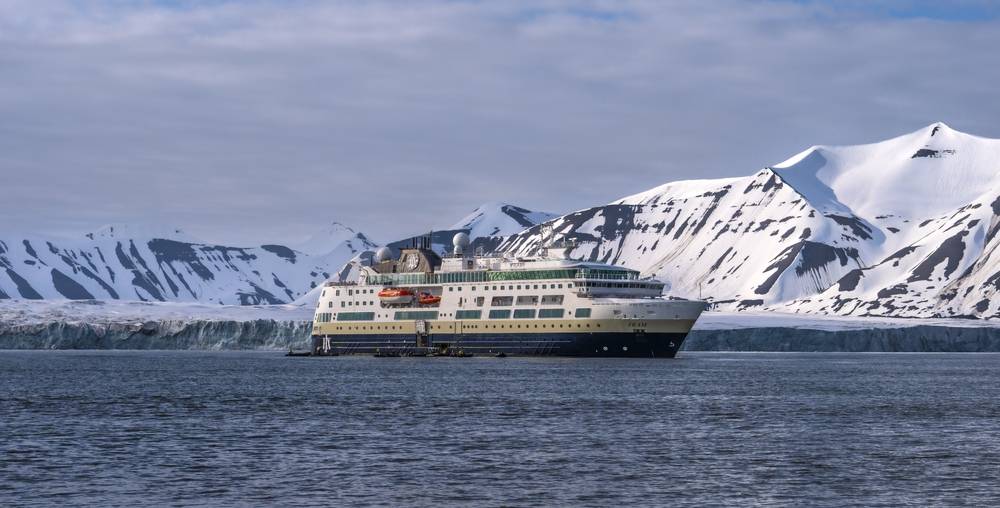
MS Fram

- 200Guests
- 127Cabins
- 2007Launched
- 114 mLength
All ship facts
- Decks
- 7
- Gross tonnage
- 11647
- Speed
- 13 kts
- Width
- 20 m
- Wheelchair cabins
- 2
- Currency on board
- NOK
- Language
- no+en