

Into the Northwest Passage – Circumnavigating Baffin Island
CRUISE ID # HXRACAN03R-280917
Nuuk (Godthaab) TO Nuuk (Godthaab)
21-day all-inclusive Arctic Canada cruise round-trip from Reykjavik
A rare chance to explore one of the least-visited regions of the Canadian Arctic, through the fjords, straits, glaciers, and sea ice of Baffin Island.
This is true exploration, with expedition experiences such as Zodiac cruising, shore landings, hikes through the remote Arctic landscapes, and visits to Inuit settlements.
An end-of-summer journey beginning and ending in Reykjavik, with flights via Nuuk in Greenland.
A circle through the High Arctic
A full circumnavigation of Baffin Island, tracing one of the most complex and varied Arctic cruising routes in the transitional late-summer season. From Greenland into the Canadian Arctic Archipelago and back again, the voyage threads deep fjords, narrow channels, and regions where sea ice is constantly shifting.
A voyage of ice, culture and connection
Baffin is the largest island in Canada, defined by dramatic geography: deep glacier-carved fjords, ice caps, and some of the steepest cliffs on Earth. We’ll learn of the long history of Thule culture and present-day Inuit communities, visit small settlements with local Cultural Ambassadors, and enjoy adventures on Zodiacs, shore landings, hikes, and more.
Suites & Fares
Itinerary
- Day 1September 17, 2028
Nuuk (Godthaab), Greenland
Nuuk, meaning “the cape”, was Greenland’s first town (1728). Started as a fort and later mission and trading post some 240 kilometers south of the Arctic Circle, it is the current capital. Almost 30% of Greenland’s population lives in the town. Not only does Nuuk have great natural beauty in its vicinity, but there are Inuit ruins, Hans Egede’s home, the parliament, and the Church of our Saviour as well. The Greenlandic National Museum has an outstanding collection of Greenlandic traditional dresses, as well as the famous Qilakitsoq mummies. The Katuaq Cultural Center’s building was inspired by the undulating Northern Lights and can house 10% of Nuuk’s inhabitants.
- Day 2September 18, 2028
Cruising
A day at sea
As Nuuk fades into the distance, we begin our first sea passage into the waters of Baffin Bay. Look out for seabirds following the ship and watch as the landscape begins to shift.
This is a time of orientation: both practical and environmental. With onboard lectures, you’ll get an introduction to ice navigation, wildlife patterns, and Arctic history, while the landscape slowly transforms from coastal Greenland into open polar seascape.
- Day 3September 19, 2028
Qikiqtarjuaq, Nunavut, Canada
Ice-carved coasts and living Arctic communities
The eastern edge of Baffin Island reveals some of the most dramatic scenery in the Arctic: steep mountains, deep fjords, and glaciers descending directly into the sea. Sea ice often lingers here, shaping access and movement throughout the region.
In settlements such as Qikiqtarjuaq, life is in close connection with land and sea, where hunting, fishing, and travel remain guided by environmental conditions. Zodiac cruising and shore landings, where possible, offer encounters with this immense coastal landscape and its wildlife-rich waters.
- Day 4September 20, 2028
Kangok Fjord, Canada
- Day 5September 21, 2028
Baffin Island, Nunavut, Canada
- Day 6September 22, 2028
Fecham Bay
- Day 7September 23, 2028
Baffin Island, Nunavut, Canada
Science at sea
Time at sea allows the scale of the region to settle in. Baffin Island’s vast coastline stretches behind while new regions approach ahead. Sea conditions can shift rapidly, from open water to scattered ice, requiring constant observation and adaptation.
Onboard life continues with lectures and sessions that bring the Arctic environment into focus: how ice forms, how ecosystems function, and how navigation in these waters is shaped by nature rather than fixed routes.
- Day 8September 24, 2028
Dundas Harbour, Devon Island, Nunavut, Canada
Dundas Harbour is located in the southeast of Devon Island, Canada’s 6th largest island. It is a forlorn but starkly beautiful spot. The island was first sighted by Europeans in 1616 by the English explorers Robert Bylot and William Baffin. But it did not appear on maps until after explorer William Edward Parry’s exploration in the 1820’s. Parry named it after Devon, England. In the local Inuktitut language, the place is called Talluruti, which translates as “a woman’s chin with tattoos on it.” This refers to the deep crevasses and streaks on Devon Island, which from a distance resemble traditional facial tattoos. On land there are remains of a Thule settlement dating back to 1000 A.D., including tent rings, middens and a gravesite. There are also much more recent remains a Royal Canadian Mounted Police outpost. The first post was established in 1924 to monitor and control illegal activities, such as foreign whaling, in the eastern entrance to the Northwest Passage. But conditions were so isolated and severe that the post was abandoned in 1933. It was reopened in 1945, but again closed, this time permanently, in 1951. Today, Devon Island is the largest uninhabited island in the world.
- Day 8September 24, 2028
Croker Bay, Nunavut, Canada
Gateway to the Northwest Passage
Lancaster Sound is one of the most important waterways in the Arctic. It’s a historic entry point into the Northwest Passage. We’ll pass towering cliffs and deep channels along the coast of Devon Island, which is the largest uninhabited island on Earth. Conditions permitting, we may visit Beechey Island, an important historical site associated with early Arctic exploration, including Sir John Franklin’s 1845 expedition.
- Day 9September 25, 2028
Elwin Bay, Prince Regent Inlet, Nunavut, Canada
- Day 10September 26, 2028
Exploring Canada’s High Arctic
Into the shifting ice
Sailing deeper into the Canadian High Arctic, the environment becomes more enclosed and remote. Prince Regent Inlet and the Gulf of Boothia are defined by long, quiet waterways, low-lying tundra, and the first patches of sea ice forming in the late Arctic autumn. With a little luck and patience, wildlife such as ringed or bearded seals may make an appearance along the ice edges.
- Day 11September 27, 2028
Exploring Canada’s High Arctic
- Day 12September 28, 2028
Igloolik, Nunavut, Canada
Wide seas and Inuit homelands
Foxe Basin opens into a vast, shallow sea bordered by low tundra and distant, broken coastline. It feels open and exposed: water and sky blending at the horizon, with few landmarks to hold onto.
Over these few days, you move through a landscape shaped by long Thule and Inuit presence. Over 100 stone cairns called ‘inuksuit’ line the tundra at Enukso Point, some dating back 2,000 years. In Igloolik, a small hamlet literally translating as 'there is a house here', it’s easy to see how life remains closely tied to sea ice, hunting, and the seasonal rhythm of the land.
- Day 13September 29, 2028
Foxe Basin
- Day 14September 30, 2028
Harkin Bay, Canada
- Day 14September 30, 2028
Inuksuk Point, Canada
- Day 15October 01, 2028
Cape Dorset, Nunavut, Canada
Cape Dorset is a small Inuit hamlet located on Dorset Island, off the southern shore of Baffin Island. The traditional name for Cape Dorset is Kinngait (meaning "high mountain"), describing the ‘Cape’, which is actually a 800 foot mountain. This is a nature-lovers paradise with breath-taking landscapes and an amazing abundance of arctic wildlife, such as migratory caribou, seabirds, whales, seals and walruses. Ancient native Thule (Dorset Culture) peoples lived in this area for three thousand years, and it is here where the first archaeological remains were found. Captain Luke Foxe, during his attempt to find the Northwest Passage in 1631, was the first European to land here. He named the Cape in honour of his sponsor Edward Sackville, the Earl of Dorset. In 1913, the Hudson's Bay Company started a trading post, exchanging furs and skins for supplies like tobacco, ammunition, flour, gas, tea and sugar. In 1949, the market for white fox collapsed but the art industry boomed. Since the 1950s, Cape Dorset, the "Capital of Inuit Art", has become an economic mainstay of the community, with more than 20% of it residents employed in the arts.
- Day 16October 02, 2028
Cruising Hudson Strait
- Day 17October 03, 2028
Hantzsch Island, Canada
- Day 18October 04, 2028
Cruising
The long return through open waters
s the circumnavigation nears completion, time at sea becomes reflective. The Arctic landscapes of Baffin Island gradually recede as we move back toward Greenland. Ice becomes less dominant, replaced by longer stretches of open water and broader ocean conditions.
This is the perfect time to relax on board, perhaps chat with new friends in the Explorer Lounge & Bar, and catch up on any lectures you may have missed. If you haven’t tried the hot tubs yet, now’s your moment.
- Day 19October 05, 2028
Nuuk (Godthaab), Greenland
Nuuk, meaning “the cape”, was Greenland’s first town (1728). Started as a fort and later mission and trading post some 240 kilometers south of the Arctic Circle, it is the current capital. Almost 30% of Greenland’s population lives in the town. Not only does Nuuk have great natural beauty in its vicinity, but there are Inuit ruins, Hans Egede’s home, the parliament, and the Church of our Saviour as well. The Greenlandic National Museum has an outstanding collection of Greenlandic traditional dresses, as well as the famous Qilakitsoq mummies. The Katuaq Cultural Center’s building was inspired by the undulating Northern Lights and can house 10% of Nuuk’s inhabitants.
About the Ship
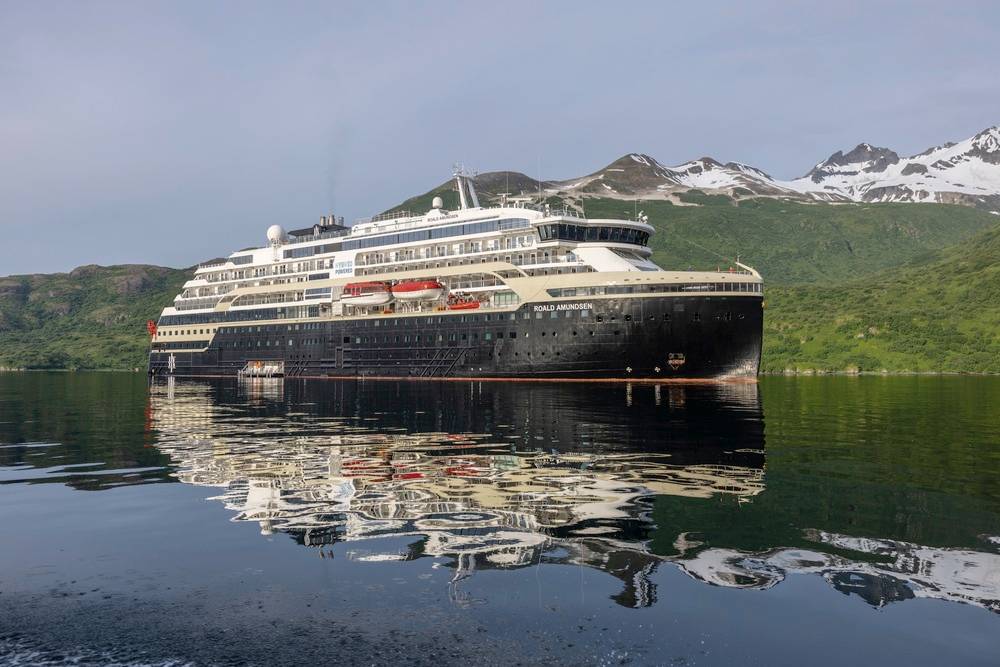
MS Roald Amundsen

- 530Guests
- 265Cabins
- 2019Launched
- 140 mLength
All ship facts
- Crew
- 98
- Decks
- 9
- Gross tonnage
- 20889
- Speed
- 15 kts
- Width
- 23.6 m
- Currency on board
- NOK
- Language
- no+en