

Discovering Greenland – From Reykjavík to Nuuk
CRUISE ID # HXFNGRE07-270602
Reykjavík TO Nuuk (Godthaab)
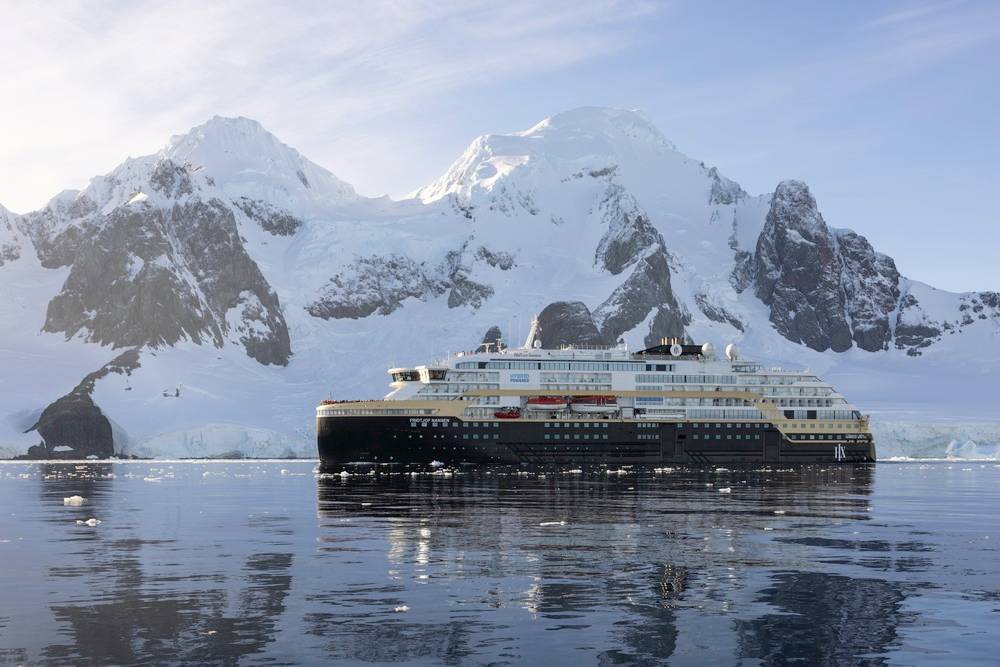
13-day all-inclusive Greenland expedition cruise from Reykjavík to New York
Sail from Reykjavík to southwest Greenland and witness spectacular glaciers and icebergs as we probe deep into little-visited fjords.
See awe-inspiring scenery and wildlife, visit colorful local communities, and delve into Norse history at ancient sites.
With an onboard science focus, learn about the geology that shaped the world’s largest island, as well as its biodiversity and mineral deposits.
This voyage ends in Nuuk for you to fly back to New York (planned airport). This voyage is also available via Reykjavík or Copenhagen gateways.
Wild nature and traditional communities
Sailing from Reykjavík, we cross the Denmark Strait and explore remote areas that few get to visit. There, you’ll discover Norse ruins, visit traditional communities, explore UNESCO-listed historical sites, and learn about the culture of the Arctic peoples.
Wildlife and ice-sculpted landscapes
Witness the majestic landscapes of Greenland as we explore deep fjords cut into breathtaking mountain landscapes, cruise to cascading tidewater glaciers, delight in the otherworldly beauty of crystalline icebergs, and spot aquatic mammals along the way.
Suites & Fares
Itinerary
- Day 1June 02, 2027
Reykjavík, Iceland
Sprawling Reykjavík, the nation's nerve center and government seat, is home to half the island's population. On a bay overlooked by proud Mt. Esja (pronounced eh-shyuh), with its ever-changing hues, Reykjavík presents a colorful sight, its concrete houses painted in light colors and topped by vibrant red, blue, and green roofs. In contrast to the almost treeless countryside, Reykjavík has many tall, native birches, rowans, and willows, as well as imported aspen, pines, and spruces.Reykjavík's name comes from the Icelandic words for smoke, reykur, and bay, vík. In AD 874, Norseman Ingólfur Arnarson saw Iceland rising out of the misty sea and came ashore at a bay eerily shrouded with plumes of steam from nearby hot springs. Today most of the houses in Reykjavík are heated by near-boiling water from the hot springs. Natural heating avoids air pollution; there's no smoke around. You may notice, however, that the hot water brings a slight sulfur smell to the bathroom.Prices are easily on a par with other major European cities. A practical option is to purchase a Reykjavík City Card at the Tourist Information Center or at the Reykjavík Youth Hostel. This card permits unlimited bus usage and admission to any of the city's seven pools, the Family Park and Zoo, and city museums. The cards are valid for one (ISK 3,300), two (ISK 4,400), or three days (ISK 4,900), and they pay for themselves after three or four uses a day. Even lacking the City Card, paying admission (ISK 500, or ISK 250 for seniors and people with disabilities) to one of the city art museums (Hafnarhús, Kjarvalsstaðir, or Ásmundarsafn) gets you free same-day admission to the other two.
- Day 2June 03, 2027
Cruising Denmark Strait
In the wake of Vikings
We sail to Greenland across the Denmark Strait. This is the route taken by the Viking Erik the Red, who is credited as being the first European to have settled there. Sometimes we spot whales along the way, so keep a lookout.
During the two-day crossing, you’ll have plenty of time to get to know the ship and all its onboard facilities. At the same time the Expedition Team will give presentations about the protocols of respectfully visiting the fragile natural areas and Indigenous Arctic communities. Now is the time to book excursions and maybe learn a few words of Greenlandic.
Primarily, however, this is a time of adjustment and enjoyment. You’ll relish delicious meals in the onboard restaurants, listen to some amazing talks and simply get to relax and unwind on this comfortable ship. As we get closer to Greenland, or Kalaallit Nunaat as it is known you’ll feel the anticipation and excitement building … your adventure is about to begin!
- Day 3June 04, 2027
Cruising Denmark Strait
- Day 4June 05, 2027
Prince Christian Sound, Greenland
The transit through the Sound is one of this voyage’s highlights. Connecting the Labrador Sea with the Irminger Seat, Prince Christian Sound or “Prins Christian Sund” in Danish is named after Prince (later King) Christian VII (1749-1808). 100 km (60 miles ), long and at times just 500 m (1500 ft) wide, this majestic and spectacular fiord throws you back into a Viking era – flanked by soaring snow-topped mountains, rock-strewn cliffs and rolling hills, it is as if time has stood still and one easily forgets that this is the 21st century. As you marvel at the sheer size of the mountains that surround you, with the Arctic waters lapping deceptively at the hull, revel in the silence enveloping you. Icebergs float serenely by, carrying with them the ages of time. Be sure to wear warm clothing as this is one spectacle that you do not want to miss.
- Day 5June 06, 2027
Qaqortoq (Julianehaab), Greenland
The largest town in southern Greenland, Qaqortoq has been inhabited since prehistoric times. Upon arrival in this charming southern Greenland enclave, it's easy to see why. Qaqortoq rises quite steeply over the fjord system around the city, offering breath-taking panoramic vistas of the surrounding mountains, deep, blue sea, Lake Tasersuag, icebergs in the bay, and pastoral backcountry. Although the earliest signs of ancient civilization in Qaqortoq date back 4,300 years, Qaqortoq is known to have been inhabited by Norse and Inuit settlers in the 10th and 12th centuries, and the present-day town was founded in 1774. In the years since, Qaqortoq has evolved into a seaport and trading hub for fish and shrimp processing, tanning, fur production, and ship maintenance and repair.
- Day 6June 07, 2027
Qassiarsuk, Greenland
Qassiarsuk is the newer, Greenlandic name for this small village. Brattahlid is the older, Norse name. Here we tour the foundation remains of the manor house of Erik the Red, who found Greenland after being banished from Iceland and Norway for murder. We will also visit the site of the first Christian church ever built in North America (physiographically speaking), see a recently unearthed Norse graveyard that contains remains of 144 Norse colonists, and have a chance to admire Hans Lynge’s remarkable bronze sculpture of Erik the Red.
- Day 7June 08, 2027
Narsaq, Greenland
- Day 8June 09, 2027
Ivigtut, Greenland
Fjords, glaciers, and ghostly mining towns
The stretch of coast between the fjord systems of southern Greenland and Nuuk is as wild as can be. Long distances separate the few scattered settlements. And although the climate is still mild by Arctic standards the topography is rough, segmented by high mountain ranges half covered by ice and cut through by deep turquoise fjords. With very few inside passages, travelling here has been a challenge since ancient times. And it still is. Mother Nature is in charge here, meaning it’s the perfect adventure playground for modern explorers.
On our way north, and always adapted to the local conditions, we’ll get to know the landscapes of the so-called Mellembygden – the Middle Settlement of the Norse settlers. We’ll also look for the ghostly mining town of Ivittuut, where the historically important mineral cryolite was mined, but where today the only inhabitants are shy musk oxen. And we’ll sail into great fjords carved out over millennia by massive glaciers cascading down from the icecap.
Wildlife thrives in this isolated region. Join our Expedition Team on their wildlife watches either on board or on land, and keep your camera and binoculars ready for seabirds, nesting colonies, and whales feeding at sea. If we’re lucky, we may even see one of the few musk ox herds living on the west Greenland coast.
- Day 9June 10, 2027
Kvanefjord, Greenland
- Day 10June 11, 2027
Qeqertarsuaq (Godhavn), Greenland
- Day 11June 12, 2027
Kapisillit, Greenland
Kapisillit is a settlement in the Sermersooq municipality in southwestern Greenland. In 2020, the settlement had 52 inhabitants. Kapisillit means the salmon in the Greenlandic language. The name refers to the belief that the only spawning-ground for salmon in Greenland is a river near the settlement.
- Day 12June 13, 2027
Nuuk (Godthaab), Greenland
Nuuk, meaning “the cape”, was Greenland’s first town (1728). Started as a fort and later mission and trading post some 240 kilometers south of the Arctic Circle, it is the current capital. Almost 30% of Greenland’s population lives in the town. Not only does Nuuk have great natural beauty in its vicinity, but there are Inuit ruins, Hans Egede’s home, the parliament, and the Church of our Saviour as well. The Greenlandic National Museum has an outstanding collection of Greenlandic traditional dresses, as well as the famous Qilakitsoq mummies. The Katuaq Cultural Center’s building was inspired by the undulating Northern Lights and can house 10% of Nuuk’s inhabitants.
- Day 13June 14, 2027
Nuuk (Godthaab), Greenland
Nuuk, meaning “the cape”, was Greenland’s first town (1728). Started as a fort and later mission and trading post some 240 kilometers south of the Arctic Circle, it is the current capital. Almost 30% of Greenland’s population lives in the town. Not only does Nuuk have great natural beauty in its vicinity, but there are Inuit ruins, Hans Egede’s home, the parliament, and the Church of our Saviour as well. The Greenlandic National Museum has an outstanding collection of Greenlandic traditional dresses, as well as the famous Qilakitsoq mummies. The Katuaq Cultural Center’s building was inspired by the undulating Northern Lights and can house 10% of Nuuk’s inhabitants.
About the Ship
MS Fridtjof Nansen

- 490Guests
- 265Cabins
- 2020Launched
- 140 mLength
All ship facts
- Crew
- 98
- Decks
- 9
- Gross tonnage
- 20889
- Speed
- 15 kts
- Width
- 24 m
- Currency on board
- NOK
- Language
- en