

Arctic Islands Discovery – Svalbard, Jan Mayen, Greenland and Iceland
CRUISE ID # HXFRSVA09D2-280803
Oslo TO Reykjavík
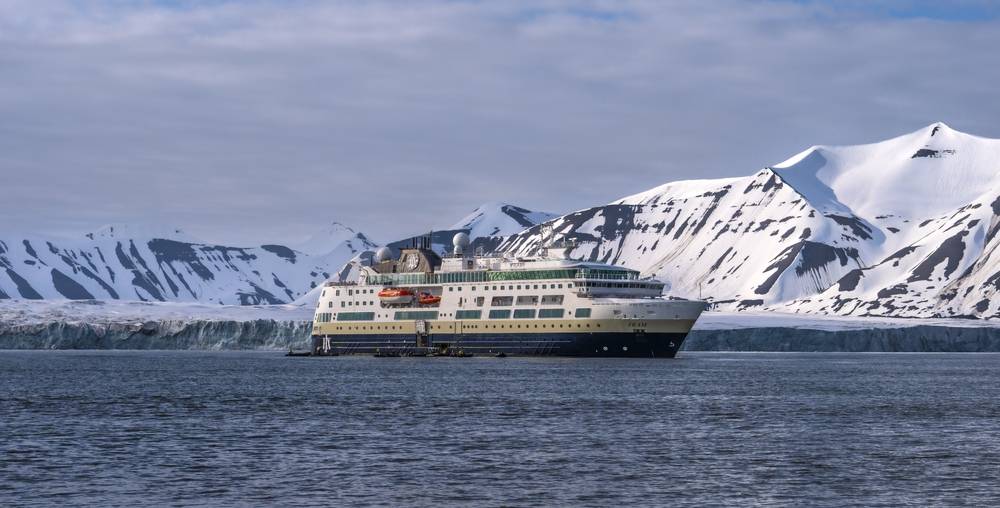
14-day all-inclusive Svalbard, Jan Mayen, Greenland and Iceland from Oslo to Reykjavík
Visit Svalbard, Jan Mayen, and East Greenland in a single expedition, three of the hardest-to-reach destinations in the Arctic, rarely combined in one voyage.
Explore the world's largest fjord system in East Greenland and the volcanic wilderness of Jan Mayen, an island most people will never see.
Travel in peak Arctic summer, when glaciers calve, wildlife thrives, and 24-hour light reveals landscapes in their full, raw beauty.
High Arctic in high summer
Mid-August brings near-continuous daylight to the High Arctic. Glaciers calve into open waters, whales feed in the fjords, and seabird colonies are at their busiest. This is the narrow window when these remote regions are at their most accessible and most dramatic.
The hardest places to reach
This expedition connects some of the most isolated destinations in the Northern Hemisphere: the glaciers of Svalbard, the volcanic wilderness of Jan Mayen, the vast fjord system of East Greenland, and the iconic coastline of Iceland's Snæfellsnes peninsula. Many of these places have only been open to visitors for a relatively short time, and few voyages bring them together in a single sailing. Each stop feels like a different world: ice-carved, volcanic, wild, and almost untouched.
Suites & Fares
Itinerary
- Day 1July 31, 2028
Pre-Cruise Night
- Day 2August 01, 2028
Pre-Cruise Night
- Day 3August 02, 2028
Pre-Cruise Night
- Day 4August 03, 2028
Oslo, Norway
Oslo is the capital of Norway and is also its largest city, situated at the head of Oslo Fjord and surrounded by hills and forests. Home to some 50 museums and full of galleries, cafés, a sculpture park and the Royal Palace, this vibrant city with its handsome 19th-century buildings and wide streets has much to offer. Its history dates back 1,000 years, and includes a rich seafaring heritage that ranges from the Viking era to Thor Heyerdahl’s Kon Tiki expedition. Discover more about this exciting city on our varied selection of excursions.
- Day 5August 04, 2028
Longyearbyen, Svalbard and Jan Mayen
Longyearbyen is the biggest settlement in Svalbard. Seat of the Norwegian administration, it also has the best services and infrastructure in the archipelago. Located deep in the Adventfjord, a sidearm of the Isfjorden (Icefjord), Longyearbyen’s airport can be used all-year round, but its harbor is blocked by ice in winter. Most shops, hotels, restaurants and a hospital are within easy walking distance of the port. One of the most prominent buildings in town is the UNIS center, where several Norwegian universities have joined forces to operate and offer the northernmost higher education to both Norwegian and international students. Adjacent to UNIS, and well worth a visit, is the Svalbard Museum, covering the natural history and exploitation of Svalbard. Remnants of the former mining activity can be seen all around Longyearbyen and even in town.
- Day 6August 05, 2028
Longyearbyen, Svalbard and Jan Mayen
Longyearbyen is the biggest settlement in Svalbard. Seat of the Norwegian administration, it also has the best services and infrastructure in the archipelago. Located deep in the Adventfjord, a sidearm of the Isfjorden (Icefjord), Longyearbyen’s airport can be used all-year round, but its harbor is blocked by ice in winter. Most shops, hotels, restaurants and a hospital are within easy walking distance of the port. One of the most prominent buildings in town is the UNIS center, where several Norwegian universities have joined forces to operate and offer the northernmost higher education to both Norwegian and international students. Adjacent to UNIS, and well worth a visit, is the Svalbard Museum, covering the natural history and exploitation of Svalbard. Remnants of the former mining activity can be seen all around Longyearbyen and even in town.
- Day 7August 06, 2028
Longyearbyen, Svalbard and Jan Mayen
Longyearbyen is the biggest settlement in Svalbard. Seat of the Norwegian administration, it also has the best services and infrastructure in the archipelago. Located deep in the Adventfjord, a sidearm of the Isfjorden (Icefjord), Longyearbyen’s airport can be used all-year round, but its harbor is blocked by ice in winter. Most shops, hotels, restaurants and a hospital are within easy walking distance of the port. One of the most prominent buildings in town is the UNIS center, where several Norwegian universities have joined forces to operate and offer the northernmost higher education to both Norwegian and international students. Adjacent to UNIS, and well worth a visit, is the Svalbard Museum, covering the natural history and exploitation of Svalbard. Remnants of the former mining activity can be seen all around Longyearbyen and even in town.
- Day 8August 07, 2028
Spitsbergen, Svalbard and Jan Mayen
A land of spectacular beauty
Spitsbergen, Svalbard's largest island, is a wilderness of steep mountains, glaciers, and scattered offshore islands.
Over the next few days, we'll explore dramatic fjords where glaciers creak and calve icebergs into the sea, push north towards Northwest Spitsbergen National Park where sea ice may shape our route, and scan for the wildlife that thrives here: polar bears, walruses, Arctic foxes, reindeer, and colonies of seabirds nesting on the cliffs.
Each day will be different. Landings, Zodiac cruises, kayaking, hikes: be ready for anything as your Captain and Expedition Team read the conditions and seize every opportunity the Arctic offers.
- Day 9August 08, 2028
Spitsbergen, Svalbard and Jan Mayen
- Day 10August 09, 2028
Spitsbergen, Svalbard and Jan Mayen
- Day 11August 10, 2028
Cruising Greenland Sea
Enjoy a restorative day at sea
Take advantage of a day sailing through Arctic waters to relax. on board the ship. Watch the Arctic waters slip by from the Explorer Lounge & Bar, soak in a hot tub on deck while scanning for seabirds, or simply take in the panoramic views with fellow explorers.
The Expedition Team will bring the journey to life with lectures on local history, geology, and Arctic wildlife. Visit the Science Center for deeper insight into the places ahead, or join a Citizen Science project and contribute to real, ongoing research.
- Day 12August 11, 2028
Jan Mayen Island, Norway
Described as one of the most remote islands in the world, Jan Mayen liesbetween Norway to the east and Greenland to the west. It is a rugged volcanicisland 34 miles long and is made up of two parts – the larger section to thenorth (Beerenbeg Volcano) and the longer but narrower section to the south. Amile-wide isthmus links these two parts. Geologically, the island was formed bya ‘hotspot’ where molten magma pushes up through the earth’s crust to createvolcanoes in the middle of nowhere. Politically, Jan Mayen is an integral partof Norway. The eighteen people living on the island work for either the NorwegianArmed Forces or the Norwegian Meteorological Institute. Their main purpose isto operate the Loran-C radio navigation system. From 1615 to 1638, the Dutchran a whaling station here. Today, the island is a nature reserve underNorwegian jurisdiction aimed at preserving the pristine Arctic island and themarine life, including the ocean floor.
- Day 13August 12, 2028
Cruising
Unwind and prepare for more adventures
On this day at sea sailing west towards Greenland, time is yours to enjoy at your own pace. Relax on deck with a book, share memories of the past few days with fellow travellers in the Explorer Lounge, or join the Expedition Team to find out what awaits in eastern Greenland and northern Iceland. Before you know, you'll spot the first icy peaks rising on the horizon before the day is done.
- Day 14August 13, 2028
Scoresby Sund, Greenland
The largest fjord system on Earth
With stunning white and blue icebergs, mirror-like waters, and looming mountains, the scenery in Scoresby Sund is spectacular and the scale almost incomprehensible.
Over these few days, we'll make the most of conditions, packing in as many shore landings, nature walks, kayaking tours, and wildlife encounters as possible. In summer, the open waters draw remarkable wildlife: musk oxen, Arctic foxes, mountain hares, whales, and seals. Birdlife thrives here too, including little auks, Atlantic puffins, fulmars, snowy owls, Greenlandic gyrfalcons, and great black-backed gulls.
Beyond the small Inuit community of Ittoqqortoormiit that calls it home, these carved glacier walls remain a mystery to most. These days are your chance to explore it in all its sublimity.
- Day 15August 14, 2028
Scoresby Sund, Greenland
- Day 16August 15, 2028
Ittoqqortoormiit (ex Scoresbysund), Greenland
Scoresbysund is the ultimate fjord system; likely the longest, largest and deepest of any in the world. The massive fjord is tucked into the eastern coast of Greenland and on the icy western edges of the Greenland Sea. Scoresbysund’s scale deserves several days to explore, especially while plying the waters between castle-sized icebergs as they gently drift under the persuasion of the Arctic waters in the mighty fjord. Scattered in the remote bays and smaller fjords are places to discover old Inuit settlements, slowly growing over with Arctic willow and dwarf birch. The lower slopes of many mountains are draped in the herbs and grasses favoured by muskox, Arctic fox, lemmings, Ptarmigan, Barnacle Geese, and Snowy Owls. Tundra walks give impressive views of landscape, flora and fauna. Not to be neglected, the waters of Scoresbysund warrant a vigilant eye for sightings of whales, seals, narwhals, beluga whales and walrus.
- Day 17August 16, 2028
Cruising
Relax at sea
After the adventures of East Greenland, a day at sea might feel like a welcome rest.
MS Fram glides through the North Atlantic towards our final destination: northwest Iceland. Whether you work up a sweat in the gym, take a little R&R in your cabin, or join the Science & Education Programme, this time is yours to enjoy.
- Day 18August 17, 2028
Grundarfjørdur, Iceland
Visit Iceland in miniature
Snæfellsnes is a peninsula of dramatic coastlines, volcanic peaks, lava fields, black sand beaches, and traditional fishing villages, all set beneath the glacier-capped Snæfellsjökull volcano. It inspired Jules Verne's book, Journey to the Centre of the Earth, and it's often called Iceland in miniature because almost every landscape the country is known for can be found here in one compact stretch of coast.
From our port in Grundarfjörður, overlooked by the iconic Kirkjufell mountain, you can join excursions around the peninsula or explore the surroundings on foot.
- Day 19August 18, 2028
Reykjavík, Iceland
Sprawling Reykjavík, the nation's nerve center and government seat, is home to half the island's population. On a bay overlooked by proud Mt. Esja (pronounced eh-shyuh), with its ever-changing hues, Reykjavík presents a colorful sight, its concrete houses painted in light colors and topped by vibrant red, blue, and green roofs. In contrast to the almost treeless countryside, Reykjavík has many tall, native birches, rowans, and willows, as well as imported aspen, pines, and spruces.Reykjavík's name comes from the Icelandic words for smoke, reykur, and bay, vík. In AD 874, Norseman Ingólfur Arnarson saw Iceland rising out of the misty sea and came ashore at a bay eerily shrouded with plumes of steam from nearby hot springs. Today most of the houses in Reykjavík are heated by near-boiling water from the hot springs. Natural heating avoids air pollution; there's no smoke around. You may notice, however, that the hot water brings a slight sulfur smell to the bathroom.Prices are easily on a par with other major European cities. A practical option is to purchase a Reykjavík City Card at the Tourist Information Center or at the Reykjavík Youth Hostel. This card permits unlimited bus usage and admission to any of the city's seven pools, the Family Park and Zoo, and city museums. The cards are valid for one (ISK 3,300), two (ISK 4,400), or three days (ISK 4,900), and they pay for themselves after three or four uses a day. Even lacking the City Card, paying admission (ISK 500, or ISK 250 for seniors and people with disabilities) to one of the city art museums (Hafnarhús, Kjarvalsstaðir, or Ásmundarsafn) gets you free same-day admission to the other two.
About the Ship
MS Fram

- 200Guests
- 127Cabins
- 2007Launched
- 114 mLength
All ship facts
- Decks
- 7
- Gross tonnage
- 11647
- Speed
- 13 kts
- Width
- 20 m
- Wheelchair cabins
- 2
- Currency on board
- NOK
- Language
- no+en