

Epic Antarctica: Crossing the 7th Continent
CRUISE ID # AURORAASC002G
Dunedin TO Ushuaia
Suites & Fares
Itinerary
- Day 1January 07, 2027
Dunedin, New Zealand
Clinging to the walls of the natural amphitheater at the west end of Otago Harbour, the South Island's second-largest city is enriched with inspiring nearby seascapes and wildlife. Because Dunedin is a university town, floods of students give the city a vitality far greater than its population of 122,000 might suggest. Its manageable size makes it easy to explore on foot—with the possible exception of Baldwin Street, the world's steepest residential street and home to the annual "gutbuster" race, in which people run up it, and the "Jaffa" race, in which people roll the namesake spherical chocolate candy down it.Dunedin, the Gaelic name for Edinburgh, was founded in 1848 by settlers of the Free Church of Scotland, a breakaway group from the Presbyterian Church. The city's Scottish roots are still visible; you'll find New Zealand's first and only (legal) whisky distillery, a statue of Scottish poet Robert Burns, and more kilts, sporrans, and gillies than you can shake a stick at! The Scottish settlers and local Māori came together in relative peace, but this wasn't true of the European whalers who were here three decades before, as places with names such as Murdering Beach illustrate.Dunedin has always had a reputation for the eccentric. Wearing no shoes and a big beard here marks a man as bohemian rather than destitute, and the residents wouldn't have it any other way. The University of Otago was the country's first university and has been drawing writers ever since its founding in 1871, most notably Janet Frame and the poet James K. Baxter. Dunedin also has a musical heritage, which blossomed into the "Dunedin Sound" of the 1970s and '80s.
- Day 2January 08, 2027
Dunedin, New Zealand
Clinging to the walls of the natural amphitheater at the west end of Otago Harbour, the South Island's second-largest city is enriched with inspiring nearby seascapes and wildlife. Because Dunedin is a university town, floods of students give the city a vitality far greater than its population of 122,000 might suggest. Its manageable size makes it easy to explore on foot—with the possible exception of Baldwin Street, the world's steepest residential street and home to the annual "gutbuster" race, in which people run up it, and the "Jaffa" race, in which people roll the namesake spherical chocolate candy down it.Dunedin, the Gaelic name for Edinburgh, was founded in 1848 by settlers of the Free Church of Scotland, a breakaway group from the Presbyterian Church. The city's Scottish roots are still visible; you'll find New Zealand's first and only (legal) whisky distillery, a statue of Scottish poet Robert Burns, and more kilts, sporrans, and gillies than you can shake a stick at! The Scottish settlers and local Māori came together in relative peace, but this wasn't true of the European whalers who were here three decades before, as places with names such as Murdering Beach illustrate.Dunedin has always had a reputation for the eccentric. Wearing no shoes and a big beard here marks a man as bohemian rather than destitute, and the residents wouldn't have it any other way. The University of Otago was the country's first university and has been drawing writers ever since its founding in 1871, most notably Janet Frame and the poet James K. Baxter. Dunedin also has a musical heritage, which blossomed into the "Dunedin Sound" of the 1970s and '80s.
- Day 3January 09, 2027
Snares Islands, New Zealand
The Snares Islands, also known as ‘The Snares’ are the northernmost of New Zealand's subantarctic islands. The islands are totally uninhabited and land mammals were never introduced on the islands, so it is only inhabited by sea mammals, birds and flora. The area is among one of five subantarctic island groups forming the New Zealand Subantarctic Islands, designated as a World Heritage Site by UNESCO.
- Day 4January 10, 2027
New Zealand's Subantarctic Islands
First visited by Māori navigators centuries ago, these islands are of great significance to Ngāi Tahu, the indigenous peoples of New Zealand’s South Island. Their natural beauty and astonishing biodiversity have now been recognised globally, but few have had the privilege to visit these far-flung shores, which are now yours to explore.
Auckland Islands (Maungahuka / Motu Maha)
Born of fire, scoured by ancient glaciers and shaped by the fierce hand of the Southern Ocean, there is an exquisite ruggedness to this group of weather-worn islands. This apparent bleakness belies the extraordinary abundance of life that thrives here. Roughly half of the world’s yellow-eyed penguins (hoiho), most of the world’s white-capped mollymawks, and the entire population of Auckland Islands wandering albatross find shelter on these shores.
Embrace the spirit of exploration as your expedition team designs your voyage from day to day, bringing decades of experience to selecting ideal sites based on the prevailing conditions and wildlife opportunities.
Some places we may visit include:
Sandy Bay
Sandy Bay is home to a breeding colony of rare New Zealand (Hooker’s) sea lions and an enchanting rātā forest where yellow-eyed penguins (hoiho) make their nests.
Carnley Harbour, Erlangen Clearing
Carnley Harbour offers superb Zodiac cruising through a landscape rich in human history. In 1864, five men became stranded here after their schooner, the Grafton, was wrecked, putting a sudden end to their sealing and tin prospecting ambitions. We hope to see the skeletal remnants of the Grafton, and the moss-covered remains of the Epigwaitt Hut, where they sheltered for 20 months.
Victoria Passage
Victoria Passage is a lively channel separating Auckland Island from the mountainous Adams Island to the south. We may Zodiac cruise these scenic waters, watching for sooty shearwaters, penguins and sea-lions frolicking in the pure waters.
Campbell Island (Motu Ihupuku)
Wind and weather permitting, we will Zodiac cruise sheltered harbours and coves in search of Campbell Island snipes and teals, yellow-eyed penguins (hoiho), and New Zealand (Hooker’s) sea lions (whakahao).
We hope to land at Beeman Cove, Perseverance Harbour, where an old meteorological station stands vigil on the windswept shoreline. Follow a boardwalk through tussock and upland tundra, then enter an otherworldly landscape where large-leaved megaherbs abound. Wonder at the Ross Lily, Campbell Island Daisy and Campbell Island carrot, whose brilliant flowers would look more at home in the tropics than these southern climes. Continue towards the nesting grounds of majestic southern royal albatross, whose wingspans can exceed three metres (10 feet). It is truly humbling to be in the presence of these great wanderers of the southern seas. Find a spot to quietly observe these marvellous birds as they go about their daily duties, undisturbed by their human visitors.
- Day 5January 11, 2027
New Zealand's Subantarctic Islands
- Day 6January 12, 2027
New Zealand's Subantarctic Islands
- Day 7January 13, 2027
Day at Sea
- Day 8January 14, 2027
Macquarie Island, Tasmania, Australia
Macquarie Island is a UNESCO World Heritage Site due to its major geoconservation significance. It is the only island in the world that is entirely composed of oceanic crust and rocks from the mantel. The unique diversity of the island makes it a truly remarkable place to visit. Sand Bay is located on the east coast where you will find Royal and King Penguin rookeries as well as Southern Elephant Seals, and if the weather permits, you will have the opportunity to get closer on a Zodiac®.
- Day 9January 15, 2027
Day at Sea
- Day 10January 16, 2027
Day at Sea
- Day 11January 17, 2027
Day at Sea
- Day 12January 18, 2027
Day at Sea
- Day 13January 19, 2027
Cruise East, Antarctica, Ross Sea
It’s almost impossible to describe the feeling of arriving in this storied, ice-bound sector of Antarctica. Stepping outside and taking a deep breath of some of the most fresh, crisp air on earth is an experience to cherish forever.
The Ross Sea region is a globally significant wildlife sanctuary. Its nutrient-rich waters support an astonishing array of uniquely adapted Antarctic species, including Ross Sea orcas, Antarctic petrels and South Pacific Weddell seals. It is also home to Antarctica’s largest Adélie penguin colony, and many of the largest emperor penguin colonies. The unique biodiversity of the Ross Sea has been protected within the world’s largest marine protected area since 2016.
The human heritage of the Ross Sea coast is equally impressive. Since James Clark Ross discovered the region in 1841, countless expeditions have built base camps on scattered ice-free slivers of land, using them as staging posts for bold forays across the polar plateau. Many of them departed in a hurry, leaving artefacts, scientific equipment and sometimes entire huts behind. Today these sites are preserved as open-air museums and protected under the Antarctic Treaty System.
Embrace the spirit of exploration as your expedition team designs your voyage from day to day, bringing decades of experience to selecting the ideal sites based on the prevailing weather, ice conditions and wildlife opportunities.
Some places we may visit include:
Ross Ice Shelf
Find a spot on deck as we cruise perfectly cleaved ice cliffs towering some 30 metres above the crystalline waters of the Ross Sea. This is the floating edge of the largest ice shelf in Antarctica, which covers an area the size of France. Watch for elegant emperor penguins, sweet-faced Weddell seals hauled out on ice floes, and the unmistakable ‘pouf’ of an orca’s exhalation.
Franklin Island
This delightful ice-free outpost with a rookery of rambunctious Adélie penguins is well worth a visit. Stretch your legs as you stroll up a gentle incline past the colony to a high point, where panoramic views of the Ross archipelago and the ice shelf unfurl.
McMurdo Sound
Enter a realm of exquisite beauty, an otherworldly icescape set against a backdrop of gleaming glaciers, shimmering mountains, and the polar ice sheet itself. McMurdo Sound is the historic gateway to the South Pole and remains a busy working harbour today, serving as a logistics hub for the extensive scientific operations taking place at the McMurdo and Scott Research bases on Ross Island.
It is here, in this achingly barren landscape, that early explorers established their base camps and struck out for the South Pole. If conditions allow, we aim to land at one (or more) of their beautifully preserved huts, many of which still stand, to dwell for a moment amongst the artefacts of a distant time, and reflect on the triumphs and tragedies of those who brought them here.
Cape Washington, Terra Nova Bay
Bounded by soaring peaks and fed by immense glaciers, Terra Nova Bay supports an abundance of polar wildlife, including the rarely sighted Arnoux's Beaked Whale. Fast ice anchored to the bay’s northern shore in the shelter of Cape Washington is home to one of the largest known emperor penguin colonies. Some 20,000 males huddle here each winter, incubating their eggs and awaiting the sun’s return. Weather and ice permitting, visit the bustling rookery to witness the delightful emperors and their fledging chicks.
Cape Hallett
The snow-capped Admiralty Mountains rise dramatically from the gravelly spit of Cape Hallett, where we hope to land. This is the site of a decommissioned scientific base and an abundance of Antarctic mosses, lichens and invertebrates, protected by the Antarctic Treaty System.
Amble across gently undulating terrain, taking care to give resting Weddell seals a wide berth. The Adélie penguin rookery here can host close to 50,000 breeding pairs, while snow petrels, Wilson’s storm petrels and South Polar skuas breed in the rocky crevices nearby.
Cape Hallett also has a special significance for Aurora. It was from this rocky foothold that Greg Mortimer, co-founder of Aurora Expeditions, launched the Australian Bicentennial Antarctic Expedition in 1988. Cape Hallett provided access to the glaciated coastal ranges beyond, where the six-man team completed the first ascent of Mt Minto (4,165 metres).
Cape Adare
Cape Adare lies 100 km (62 miles) north of Cape Hallet, at the western entrance to the Ross Sea. A rare ice-free refuge on this icebound coastline, Cape Adare is home to Antarctica’s largest Adélie penguin colony. Ice and weather permitting, wend your way through the pack ice to land on the flat, cobbled spit where more than 250,000 breeding pairs of Adélies gather to busily breed, feed and raise their chicks in the short southern summer.
First visited by James Clark Ross in 1841, this rocky promontory played an important role in the pioneering expeditions of the Heroic Age of Antarctic exploration. It was here in 1899 that the Southern Cross expedition, led by Carsten Borchgrevink, became the first to winter over in Antarctica and establish the first human structures on the continent.
The remnants of these pioneering constructions, and thousands of artefacts scattered in their vicinity, remain virtually untouched and protected under the Antarctic Treaty System. We hope to enter Borchgrevink’s living quarters to experience the awe and imagine the perils of conducting science here, as they did, through an Antarctic winter.
- Day 14January 20, 2027
Cruise East, Antarctica, Ross Sea
- Day 15January 21, 2027
Cruise East, Antarctica, Ross Sea
- Day 16January 22, 2027
Cruise East, Antarctica, Ross Sea
- Day 17January 23, 2027
Cruise East, Antarctica, Ross Sea
- Day 18January 24, 2027
Cruise East, Antarctica, Ross Sea
- Day 19January 25, 2027
Day at Sea
- Day 20January 26, 2027
Day at Sea
- Day 21January 27, 2027
Day at Sea
- Day 22January 28, 2027
Crossing the International Date Line
- Day 23January 29, 2027
Day at Sea
- Day 24January 30, 2027
Day at Sea
- Day 25January 31, 2027
Day at Sea
- Day 26February 01, 2027
Day at Sea
- Day 27February 02, 2027
Antarctic Peninsula, Antarctica
Remote and otherworldly, Antarctic is irresistible for its spectacular iceberg sculptures and calving glaciers, and for the possibility of up-close encounters with marine mammals and the iconic penguins. The Antarctic Peninsula – the main peninsula closest to South America – has a human history of almost 200 years, with explorers, sealers, whalers, and scientists who have come to work, and eventually intrepid visitors coming to enjoy this pristine and remote wilderness. It is a region of protected bays, unscaled snow-capped mountains, vast glaciers and a few places where whalers or scientists have worked. Just as irresistible are the many Gentoo and Chinstrap Penguin colonies, the seals basking on ice floes, the whales and orcas.
- Day 28February 03, 2027
Antarctic Peninsula, Antarctica
Remote and otherworldly, Antarctic is irresistible for its spectacular iceberg sculptures and calving glaciers, and for the possibility of up-close encounters with marine mammals and the iconic penguins. The Antarctic Peninsula – the main peninsula closest to South America – has a human history of almost 200 years, with explorers, sealers, whalers, and scientists who have come to work, and eventually intrepid visitors coming to enjoy this pristine and remote wilderness. It is a region of protected bays, unscaled snow-capped mountains, vast glaciers and a few places where whalers or scientists have worked. Just as irresistible are the many Gentoo and Chinstrap Penguin colonies, the seals basking on ice floes, the whales and orcas.
- Day 29February 04, 2027
Antarctic Peninsula, Antarctica
Remote and otherworldly, Antarctic is irresistible for its spectacular iceberg sculptures and calving glaciers, and for the possibility of up-close encounters with marine mammals and the iconic penguins. The Antarctic Peninsula – the main peninsula closest to South America – has a human history of almost 200 years, with explorers, sealers, whalers, and scientists who have come to work, and eventually intrepid visitors coming to enjoy this pristine and remote wilderness. It is a region of protected bays, unscaled snow-capped mountains, vast glaciers and a few places where whalers or scientists have worked. Just as irresistible are the many Gentoo and Chinstrap Penguin colonies, the seals basking on ice floes, the whales and orcas.
- Day 30February 05, 2027
Antarctic Peninsula, Antarctica
Remote and otherworldly, Antarctic is irresistible for its spectacular iceberg sculptures and calving glaciers, and for the possibility of up-close encounters with marine mammals and the iconic penguins. The Antarctic Peninsula – the main peninsula closest to South America – has a human history of almost 200 years, with explorers, sealers, whalers, and scientists who have come to work, and eventually intrepid visitors coming to enjoy this pristine and remote wilderness. It is a region of protected bays, unscaled snow-capped mountains, vast glaciers and a few places where whalers or scientists have worked. Just as irresistible are the many Gentoo and Chinstrap Penguin colonies, the seals basking on ice floes, the whales and orcas.
- Day 31February 06, 2027
Antarctic Peninsula, Antarctica
Remote and otherworldly, Antarctic is irresistible for its spectacular iceberg sculptures and calving glaciers, and for the possibility of up-close encounters with marine mammals and the iconic penguins. The Antarctic Peninsula – the main peninsula closest to South America – has a human history of almost 200 years, with explorers, sealers, whalers, and scientists who have come to work, and eventually intrepid visitors coming to enjoy this pristine and remote wilderness. It is a region of protected bays, unscaled snow-capped mountains, vast glaciers and a few places where whalers or scientists have worked. Just as irresistible are the many Gentoo and Chinstrap Penguin colonies, the seals basking on ice floes, the whales and orcas.
- Day 32February 07, 2027
Day at Sea
- Day 33February 08, 2027
Ushuaia, Argentina
At 55 degrees latitude south, Ushuaia (pronounced oo-swy-ah) is closer to the South Pole than to Argentina's northern border with Bolivia. It is the capital and tourism base for Tierra del Fuego, the island at the southernmost tip of Argentina.Although its stark physical beauty is striking, Tierra del Fuego's historical allure is based more on its mythical past than on rugged reality. The island was inhabited for 6,000 years by Yámana, Haush, Selk'nam, and Alakaluf Indians. But in 1902 Argentina, eager to populate Patagonia to bolster its territorial claims, moved to initiate an Ushuaian penal colony, establishing the permanent settlement of its most southern territories and, by implication, everything in between.When the prison closed in 1947, Ushuaia had a population of about 3,000, made up mainly of former inmates and prison staff. Today the Indians of Darwin's "missing link" theory are long gone—wiped out by diseases brought by settlers and by indifference to their plight—and the 60,000 residents of Ushuaia are hitching their star to tourism.The city rightly (if perhaps too loudly) promotes itself as the southernmost city in the world (Puerto Williams, a few miles south on the Chilean side of the Beagle Channel, is a small town). You can make your way to the tourism office to get your clichéd, but oh-so-necessary, "Southernmost City in the World" passport stamp. Ushuaia feels like a frontier boomtown, at heart still a rugged, weather-beaten fishing village, but exhibiting the frayed edges of a city that quadrupled in size in the '70s and '80s and just keeps growing. Unpaved portions of Ruta 3, the last stretch of the Pan-American Highway, which connects Alaska to Tierra del Fuego, are finally being paved. The summer months (December through March) draw more than 120,000 visitors, and dozens of cruise ships. The city is trying to extend those visits with events like March's Marathon at the End of the World and by increasing the gamut of winter activities buoyed by the excellent snow conditions.A terrific trail winds through the town up to the Martial Glacier, where a ski lift can help cut down a steep kilometer of your journey. The chaotic and contradictory urban landscape includes a handful of luxury hotels amid the concrete of public housing projects. Scores of "sled houses" (wooden shacks) sit precariously on upright piers, ready for speedy displacement to a different site. But there are also many small, picturesque homes with tiny, carefully tended gardens. Many of the newer homes are built in a Swiss-chalet style, reinforcing the idea that this is a town into which tourism has breathed new life. At the same time, the weather-worn pastel colors that dominate the town's landscape remind you that Ushuaia was once just a tiny fishing village, snuggled at the end of the Earth.As you stand on the banks of the Canal Beagle (Beagle Channel) near Ushuaia, the spirit of the farthest corner of the world takes hold. What stands out is the light: at sundown the landscape is cast in a subdued, sensual tone; everything feels closer, softer, and more human in dimension despite the vastness of the setting. The snowcapped mountains reflect the setting sun back onto a stream rolling into the channel, as nearby peaks echo their image—on a windless day—in the still waters.Above the city rise the last mountains of the Andean Cordillera, and just south and west of Ushuaia they finally vanish into the often-stormy sea. Snow whitens the peaks well into summer. Nature is the principal attraction here, with trekking, fishing, horseback riding, wildlife spotting, and sailing among the most rewarding activities, especially in the Parque Nacional Tierra del Fuego (Tierra del Fuego National Park).
- Day 34February 09, 2027
Ushuaia, Argentina
At 55 degrees latitude south, Ushuaia (pronounced oo-swy-ah) is closer to the South Pole than to Argentina's northern border with Bolivia. It is the capital and tourism base for Tierra del Fuego, the island at the southernmost tip of Argentina.Although its stark physical beauty is striking, Tierra del Fuego's historical allure is based more on its mythical past than on rugged reality. The island was inhabited for 6,000 years by Yámana, Haush, Selk'nam, and Alakaluf Indians. But in 1902 Argentina, eager to populate Patagonia to bolster its territorial claims, moved to initiate an Ushuaian penal colony, establishing the permanent settlement of its most southern territories and, by implication, everything in between.When the prison closed in 1947, Ushuaia had a population of about 3,000, made up mainly of former inmates and prison staff. Today the Indians of Darwin's "missing link" theory are long gone—wiped out by diseases brought by settlers and by indifference to their plight—and the 60,000 residents of Ushuaia are hitching their star to tourism.The city rightly (if perhaps too loudly) promotes itself as the southernmost city in the world (Puerto Williams, a few miles south on the Chilean side of the Beagle Channel, is a small town). You can make your way to the tourism office to get your clichéd, but oh-so-necessary, "Southernmost City in the World" passport stamp. Ushuaia feels like a frontier boomtown, at heart still a rugged, weather-beaten fishing village, but exhibiting the frayed edges of a city that quadrupled in size in the '70s and '80s and just keeps growing. Unpaved portions of Ruta 3, the last stretch of the Pan-American Highway, which connects Alaska to Tierra del Fuego, are finally being paved. The summer months (December through March) draw more than 120,000 visitors, and dozens of cruise ships. The city is trying to extend those visits with events like March's Marathon at the End of the World and by increasing the gamut of winter activities buoyed by the excellent snow conditions.A terrific trail winds through the town up to the Martial Glacier, where a ski lift can help cut down a steep kilometer of your journey. The chaotic and contradictory urban landscape includes a handful of luxury hotels amid the concrete of public housing projects. Scores of "sled houses" (wooden shacks) sit precariously on upright piers, ready for speedy displacement to a different site. But there are also many small, picturesque homes with tiny, carefully tended gardens. Many of the newer homes are built in a Swiss-chalet style, reinforcing the idea that this is a town into which tourism has breathed new life. At the same time, the weather-worn pastel colors that dominate the town's landscape remind you that Ushuaia was once just a tiny fishing village, snuggled at the end of the Earth.As you stand on the banks of the Canal Beagle (Beagle Channel) near Ushuaia, the spirit of the farthest corner of the world takes hold. What stands out is the light: at sundown the landscape is cast in a subdued, sensual tone; everything feels closer, softer, and more human in dimension despite the vastness of the setting. The snowcapped mountains reflect the setting sun back onto a stream rolling into the channel, as nearby peaks echo their image—on a windless day—in the still waters.Above the city rise the last mountains of the Andean Cordillera, and just south and west of Ushuaia they finally vanish into the often-stormy sea. Snow whitens the peaks well into summer. Nature is the principal attraction here, with trekking, fishing, horseback riding, wildlife spotting, and sailing among the most rewarding activities, especially in the Parque Nacional Tierra del Fuego (Tierra del Fuego National Park).
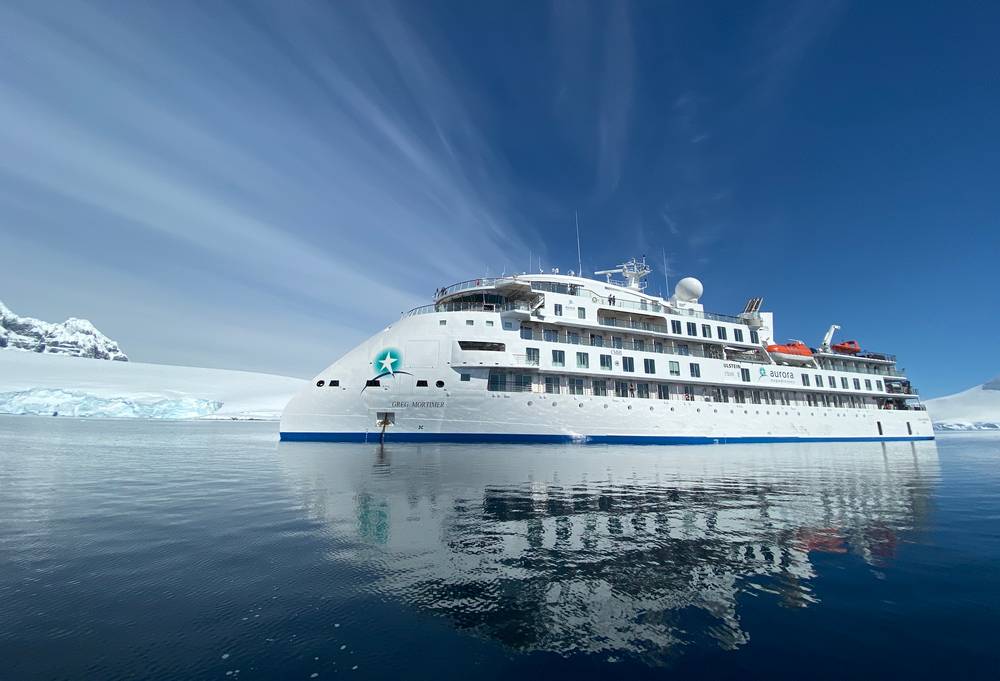
About the Ship
Greg Mortimer

- 130Guests
- 76Cabins
- 2019Launched
- 104.4 mLength
All ship facts
- Crew
- 74
- Decks
- 8
- Gross tonnage
- 7400
- Speed
- 12 kts
- Width
- 18.2 m
- Wheelchair cabins
- 2
- Currency on board
- USD
- Language
- en