

Faroe Islands, Iceland, Spitsbergen – Island Hopping in and around the Arctic (Northbound)
CRUISE ID # HXSPSVA04B-280603
Glasgow TO Longyearbyen
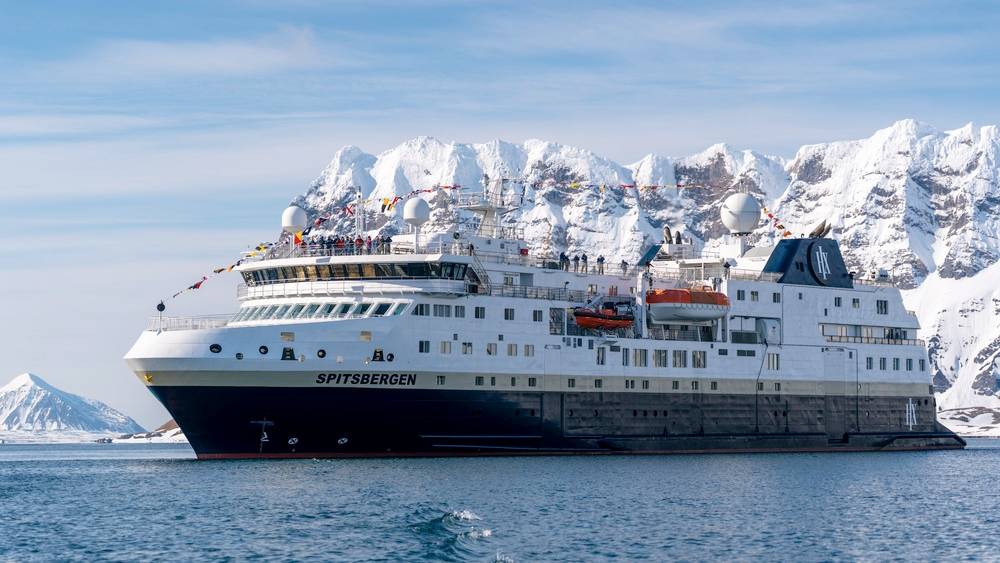
Island Hopping in and around the Arctic (Northbound)
15-day all-inclusive Iceland and Svalbard expedition cruise from Bergen to Oslo
Explore five beautiful islands across four countries and three archipelagos with stunningly wild landscapes.
Keep watch for spectacular wildlife in this birdwatching and whale-watching paradise as we sail deep into the Arctic.
We’ll attempt to land at Jan Mayen, home to the world’s northernmost active volcano.
Island adventures
Our springtime adventure starts in Bergen, Norway, before sailing to Lerwick in Scotland’s Shetland Isles. From there, we travel to the green Faroe Islands, then cross to the north coast of Iceland. We finish our expedition cruise in Longyearbyen after sailing to scenic Spitsbergen in the High Arctic, in all its untouched glory.
Keep watch for wildlife
The pristine waters and stunning islands on this North Atlantic island-hopping adventure are home to all kinds of wildlife. We'll look out for birds, whales and more along the way. Keep your eyes peeled for the majestic – but elusive – polar bear as we sail the waters near Spitsbergen.
Suites & Fares
Itinerary
- Day 1June 03, 2028
Glasgow, Scotland
Start your adventure in Scotland’s largest city, Glasgow which is overflowing with historic landmarks and a vibrant culture. The distinct architecture is reminiscent classic 19th-century fused together with modern early 20th-century dubbed ‘Glasgow Style’. The checkerboard layout makes the city easy to navigate with lively street entertainment around every corner.
- Day 2June 04, 2028
Cruising through the Hebrides
Discover the mystical coastline of the Scottish Isles
Today, we sail through the wild beauty of the Hebrides, a scattered world of rugged coastlines and quiet islands. Spend the day on deck with the Expedition Team as we navigate these storied waters, keeping watch for seabirds, dolphins, seals, and perhaps even whales.
The Hebrides have inspired travellers, monks, fishermen, and storytellers for centuries, and there's a special atmosphere to these remote islands that reveals itself best from the sea. Enjoy the shifting landscapes of green hills, dark cliffs, white beaches, and distant lighthouses as we continue deeper into the North Atlantic.
- Day 3June 05, 2028
Kirkwall, Orkney Islands, Scotland
In bustling Kirkwall, the main town on Orkney, there's plenty to see in the narrow, winding streets extending from the harbor. The cathedral and some museums are highlights.
- Day 4June 06, 2028
Lerwick, Shetland Islands, Scotland
Founded by Dutch fishermen in the 17th century, Lerwick today is a busy town and administrative center. Handsome stone buildings—known as lodberries—line the harbor; they provided loading bays for goods, some of them illegal. The town's twisting flagstone lanes and harbor once heaved with activity, and Lerwick is still an active port today. This is also where most visitors to Shetland dock, spilling out of cruise ships, allowing passengers to walk around the town.
- Day 5June 07, 2028
Thorshavn, Faroe Islands
More than 600 miles (nearly 1,000 kilometres) from Denmark’s west coast lie the Faroes, a triangle of eighteen windswept islands, seventeen of which are inhabited. Only 48,500 people plus some 70,000 sheep roam these remote lands. Much of the islands’ heritage reflects a medieval past, beginning with the arrival of farmers from western Norway who settled here in the 9th century. Evidence of this Scandinavian heritage is preserved through centuries of isolation; ancient structures can still be seen in villages clustered around old churches. Sheer cliffs and waterfalls carve Streymoy, the largest of the islands, where Torshavn is one of the world’s smallest capitals with about 12,400 inhabitants, plus another 5,000 living in the suburbs of Argir and Hoyvik. Visitors find interesting museums, churches, monuments and all the amenities of a modern town and thriving harbour here. The world’s oldest, still active parliament was founded in the Viking age. Today, it houses the main offices of the local government. Many of the attractions are found outside of Torshavn in the rugged beauty of Streymoy. There are fields with grazing ponies and sheep, tiny hamlets where residents live in half-timbered houses topped by green grass roofs, and dramatic rock formations. Birds by the thousands populate the craggy seaside cliffs, which make an ideal stopover for migratory gannets, guillemots and puffins. The Faroes' climate is generally wet and windy. Because of the Gulf Stream, the temperature is a good deal more moderate than the latitude might imply; it also helps to keep Faroe harbours ice-free year-round.
- Day 6June 08, 2028
Cruising
Enjoy a relaxing day as we cruise towards Iceland
As we sail towards Bakkagerði, time is yours to enjoy at your own pace. Swap stories with fellow travellers in the Explorer Lounge, relax in a hot tub on deck while scanning for seabirds and marine life, or join the Expedition Team in the Science Centre as they set the scene for northern Iceland: its stunning landscapes, cultures, and beliefs.
- Day 7June 09, 2028
Bakkagerði, Iceland
Exploring the fjord-cut coastline
Iceland's east coast is cut by deep fjords, lined with tumbling waterfalls and bird-filled cliffs. Quiet villages dot the shoreline, including Bakkagerði, known as Iceland's puffin capital, where nearby platforms at Hafnarhólmi let you watch Atlantic puffins nesting in their thousands.
Beyond the birds, this is a landscape steeped in folklore and drama. We might visit Álfaborg, the legendary 'elf rock' said to house the queen of the queen of the 'hidden people' – huldufólk – and look up at the jagged Dyrfjöll peaks and colourful rhyolite mountains framing the fjord. Thanks to our Zodiacs, we can reach stretches of this coastline that are otherwise inaccessible, exploring Iceland in true expedition style.
- Day 8June 10, 2028
Husavik, Iceland
The town of Húsavík sits below Húsavíkurfjall mountain on the eastern shore of Skjálfandi bay. Just above the town is lake Botnsvatn, a popular place for outings. The lake is just the right size for a nice hike around it. The lakes surroundings are rich in vegetation and bird life and trout is said to be abundant, though small. Húsavík harbour lies below the bank right in the heart of town. The harbour once boasted a large fishing fleet, bustling with the activity of fishermen. It still serves as a fishing harbour but today's activity revolves more around the successful whale watching businesses. The first organised whale watching excursions in Iceland started from here in 1995. Since then, whale watching has become a major attraction and Húsavík continues to be the leading destination for whale watching. In addition to the tours, a fascinating whale museum is located right by the harbour. Húsavík is considered to be the oldest settlement in Iceland. The Swedish explorer, Gardar Svavarsson, spent one winter there in 870 AD during which time he built himself a house from which the settlement derives its name.
- Day 9June 11, 2028
Cruising
Time to relax and discover what adventures lie ahead
As we cross the Arctic Circle and head towards Jan Mayen, you’ll enjoy a day at sea. There's plenty to do on board. Scan for marine wildlife from the deck, enjoy the panoramic sauna or soak in a hot tub, or simply relax in the Explorer Lounge & Bar, a great place to read or watch the world glide by.
The Expedition Team will also be on hand to share insights on what’s to come over the next few days exporing the Arctic.
- Day 10June 12, 2028
Jan Mayen Island, Norway
Described as one of the most remote islands in the world, Jan Mayen liesbetween Norway to the east and Greenland to the west. It is a rugged volcanicisland 34 miles long and is made up of two parts – the larger section to thenorth (Beerenbeg Volcano) and the longer but narrower section to the south. Amile-wide isthmus links these two parts. Geologically, the island was formed bya ‘hotspot’ where molten magma pushes up through the earth’s crust to createvolcanoes in the middle of nowhere. Politically, Jan Mayen is an integral partof Norway. The eighteen people living on the island work for either the NorwegianArmed Forces or the Norwegian Meteorological Institute. Their main purpose isto operate the Loran-C radio navigation system. From 1615 to 1638, the Dutchran a whaling station here. Today, the island is a nature reserve underNorwegian jurisdiction aimed at preserving the pristine Arctic island and themarine life, including the ocean floor.
- Day 11June 13, 2028
Cruising
A peaceful interlude in your adventure
Spend the day at your leisure as we sail across the Barents Sea deeper into the Arctic towards the Svalbard archipelago. Watch the open water slip by from the Explorer Lounge & Bar, soak in a hot tub on deck while scanning for seabirds, or work up a sweat in the gym. The Expedition Team will set the scene for what's ahead with lectures on Svalbard's history, geology, and wildlife. This time is yours to enjoy.
- Day 12June 14, 2028
Spitsbergen, Svalbard and Jan Mayen
A land of spectacular beauty
Spitsbergen, Svalbard's largest island, is a wilderness of steep mountains, glaciers, and scattered offshore islands.
Over the next few days, we'll explore dramatic fjords where glaciers creak and calve icebergs into the sea, push north towards Northwest Spitsbergen National Park where sea ice may shape our route, and scan for the wildlife that thrives here: polar bears, walruses, Arctic foxes, reindeer, and colonies of seabirds nesting on the cliffs.
Each day will be different. Landings, Zodiac cruises, kayaking, hikes: be ready for anything as your Captain and Expedition Team read the conditions and seize every opportunity the Arctic offers.
- Day 13June 15, 2028
Spitsbergen, Svalbard and Jan Mayen
- Day 14June 16, 2028
Longyearbyen, Svalbard and Jan Mayen
Longyearbyen is the biggest settlement in Svalbard. Seat of the Norwegian administration, it also has the best services and infrastructure in the archipelago. Located deep in the Adventfjord, a sidearm of the Isfjorden (Icefjord), Longyearbyen’s airport can be used all-year round, but its harbor is blocked by ice in winter. Most shops, hotels, restaurants and a hospital are within easy walking distance of the port. One of the most prominent buildings in town is the UNIS center, where several Norwegian universities have joined forces to operate and offer the northernmost higher education to both Norwegian and international students. Adjacent to UNIS, and well worth a visit, is the Svalbard Museum, covering the natural history and exploitation of Svalbard. Remnants of the former mining activity can be seen all around Longyearbyen and even in town.
About the Ship
MS Spitsbergen

- 150Guests
- 180Cabins
- 2009Launched
- 100 mLength
All ship facts
- Crew
- 80
- Decks
- 3
- Gross tonnage
- 7344
- Speed
- 14 kts
- Width
- 18 m
- Wheelchair cabins
- 2
- Currency on board
- NOK
- Language
- no+en